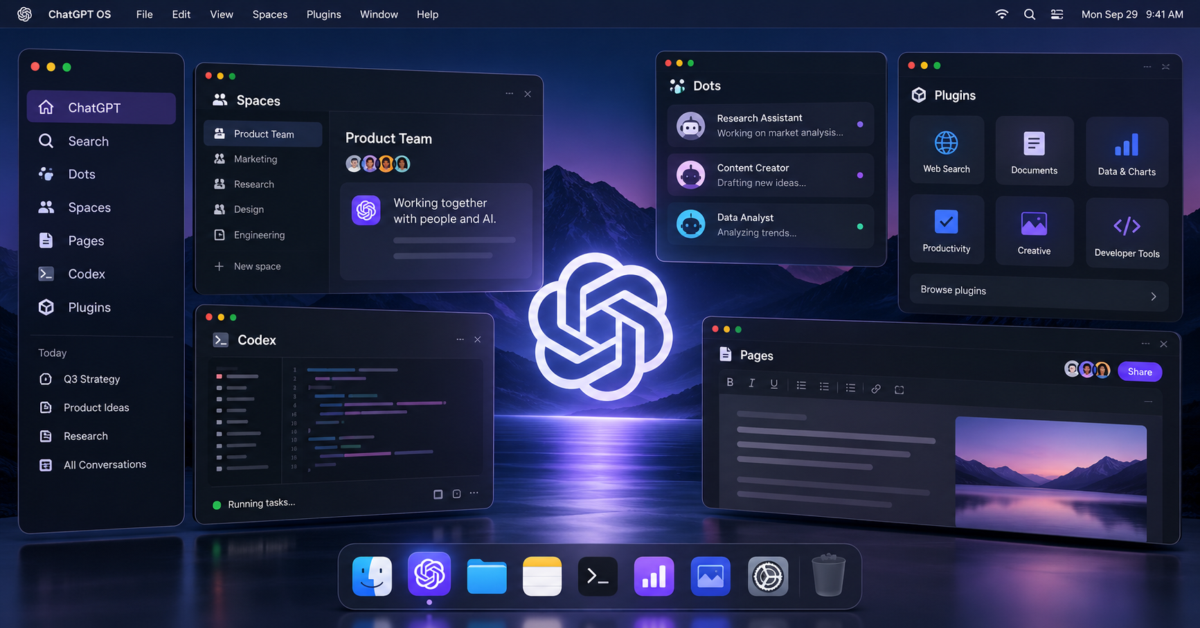
No, folks, OpenAI is not building a traditional operating system to replace Windows, macOS, or Linux. Nor is the mock image above actually real. But after its latest DevDay, ChatGPT is starting to look like an operating environment built around AI, where apps can run, agents can work, documents can be created, and outside services can trigger actions.
That bigger picture emerges from the more than 20 announcements in OpenAI’s DevDay 2026 recap. Rather than simply making the chatbot smarter, the company is building infrastructure around it that increasingly connects software, people, and AI in one place.
Plugins are a big piece of this. Developers can create interactive experiences that appear within conversations or open as full-screen apps from the ChatGPT sidebar, while connected services remain subject to their own account permissions and authorization.
Events make those connections more interesting. Supported plugins can tell ChatGPT when something happens, such as a document changing or someone replying to a thread, allowing an automation to respond without you repeatedly checking for the change yourself.
That fits naturally with the OpenAI Dots I covered separately. These persistent agents are meant to handle ongoing responsibilities, so an ecosystem where software can provide events gives them considerably more to react to.
OpenAI is moving into collaborative work too. ChatGPT Space provides a shared environment where people and AI can work with common context, while Pages lets humans and agents collaborate on documents, research, charts, images, and other material. OpenAI also plans collaborative slides with PowerPoint and Google Slides export.
Then there is Sign in with ChatGPT. OpenAI is beginning to let people use their ChatGPT identity with participating plugins and partner sites, reducing some of the friction involved in creating or linking accounts. Partners still receive limited identity information, and users separately approve the access granted to each plugin.
For Plus and Pro subscribers, DevDay goes further by allowing their ChatGPT allowance to be used with participating third-party tools. That makes a subscription more interesting to me because the AI capacity I am already paying for can potentially become useful outside ChatGPT itself.
Codex fills another part of the picture. Developers can run it locally, remotely from a phone, or in reusable cloud environments, while the refreshed CLI adds voice control and better management of multiple agents. Codex Security Cloud can also scan GitHub repositories and prepare fixes while your laptop is closed.
The intelligence underneath all of this is changing too. I already covered GPT-6.1 Sol, which OpenAI positions as a less expensive alternative that approaches Astra on several demanding workloads. There is no need to dwell on benchmarks here because the larger DevDay story is what OpenAI is building around those models.
Calling ChatGPT an operating system obviously requires some qualification. It does not boot your computer, manage hardware, schedule CPU time, or provide a kernel, and nobody should expect to install it instead of Fedora or Windows.
The comparison works at a higher level. Operating systems became platforms where applications run, identities and permissions are managed, files are created, and different pieces of software communicate. ChatGPT is beginning to perform a similar coordinating role for AI.
There are downsides to that vision. The more work that flows through one platform, the more users and developers need to think about privacy, security, permissions, pricing, reliability, and dependence on a company that controls much of the underlying infrastructure.
That may ultimately be the most consequential part of DevDay 2026. OpenAI is no longer just competing to build the chatbot you ask questions. It increasingly wants ChatGPT to be the environment where you, your apps, and your AI agents actually work.
Support independent tech journalism
NERDS.xyz is independently owned and operated. If you enjoy my coverage of Linux, AI, hardware, cybersecurity, and tech culture, consider supporting the site on Ko-fi.
Support NERDS.xyz