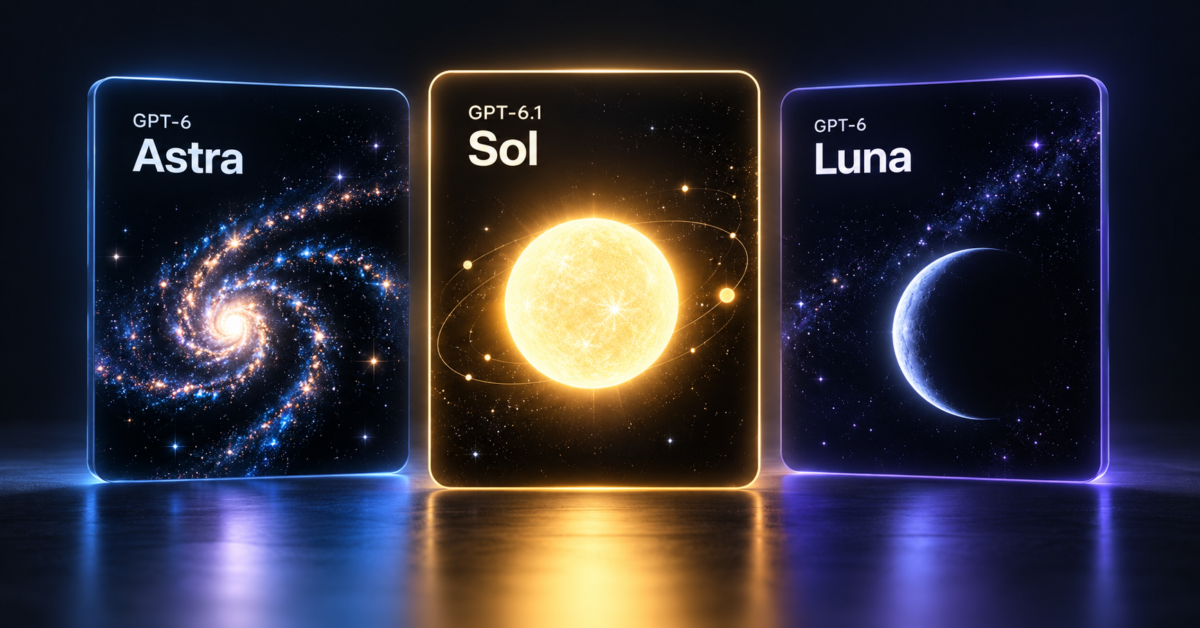
OpenAI introduced GPT-6 Sol just one week ago, but it is already getting an upgrade. GPT-6.1 Sol promises better coding, computer use, scientific work, and factual accuracy, but the part that interests me most is efficiency.
According to OpenAI, GPT-6.1 Sol gets close to the much more expensive GPT-6 Astra across agentic coding, computer use, and professional work. OpenAI says it does this at roughly one-fifth of Astra’s standard input and output token prices.
For developers using the API, GPT-6.1 Sol costs $2 per million input tokens and $10 per million output tokens. Cached input costs just $0.10 per million tokens, which OpenAI says is 95 percent cheaper than standard input and half the cached-input price of GPT-6 Sol.
The efficiency story matters outside the API too. OpenAI uses a shared allowance for Work and Codex, and different models can consume that allowance at different rates depending on the model, task, reasoning level, and other factors. Using Sol instead of Astra should generally allow that usage to last longer, although that does not mean users should expect an exact fivefold increase.
As someone who uses these tools heavily, I am excited about that. Astra is incredibly capable, but watching a usage allowance disappear quickly can make you think twice about using it for everything. If GPT-6.1 Sol can handle most of my work while stretching that allowance further, I would rather use Sol regularly and save Astra for jobs where I actually need the additional intelligence.
OpenAI’s own testing suggests that tradeoff may not be very painful. On DeepSWE v1.1, which measures difficult software engineering work in real codebases, GPT-6.1 Sol matched Astra while costing roughly one-fifth as much.
Computer use tells a similar story. On the offline portion of OSWorld 2.0, GPT-6.1 Sol came within 2.1 percentage points of Astra at maximum reasoning effort while costing roughly one-seventh as much per task.
Sol does not beat Astra everywhere, nor is OpenAI claiming that it does. Astra remains the more capable option for some demanding workloads, including scientific tasks where OpenAI’s testing still puts it ahead.
GPT-6.1 Sol also appears less prone to making factual mistakes than its predecessor. At low reasoning effort, OpenAI found that the share of responses containing a factual error fell from 11.4 percent with GPT-6 Sol to 7.7 percent with GPT-6.1 Sol.
Those numbers need some context. OpenAI deliberately used difficult conversations where users had previously flagged errors, so they should not be interpreted as the normal error rate someone will encounter while using ChatGPT.
There is also an important catch if you want to open a regular ChatGPT conversation and select GPT-6.1 Sol. You cannot do that yet.
GPT-6.1 Sol is available starting today to Plus, Pro, Business, Enterprise, and Edu users in ChatGPT Work and Codex. Developers can access gpt-6.1-sol through the API, while OpenAI says availability in regular Chat is coming later.
OpenAI also plans to add GPT-6.1 Sol to Ultrafast in the coming days. The company says that could generate tokens at up to eight times the model’s standard speed in Codex, potentially making Sol even more attractive for interactive development.
Of course, these are OpenAI’s benchmarks, and independent testing will give us a better picture of how GPT-6.1 Sol performs in everyday use. The more interesting question may ultimately be whether people notice much of a capability difference at all.
If Sol can handle most of the same work while consuming less of my allowance, I know which model I will reach for first. Astra can come out when I really need it.
Support independent tech journalism
NERDS.xyz is independently owned and operated. If you enjoy my coverage of Linux, AI, hardware, cybersecurity, and tech culture, consider supporting the site on Ko-fi.
Support NERDS.xyz