
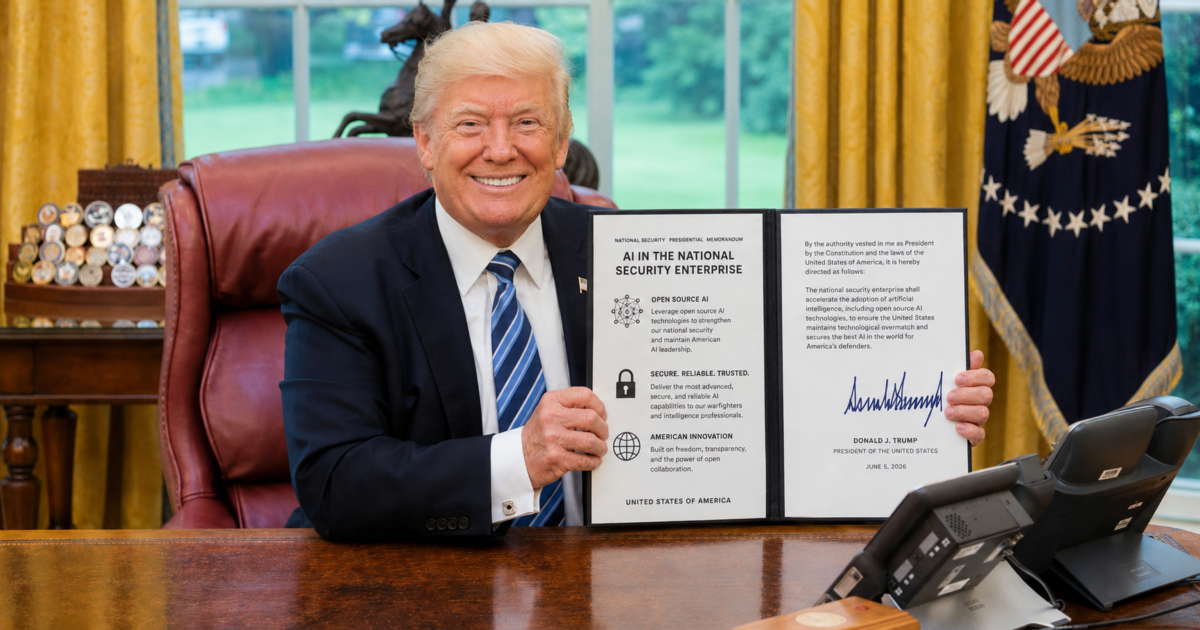
Open source software already powers huge parts of the internet. Linux runs servers around the world, Android dominates smartphones, and countless companies rely on community-driven code every day. Now, President Donald Trump wants open source artificial intelligence to play a major role in America’s national security future too.
This week, the Trump administration announced a new National Security Presidential Memorandum focused on accelerating AI adoption across the U.S. military and intelligence community. While much of the attention will likely center on advanced commercial AI systems, one detail stood out to me immediately: the White House specifically referenced adapting both commercial and open source AI technologies for mission use.
President Trump becoming an open source champion? That is a pretty significant moment…
For years, open source advocates have argued that transparent and collaborative software development can produce powerful, trustworthy technology. The Trump administration now appears to believe those same principles can help strengthen America’s defense capabilities too.
According to the White House, the memorandum is designed to rapidly place “the most advanced, secure, and reliable AI systems” into the hands of warfighters and intelligence professionals. The administration says the goal is to maintain America’s technological edge while ensuring AI systems remain controllable, accountable, and aligned with Constitutional protections.
The memorandum also pushes for faster onboarding of AI systems from multiple vendors rather than relying too heavily on any single company. Frankly, that sounds like a smart move. Vendor lock-in is rarely healthy in technology, and it would be especially risky in national security environments where flexibility and resilience matter.
The administration is also rescinding and replacing the Biden administration’s NSM-25 guidance, which Trump officials describe as outdated and overly burdened by ideological mandates. Predictably, supporters of the new approach will likely see this as removing bureaucracy and helping the United States move faster in the global AI race. Critics, however, will almost certainly argue that speeding up military AI deployment introduces serious ethical and security concerns.
And those concerns are not unreasonable.
Artificial intelligence in warfare is uncomfortable territory no matter which political party is in power. The memorandum calls for updated directives on autonomy in weapon systems and expanded use of AI across national security operations. Even with promises of accountability and human oversight, the idea of AI becoming deeply embedded in military infrastructure will make many people nervous.
At the same time, it is becoming increasingly clear that governments around the world see AI as the next major technological arms race. The United States clearly does not want to fall behind China or other adversaries in this area.
What makes this especially fascinating to me as a longtime Linux and open source enthusiast is seeing open technologies move even further into the mainstream power structure. Open source once felt like the scrappy outsider movement challenging giant corporations. Today, the White House is openly talking about leveraging open source AI for national security.
That is a pretty remarkable evolution.
Whether this ultimately proves beneficial or dangerous remains to be seen. But one thing is certain: open source AI is no longer just for hobbyists, researchers, and startups. The future of America’s military infrastructure may depend on it too.
Disclaimer: The featured image is an edited mock illustration and does not depict a real signed document.
Support independent tech journalism
NERDS.xyz is independently owned and operated. If you enjoy my coverage of Linux, AI, hardware, cybersecurity, and tech culture, consider supporting the site on Ko-fi.
Support NERDS.xyz