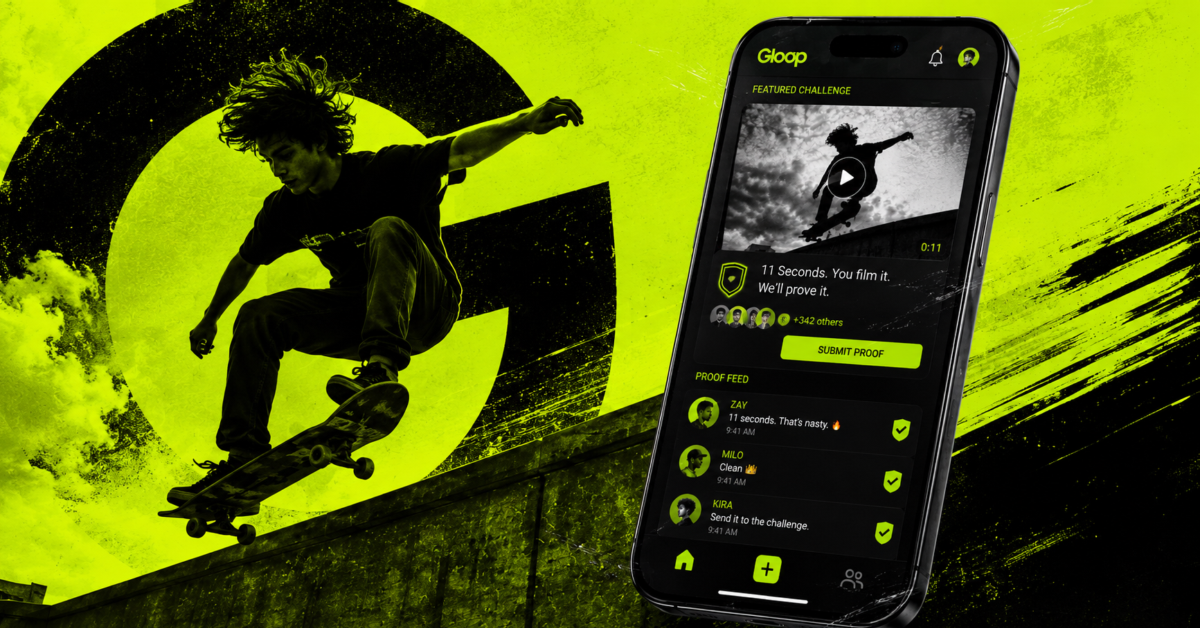
Most social media apps are built around watching. Gloop, however, wants users to put down the feed, accept a challenge, and record themselves actually doing something.
The app lets people join structured video challenges involving activities such as fitness, creativity, or friendly competition. A user accepts a challenge, records an attempt through the app, and submits timestamped video proof. Other users help verify the submission, while successful attempts can earn tokens, trophies, and positions on leaderboards.
Gloop founder and president Brett Kalina calls this model a “Challenge Network.” He believes it can offer an alternative to platforms that encourage people to spend hours passively consuming short videos.
The idea came partly from watching members of his own family spend more time staring at feeds than interacting with the world around them. Gloop still relies on smartphones, videos, rankings, and social features, but Kalina argues that it encourages participation rather than passive consumption.
That distinction sounds promising, although the platform will still need to confront many of the problems faced by larger social networks. Those include moderation, dangerous challenges, harassment, privacy, cheating, teenage users, and the possibility that rankings and rewards could become addictive themselves.
For this sponsored Q&A, I asked Kalina how Gloop works, how it plans to protect younger users, how community verification is supposed to prevent cheating, and how the company expects to make money without recreating the engagement incentives it criticizes.
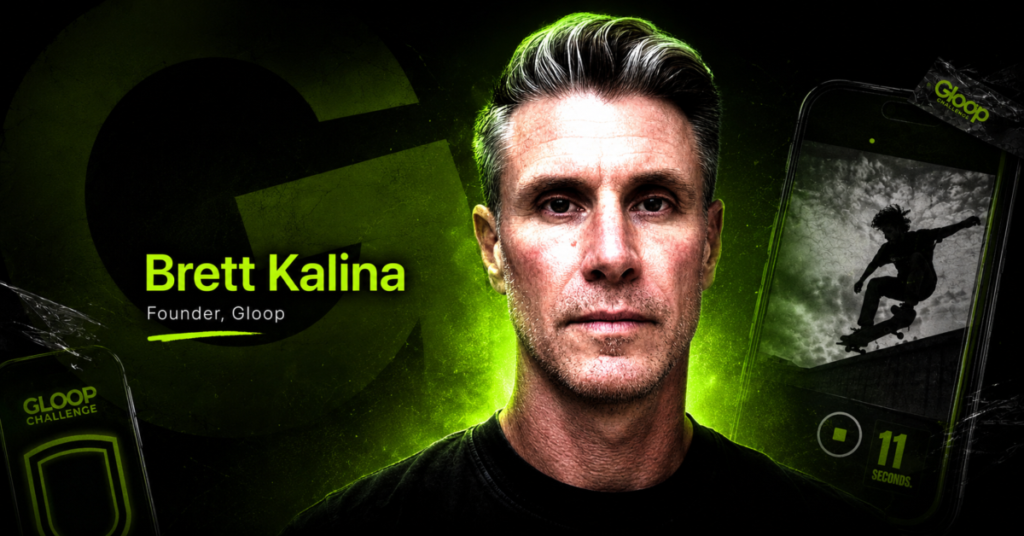
Brian Fagioli: For readers encountering Gloop for the first time, how would you describe the app and the problem you are trying to solve?
Brett Kalina: Gloop is the world’s first Challenge Network — a social app where friends and creators compete in fun, creative video challenges instead of passive scrolling. We solve the problem of endless, low-value doomscrolling by turning social media into active, rewarding participation. Users film short videos responding to challenges, get community-verified, earn tokens and rankings, and build real connections through shared accomplishments rather than curated highlights.
Fagioli: You call Gloop the world’s first “Challenge Network.” What makes a Challenge Network different from a conventional social network or the challenge content already found on TikTok, Instagram, and YouTube?
Kalina: Conventional social networks optimize for passive consumption and endless feeds. Challenge Networks are built around structured participation: every piece of content is a direct response to a challenge, with built-in rules, verification, leaderboards, and rewards. Unlike one-off TikTok or Instagram challenges that live in the algorithm and disappear, Gloop creates persistent, ranked competitions with community enforcement, real progression (tokens/trophies), and a focus on authenticity over virality at all costs.
Fagioli: What originally gave you the idea for Gloop, and when did you decide it was worth building into a real product?
Kalina: As a founder who’s built and exited companies before, I saw how social apps were making people more isolated despite “connecting” them. I wanted something that got my own family and friends off the couch and into creative, competitive fun — like our private pickleball court, but digital. The idea crystallized in early 2025 during family time when I noticed everyone glued to passive feeds. I decided it was worth building once I validated the core loop with a small group of beta testers who kept coming back for the challenges and friendly competition.
Fagioli: Gloop is positioned as an alternative to passive scrolling, but users are still filming videos, viewing submissions, messaging friends, and checking rankings. How do you prevent it from becoming another app that consumes hours of attention?
Kalina: We design for intentional engagement rather than addiction. Challenges have natural start/end cycles, daily/weekly limits on certain activities, and a strong focus on quality over quantity (e.g., verification and reliability scores reward thoughtful participation). Users earn meaningful rewards for participating, not just endless scrolling. Our goal is “better time spent” — creative output and real-world inspiration instead of passive consumption.
Fagioli: Walk us through what happens after someone accepts a challenge. How is the video recorded, timestamped, submitted, reviewed, and either accepted or rejected?
Kalina: After accepting a challenge, the in-app camera opens with the exact rules and any required elements (props, duration, format) overlaid. The video records natively, gets automatically timestamped with metadata for verification, and is submitted directly. It goes through initial automated checks (length, basic content flags), then community review via reliability scores and red flags. High-reliability users help verify faster. Valid submissions are accepted and ranked; questionable ones get flagged for more review or rejection with feedback.
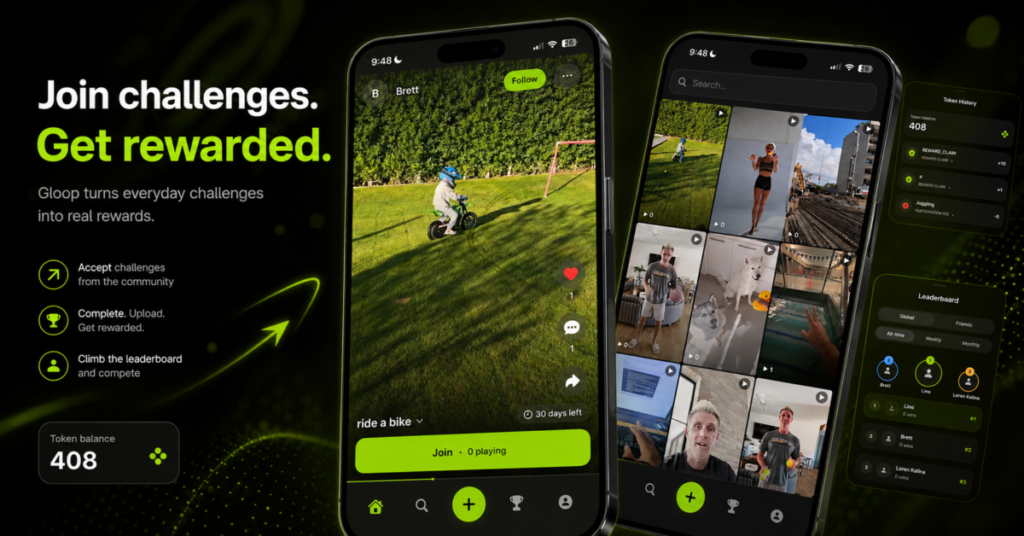
Fagioli: Your press materials say that community verification, red flags, and reliability scores help enforce authenticity. What prevents coordinated voting, bullying, cheating, or groups of friends approving one another’s questionable submissions?
Kalina: Reliability scores are earned over time based on consistent, accurate past verifications and are weighted against suspicious patterns (e.g., cliques voting in lockstep). Red flags from multiple users trigger deeper review. We combine this with automated signals like metadata consistency and behavioral analysis. Coordinated abuse gets penalized with score drops or temporary restrictions. It’s an evolving system, but early results show strong self-policing by the community.
Fagioli: What happens when a challenge is unsafe, illegal, sexually explicit, abusive, or otherwise inappropriate? Are challenges reviewed before they become visible, and does Gloop use human moderators, automated systems, or both?
Kalina: Inappropriate challenges are blocked or removed immediately. We use a combination of pre-publication automated AI filters, community reporting/red flags, and human moderation for escalated cases. Users can report instantly, and violators face warnings, suspensions, or bans. Safety is foundational — we err on the side of caution, especially for younger users.
Fagioli: The app is aimed partly at users between 16 and 26. What protections are in place for teenagers, particularly around privacy, direct messaging, location data, harassment, and dangerous dares?
Kalina: We have strict age gates, compliant privacy defaults (no public location sharing by default, limited DMs for minors), and robust harassment tools (easy blocking/muting/reporting with quick action). Dangerous dares are proactively filtered. Teen accounts have additional safeguards like limited visibility options and parental linking if desired. Moderation prioritizes younger users. We are building out DMs now and will only allow 18+ users to have access to them.
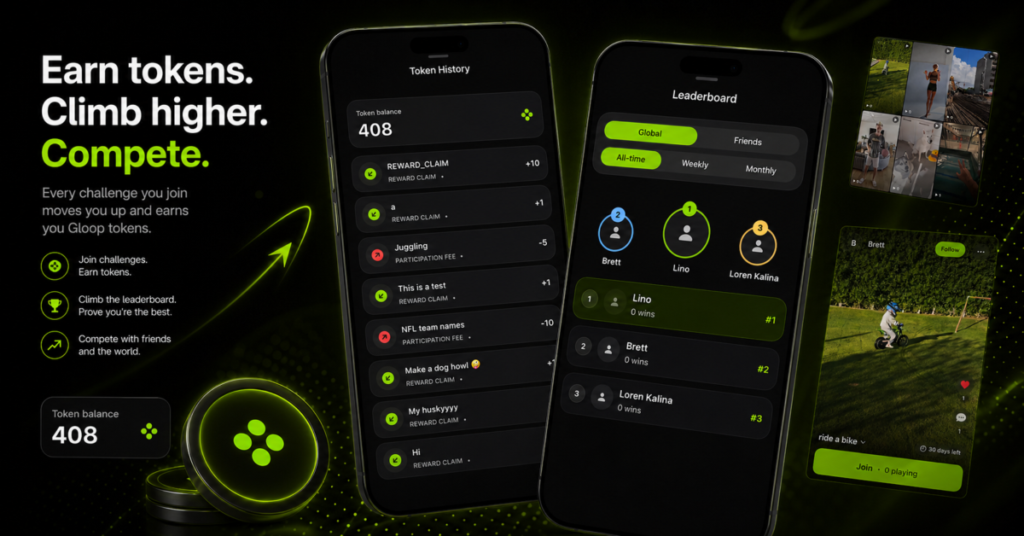
Fagioli: Gloop promises “real rewards,” while its press kit also says tokens and trophies are earned rather than purchased. What can users currently do with the tokens, and do they have any cash value or redemption value?
Kalina: Tokens and trophies are earned purely through participation and success — no pay-to-win. Currently, they unlock premium features, boost visibility in rankings, enter special challenges, and earn digital/physical badges or shoutouts. We’re rolling out more real-world rewards (partner perks, merchandise, experiences) and will explore non-cash redemptions. Tokens have no direct cash value, to keep the focus on fun and achievement.
Fagioli: What personal data does Gloop collect from users, how long are submitted videos retained, and can users permanently delete their accounts and content?
Kalina: We collect standard account info (email/phone, username, basic profile) and necessary usage data for challenges and verification. Videos are retained only as long as needed for the challenge and rankings (typically weeks to months, depending on the challenge). Users can permanently delete their account and all associated content at any time via settings, with data deletion processed promptly per our privacy policy.
Fagioli: Many social apps eventually depend on advertising, sponsored content, or paid promotion. What is Gloop’s business model, and how do you plan to make money without recreating the engagement incentives you criticize?
Kalina: Our planned hybrid model will include an optional $5/month premium (ad-free + unlocks) and non-intrusive, rewarded advertising that aligns with challenges (e.g., brand-sponsored fun dares). We avoid attention-maximizing dark patterns. Revenue supports better rewards and features for users, creating a virtuous cycle where monetization enhances the experience rather than undermining it. Currently, we do not offer ads or premium accounts, but we will have more features for premium accounts, and corporate unlocks and challenges for certain users in the future.
Fagioli: How do influencer-led challenges fit into the platform? Will paid or sponsored challenges be clearly identified, and will influencers receive preferential placement or rewards?
Kalina: Influencers create and host challenges just like any user, bringing creativity and reach. Sponsored ones will be transparently labeled as such. Top creators earn rewards through performance (participation, quality scores) rather than preferential algorithmic placement — the system stays merit-based.
Fagioli: The press kit says Gloop was built outside the traditional venture-backed accelerator system. How has the company been funded so far, and what have been the advantages and disadvantages of taking the bootstrap route?
Kalina: I’ve self-funded the initial development and launch with my own capital after previous exits. Advantages: full control, fast decisions, and a user-first focus without pressure to hyper-optimize for growth at all costs. Disadvantages: slower scaling on marketing compared to well-funded competitors, but it forces us to build something people genuinely love. We’re now preparing for a seed round after proving early traction.
Fagioli: Your stated goal is to reach 10,000 to 25,000 active users and then pursue a seed round. Which measurements will matter most when deciding whether Gloop has achieved genuine product-market fit?
Kalina: Retention (especially 7- and 30-day), daily active challenges completed, organic sharing/virality rates, and high user satisfaction/NPS scores. Raw downloads matter less than engaged users who return because they enjoy the challenges and community.
Fagioli: What has the initial response been since the app became available? Are there any early usage figures, retention numbers, popular challenge categories, or unexpected user behaviors you can share?
Kalina: The response has been encouraging since the early 2026 iOS launch. We’re seeing strong early engagement in creative and fitness challenges, with solid retention from users who complete multiple challenges per week. (Specific numbers can be shared privately or updated closer to publication as we ramp up influencer efforts.)
Fagioli: Social platforms often struggle with the cold-start problem because they are not useful until enough friends and creators join. What is your strategy for making Gloop engaging for its earliest users?
Kalina: We seed with high-quality, solo-playable or small-group challenges that deliver fun immediately. Leaderboards, daily streaks, and token rewards keep early users motivated even before their full network joins. Influencer challenges also help bootstrap vibrant content.
Fagioli: What is the biggest misconception people have about Gloop after hearing the pitch for the first time?
Kalina: That it’s just another short-video app or TikTok clone. Once they try it, they realize it’s fundamentally different — a structured competition platform focused on doing rather than watching.
Fagioli: Looking ahead 12 months, what would success for Gloop realistically look like?
Kalina: Hundreds of thousands of active users, strong retention and organic growth, a thriving creator community, initial revenue traction, and a clear path to Series A. Most importantly, users telling us Gloop replaced passive scrolling with fun, creative, and connecting experiences in their daily lives. I can’t take the noses out of the screens, but if I can get some time back into the real world with people, that’s our goal — bridging the real world and screen time together with fun, healthy competition.
Gloop is available now through Apple’s App Store. An Android version is also planned, although a public Google Play listing was not available at the time of publication.
Whether a Challenge Network can persuade people to spend less time passively consuming content will depend on how the platform develops and how carefully Gloop handles its youngest users. Rankings, streaks, tokens, and rewards can motivate participation, but they can also become another reason to keep checking an app.
Still, the idea of asking people to demonstrate what they can do rather than simply watching strangers perform has potential. Gloop now needs to prove that its healthier approach to social media can survive contact with growth, advertisers, influencers, and the moderation problems that arrive when a platform begins attracting a larger audience.
Support independent tech journalism
NERDS.xyz is independently owned and operated. If you enjoy my coverage of Linux, AI, hardware, cybersecurity, and tech culture, consider supporting the site on Ko-fi.
Support NERDS.xyz