
AI hardware keeps getting faster, but it is also getting ridiculously hot. That is becoming a real problem for chipmakers, especially with high bandwidth memory stacked tighter and tighter inside modern AI accelerators. Now, SK hynix says it has a new answer called iHBM.
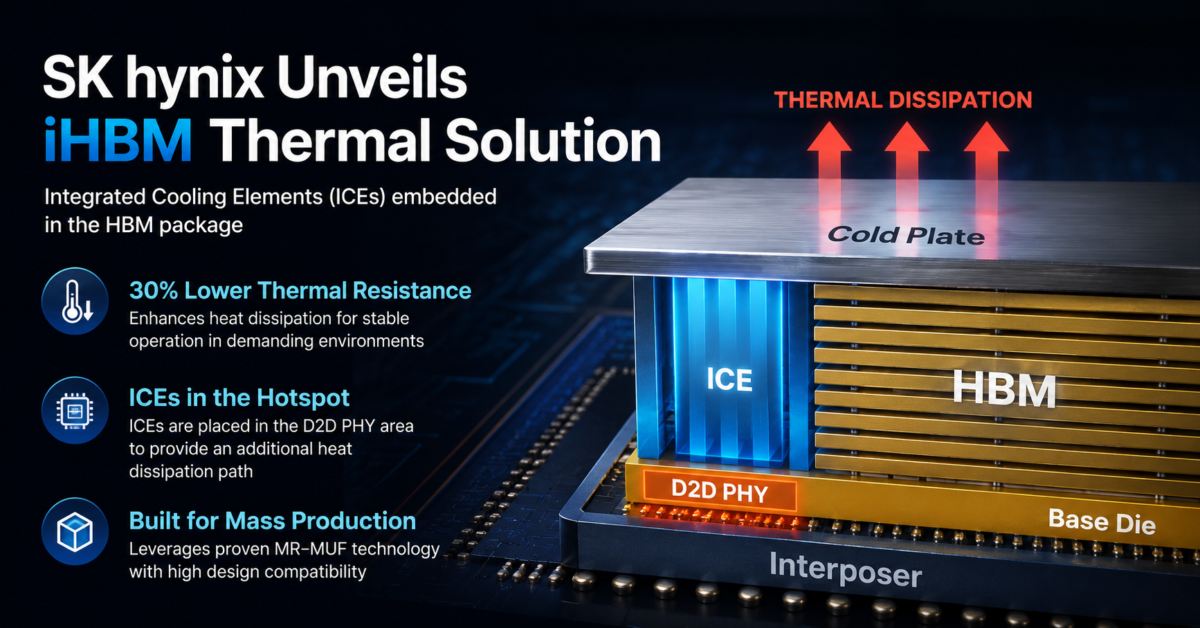
The company unveiled the thermal technology this week, describing it as a new way to cool future HBM products, including HBM5. Instead of relying entirely on traditional heat dissipation methods, SK hynix is embedding what it calls Integrated Cooling Elements directly into the memory package itself.
That might sound boring at first glance, but cooling is quickly becoming one of the biggest challenges in AI infrastructure. Everybody loves talking about giant AI models and monster GPUs, but none of that matters if the hardware overheats under sustained workloads.
According to SK hynix, the hottest area inside the HBM package is the Die-to-Die PHY region, which acts as the interface between the memory and the AI accelerator. The new ICE components are placed directly in that hotspot to create an extra path for heat to escape.
The company claims the design cuts thermal resistance by 30 percent, which could help chips stay stable even in high temperature and high pressure operating conditions common in dense AI servers.
What makes this more interesting is that SK hynix is not pitching some completely experimental manufacturing process. The company says iHBM works alongside its existing MR-MUF packaging technology that is already used in production today. In other words, it sounds like SK hynix wants customers to adopt the cooling improvements without needing to reinvent entire system designs.
That compatibility angle could matter a lot. AI companies are spending absurd amounts of money on hardware right now, and nobody wants massive redesign headaches if they can avoid them.
This announcement also highlights something the AI hype cycle rarely talks about enough – thermal engineering. As AI chips continue pushing insane bandwidth and power demands, cooling technology is becoming just as important as raw compute performance. The companies that solve heat problems fastest may end up with a major advantage.
Of course, we are still looking at early claims here. There are no real-world benchmarks yet for iHBM-equipped products, and HBM5 remains a future-facing technology for now. Still, it is clear the memory industry sees cooling as a growing bottleneck for AI systems moving forward.
Honestly, the AI race increasingly feels less like a software battle and more like an industrial engineering competition.
Support independent tech journalism
NERDS.xyz is independently owned and operated. If you enjoy my coverage of Linux, AI, hardware, cybersecurity, and tech culture, consider supporting the site on Ko-fi.
Support NERDS.xyz