
OpenAI wants ChatGPT to become more involved in people’s daily lives, and now that includes personal finance too.
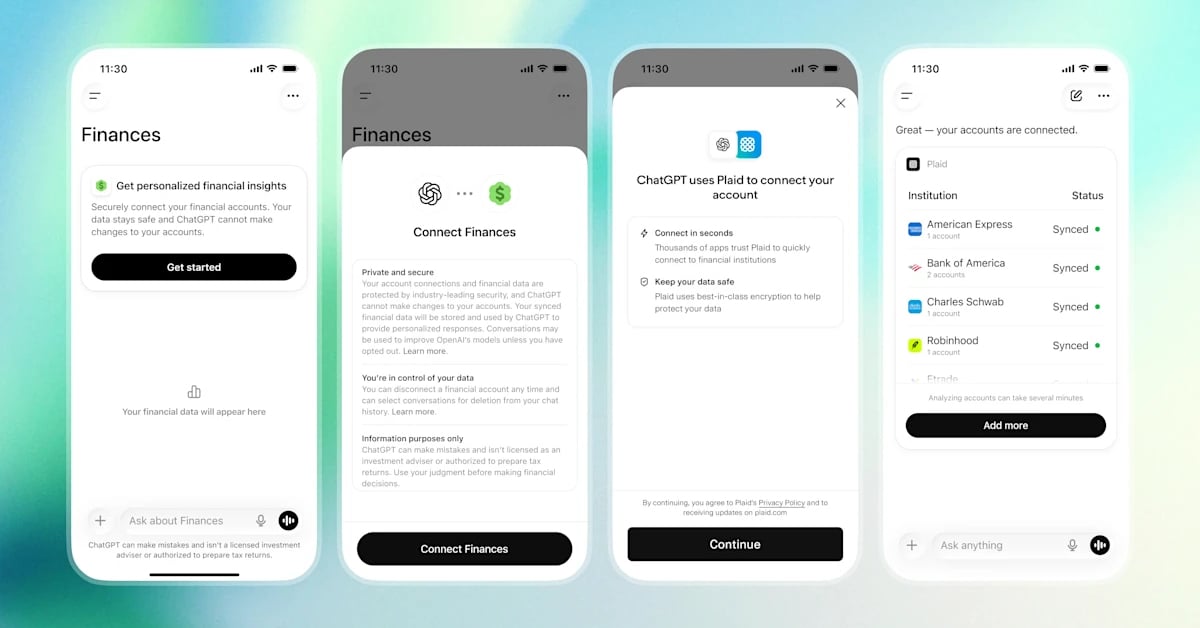
The company announced a new finance experience for ChatGPT that lets users securely connect financial accounts and ask questions based on real spending habits, subscriptions, investments, debts, and savings goals. The feature is launching first as a preview for ChatGPT Pro users in the United States on web and iOS.
On paper, it actually sounds pretty useful.
Instead of juggling banking apps, spreadsheets, budgeting tools, and investment dashboards, ChatGPT can supposedly pull everything together into one place. OpenAI says support includes more than 12,000 financial institutions through Plaid, with Intuit support planned for later.
ALSO READ: FIS and Anthropic bring agentic AI to banking, targeting financial crime investigations
Users can ask questions like how to save more money over the next few months, where their spending is getting out of control, or whether they can realistically afford a house, vacation, or car purchase. ChatGPT then analyzes actual account data to generate recommendations tailored to the individual instead of offering generic budgeting advice.
Some of the examples OpenAI shared were admittedly pretty interesting. One sample response broke down spending habits across dining, groceries, transportation, shopping, and subscriptions, then estimated how much the user could save each month by making relatively small changes. Rather than telling people to stop buying coffee entirely, the AI tried to create a plan that felt realistic.
That’s probably the biggest difference here. Traditional budgeting apps can feel cold and rigid. ChatGPT is trying to make financial planning feel more conversational and less intimidating.
Still, I’m very hesitant to connect AI directly to my financial accounts.
Yes, OpenAI says ChatGPT cannot move money or see full account numbers. The company also says users stay in control of their data and can disconnect accounts whenever they want. Temporary chats won’t access financial data either, and users can delete saved financial memories at any time.
But none of that completely removes the uneasy feeling of linking years of spending history, balances, loans, investments, and financial habits to an AI system. Maybe I’m old fashioned, but that requires a pretty serious level of trust.
At the same time, lots of folks already hand similar information over to apps like Mint and Rocket Money without much concern. OpenAI is clearly hoping people eventually view ChatGPT the same way.
The company also made it clear this is only the beginning. OpenAI says it wants ChatGPT to eventually help users take actions instead of simply answering questions. That could include applying for credit cards, estimating taxes, connecting with financial professionals, or receiving recommendations through partners like Intuit, all without leaving ChatGPT.
That future will probably excite some people and completely creep out others.
The feature currently uses GPT-5.5 Thinking by default for connected financial conversations, while Pro subscribers can also access GPT-5.5 Pro for more advanced reasoning. OpenAI says internal testing with finance professionals showed strong results compared to earlier models.
Whether people are truly ready to let AI peek into every financial detail of their lives remains to be seen. I suspect plenty of users will love the convenience. Others will keep their bank accounts far away from chatbots, no matter how advanced they become.
Support independent tech journalism
NERDS.xyz is independently owned and operated. If you enjoy my coverage of Linux, AI, hardware, cybersecurity, and tech culture, consider supporting the site on Ko-fi.
Support NERDS.xyz