
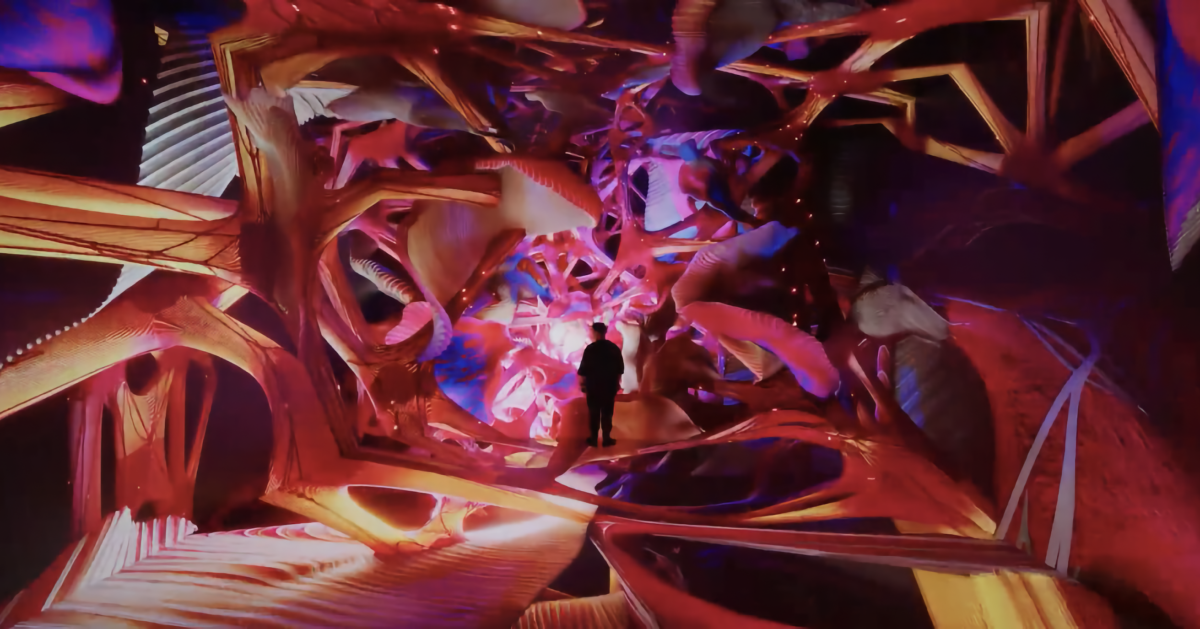
Artificial intelligence has already made its way into search engines, smartphones, office software, and even refrigerators. Now it is coming for museums too.
On June 20, Dataland will officially open in Los Angeles, billing itself as the world’s first museum dedicated entirely to AI-generated art. The project was co-founded by media artist Refik Anadol and Efsun Erkılıç, with Google serving as both a technology partner and creative collaborator.
Located inside The Grand LA, a development designed by architect Frank Gehry, Dataland spans 25,000 square feet and promises an immersive experience where artificial intelligence continuously generates visuals, sounds, and other sensory effects in response to visitors.
According to Google, the museum’s debut exhibition, “Machine Dreams: Rainforest,” is powered by Anadol’s Large Nature Model, an AI system trained on massive amounts of environmental data. The installation uses Google’s cloud infrastructure, Gemini AI models, and other machine learning technologies to create an experience that evolves in real time.
If that sounds more like a technology demonstration than a traditional art exhibit, you are not alone.
AI-generated art remains one of the most controversial applications of artificial intelligence. Supporters argue that AI is simply another creative tool, no different from a camera, synthesizer, or digital paintbrush. Critics counter that many AI systems are trained on existing human-created works and produce output by remixing that material rather than creating something truly original.
That debate is unlikely to disappear anytime soon. In fact, Dataland may end up becoming a focal point for it.
Google is also backing a new AI Artist Residency program connected to the museum. The initiative will provide four artists with $25,000 grants, mentorship opportunities, and access to Google’s AI tools and cloud infrastructure. Their work will eventually be showcased through both Dataland and Google Arts & Culture.
Whether visitors view Dataland as a groundbreaking artistic achievement or an elaborate showcase for artificial intelligence will likely depend on their feelings about AI itself.
Either way, the museum’s opening marks another sign that AI is moving beyond productivity software and into creative spaces that were once considered uniquely human. The question now is whether audiences will embrace that shift or push back against it.
Support independent tech journalism
NERDS.xyz is independently owned and operated. If you enjoy my coverage of Linux, AI, hardware, cybersecurity, and tech culture, consider supporting the site on Ko-fi.
Support NERDS.xyz