

Artificial intelligence is no longer just some tool workers occasionally use to crank through emails or summarize meetings. According to a new report from Boston Consulting Group, AI is starting to fundamentally change what people actually do at work. In many cases, workers are now spending more time managing AI than doing the job itself.
That really jumped out at me.
For the past couple of years, tech companies have been selling AI as this magical productivity booster that would supposedly free people from boring tasks. But the reality seems a lot messier. Folks are increasingly acting like supervisors for AI systems, checking outputs, fixing mistakes, tweaking prompts, and constantly second guessing what the machine spits out.
Honestly, that does not sound quite as relaxing as some executives made it seem.
BCG’s latest AI at Work survey found that 47 percent of respondents now spend more time directing AI than performing the work directly themselves. Meanwhile, 72 percent say AI has already changed the skills expected for their role.
The report surveyed nearly 12,000 workers across 14 global markets, and it paints a picture of companies scrambling to adapt while employees try to figure out what their jobs are even becoming.
One of the more interesting findings is what BCG calls the “joy paradox.” On one hand, 67 percent of regular AI users say the technology improves job satisfaction. On the other, 41 percent report increased cognitive load.
That makes perfect sense to me.
AI can absolutely remove repetitive work. But it also creates this weird new layer of mental overhead. Instead of simply doing a task, workers now have to evaluate machine-generated output, babysit AI tools, double-check facts, and sometimes rewrite things that would have been faster to just do manually in the first place.
It is less “the robots are taking over” and more “congratulations, you are now middle management for a chatbot.”
The survey also found that frontline white-collar employees are embracing AI surprisingly fast. Seventy-four percent now qualify as regular AI users, which is up more than 20 percentage points over the last two years.
Interestingly, some of the strongest adoption is happening outside the traditional Western tech bubble. India, Brazil, South Africa, and parts of the Middle East are reportedly outpacing countries like the United States, France, and Italy when it comes to regular AI usage among frontline workers.
At the same time, many companies still do not seem to know what to do with the productivity gains AI supposedly creates.
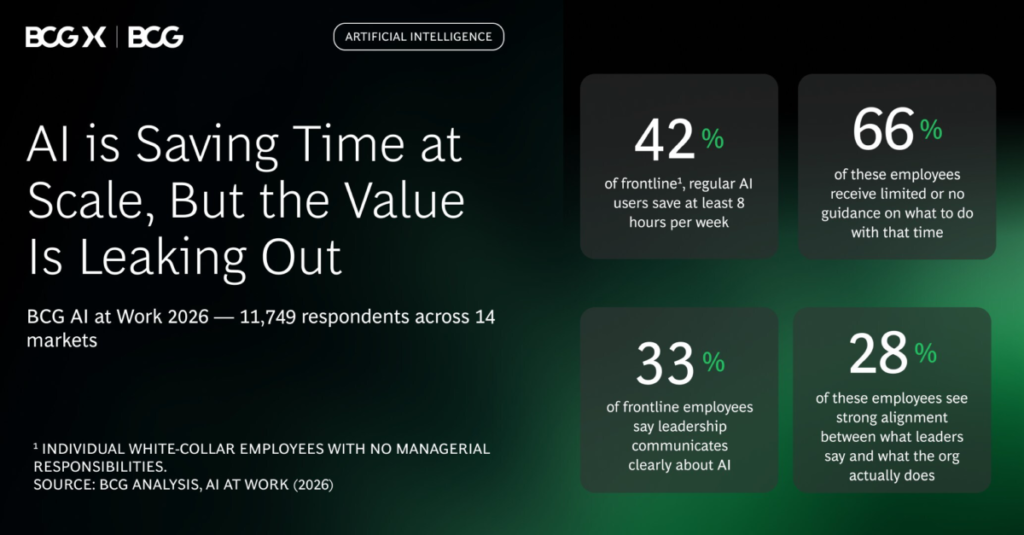
According to the report, 42 percent of regular frontline AI users say AI saves them at least a full workday every week. That sounds impressive until you read the next part. Sixty-six percent say they receive little or no guidance about how to use that saved time.
So the time savings often just evaporate.
This feels like the part of the AI conversation many executives avoid discussing. Buying AI tools is easy. Actually redesigning workflows and restructuring organizations around them is much harder.
BCG argues that companies seeing the biggest benefits are the ones actively rethinking how work gets done instead of simply throwing AI chatbots at employees and hoping for the best.
The report also highlights the rapid rise of AI agents. Thirty percent of respondents say agents are already part of their workflow, more than double last year’s number. Yet more than half of workers still say they do not really understand what AI agents even are.
That disconnect feels pretty important.
Companies are racing to integrate increasingly powerful AI systems into daily work while many employees, and probably plenty of executives too, are still trying to figure out where this all leads.
Personally, I think the AI discussion is finally starting to shift away from simplistic “AI will replace everybody” headlines. What seems more likely is that a lot of jobs are going to become stranger, more fragmented, and far more focused on overseeing machines.
Whether that ends up making work better or just more mentally draining probably depends less on AI itself and more on whether companies have an actual plan beyond chasing hype.
Support independent tech journalism
NERDS.xyz is independently owned and operated. If you enjoy my coverage of Linux, AI, hardware, cybersecurity, and tech culture, consider supporting the site on Ko-fi.
Support NERDS.xyz