

OpenAI has started testing ads inside ChatGPT, and if that sentence alone makes you uneasy, you are not alone. The company insists this is a limited experiment for logged in adult users on the Free and Go tiers in the US, and it repeatedly promises that ads will not influence answers. Paid tiers like Plus, Pro, Business, Enterprise, and Education are excluded. For now.
Whenever a platform built on trust starts talking about ads, the details matter. OpenAI is clearly aware of the concern, because the announcement leans hard on reassurance. Ads are described as a way to fund free access, not a way to steer answers. Sponsored content is supposed to be clearly labeled and visually separated from normal responses. In other words, no sneaky blending ads into advice you might actually rely on.
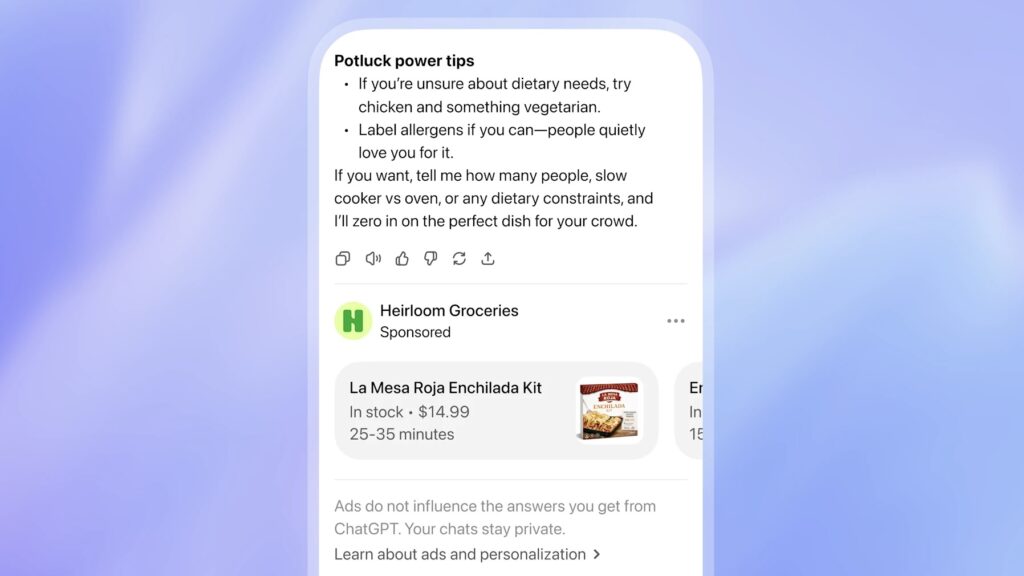
Still, this is where healthy skepticism kicks in. ChatGPT is not a social feed or a search results page. People use it to think through decisions, troubleshoot problems, and sometimes ask questions they would never type into a browser. Even if ads are labeled, their mere presence changes the tone of the product. Once money enters the conversation, users are right to wonder where the invisible lines really are.
OpenAI says ads will never affect how answers are generated. Responses are optimized for usefulness, not advertiser preference. That sounds comforting, but it is also easy to say at the start of a test. The company is effectively asking users to trust that commercial pressure will not creep in over time, even as ads become more sophisticated and revenue expectations grow.
Ad targeting is another area where the wording deserves a closer look. OpenAI says ads are selected based on the topic of your conversation, your past chats, and your previous interactions with ads. That is not nothing. While advertisers do not get direct access to your chats, the system is still learning a lot about what you are interested in, when you are researching, and how you behave. That data stays inside OpenAI, but it is still being used to decide what to show you.
Privacy safeguards are emphasized throughout the announcement. Advertisers only receive aggregate metrics like views and clicks. Ads will not appear for users under 18, and they are excluded from sensitive or regulated topics such as health, mental health, and politics. Those limits are good, but they are also a reminder that this framework can expand later. OpenAI openly says safeguards will evolve as it learns from the test.
Users are given control knobs, at least on paper. You can dismiss ads, provide feedback, see why an ad was shown, delete ad data, and manage personalization settings. You can also opt out of ads on the Free tier in exchange for fewer daily messages, which feels less like a choice and more like a tradeoff designed to push upgrades.
The company argues that ads could actually be useful in moments when people are comparing options or exploring ideas. Maybe. But ChatGPT is not a shopping assistant by default. It is a thinking tool. Introducing ads into that space risks blurring the line between help and influence, even if the separation is visually obvious.
OpenAI keeps calling this a learning phase, and that part is probably true. This is a test, not the final form. But tests have a habit of becoming permanent once users adjust. The real question is not whether ads change answers today. It is whether the product feels the same a year from now, when advertising is no longer an experiment but a business pillar.
For now, OpenAI wants users to believe three things will always hold. Answers stay independent. Conversations stay private. Users stay in control. Those are strong promises. The clicks will come from whether people believe them.
Support independent tech journalism
NERDS.xyz is independently owned and operated. If you enjoy my coverage of Linux, AI, hardware, cybersecurity, and tech culture, consider supporting the site on Ko-fi.
Support NERDS.xyz