
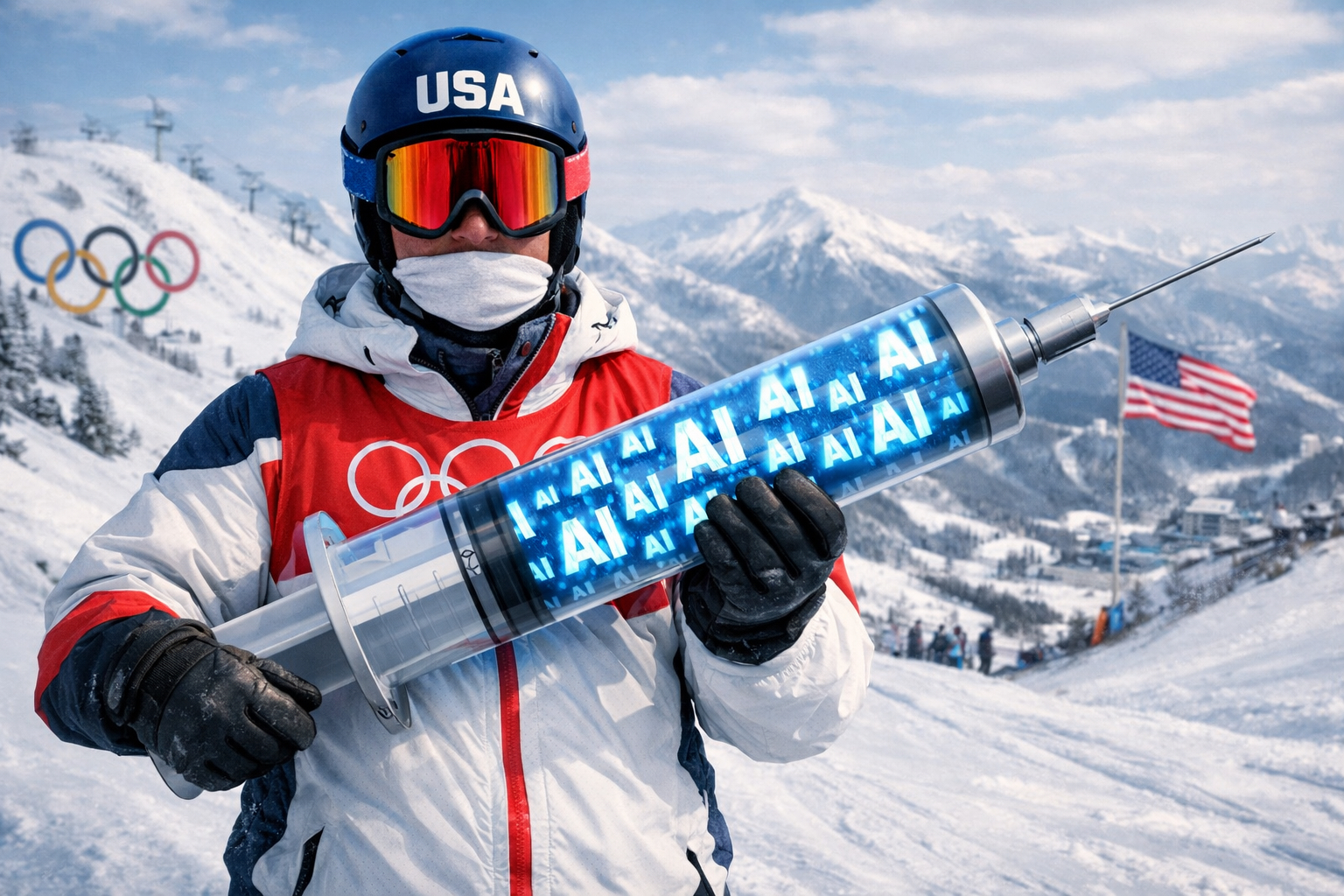
Elite winter sports are already unfair by design. Not everyone grows up near mountains. Not everyone has access to elite coaching, private training camps, or the latest gear. Now add something new to the list, artificial intelligence that can break down a trick frame by frame before an athlete even makes it back to the lift. That is exactly what Google Cloud is bringing to Team USA, and it is raising uncomfortable questions about where preparation ends and performance enhancement begins.
Google Cloud has developed an AI powered training platform for U.S. Ski and Snowboard athletes that analyzes tricks using nothing more than standard smartphone video. The goal is to expose tiny biomechanical details that are almost impossible to catch with the naked eye, especially at full speed on snow. In a sport where medals can come down to subtle body positioning or a slightly cleaner landing, those details matter.
Until now, this level of analysis lived in labs. Motion capture systems relied on tight suits, sensors, and controlled environments that bear no resemblance to a halfpipe or slopestyle course. Google’s system skips all of that. It pulls usable data directly from two dimensional video, even when athletes are wrapped in layers of winter gear.
What makes the platform genuinely disruptive is how fast it works. This is not a slow postmortem hours later back at the lodge. Athletes and coaches can review detailed breakdowns almost immediately, sometimes before the next run. Takeoff angles, rotation timing, body alignment, and landings can be compared against earlier attempts or even historical footage.
There is also a conversational element layered on top. Coaches can ask direct questions instead of relying on feel or memory. What changed between runs. Did the athlete open up early. Was the landing flatter. The system responds with data rather than opinion.
For competitors operating at the edge of what is physically possible, that kind of feedback is hard to ignore. Anyone who has ever watched themselves on video knows how unreliable memory can be. AI strips away that uncertainty. It shows exactly what happened, not what it felt like happened.
Google emphasizes that this technology works where athletes actually train. It can run on small devices that fit in a pocket, making it usable on the mountain instead of locked to a workstation. That portability is not a side detail. It is the difference between a novelty and a competitive tool.
The company also treats these athletes as a proving ground. If AI can track motion in freezing temperatures, changing light, and chaotic terrain, it can likely handle calmer environments too. Physical therapy, recreational sports, and industrial robotics all benefit from better motion analysis. The mountain just makes for a dramatic stress test.
Still, it is impossible to ignore the ethical tension this creates. At what point does AI assisted training stop being smart preparation and start becoming an unfair advantage?
Sports already struggle with uneven resources. Some programs have deeper pockets, better facilities, and more access to cutting edge tools. AI driven analysis threatens to widen that gap. When one team can tap near real time biomechanical insight powered by massive cloud infrastructure and another cannot, competition starts to feel tilted before it even begins.
That is where the steroids comparison enters the conversation. Steroids were about pushing the human body beyond its natural limits. AI does not alter muscle or endurance, but it does inject intelligence into preparation. It compresses years of trial and error into faster feedback loops.
The distinction matters. Steroids change what an athlete can physically do. AI does not make someone stronger or faster on its own. It reveals what they already did and lets them decide how to respond. In that sense, it resembles slow motion replay or high speed cameras, both of which were controversial before becoming routine.
Those tools did not kill the soul of sports. Athletes adapted. Fans adjusted. Competition moved on.
The bigger concern is access. If AI becomes essential to staying competitive, governing bodies may eventually have to decide how widely these tools should be available. Otherwise, success risks becoming more about infrastructure than talent.
There is also a cultural worry. Freestyle sports thrive on instinct and creativity. Too much data can flatten that spontaneity, turning expressive runs into optimized routines. That tension will not disappear just because the numbers look impressive.
Athletes using these systems tend to push back on that fear. They describe AI as a mirror, not a coach. It does not tell them what trick to throw. It simply shows them what actually happened when they tried.
For now, AI in elite training lives in a gray area. It is not cheating, but it is not neutral either. Like every major technological shift in sports, it forces hard conversations about fairness, access, and where the line should be drawn.
Google’s tools are not rewriting the rulebook yet. But they are quietly reshaping how athletes prepare. And in sports, preparation has a way of changing everything that follows.
Support independent tech journalism
NERDS.xyz is independently owned and operated. If you enjoy my coverage of Linux, AI, hardware, cybersecurity, and tech culture, consider supporting the site on Ko-fi.
Support NERDS.xyz