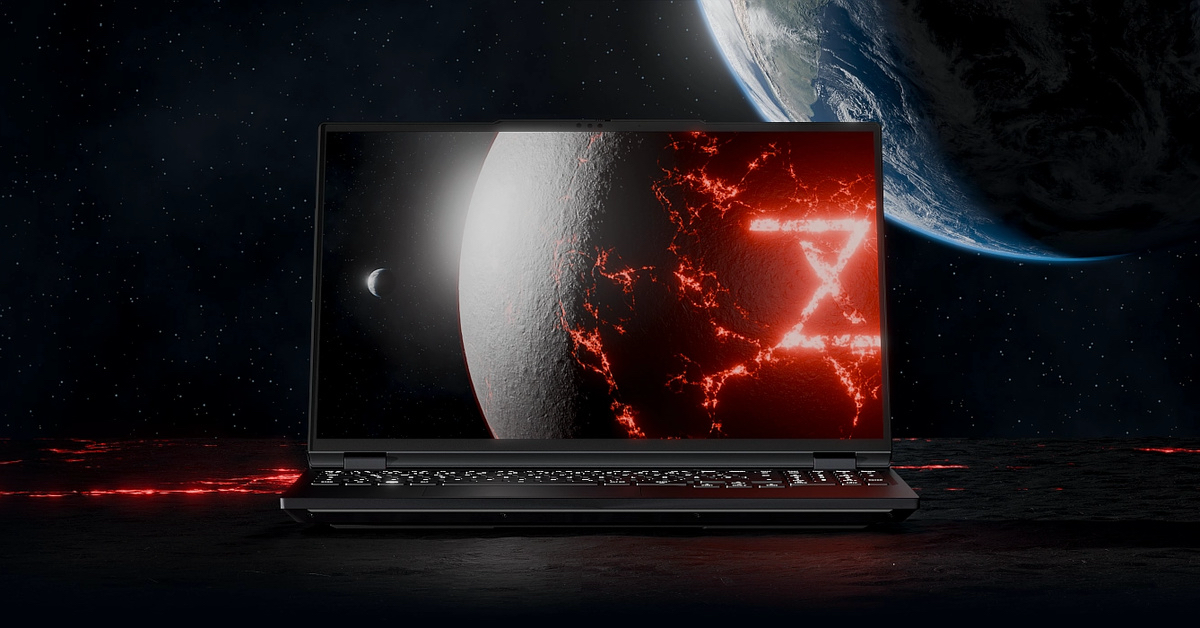
Linux users who need serious computing power have a new laptop to consider. TUXEDO has announced the Stellaris 16 Gen8, a desktop replacement aimed at gaming, video editing, 3D animation, simulations, and local AI workloads.
The TUXEDO Stellaris 16 Gen8 pairs an Intel Core Ultra 9 290HX Plus processor with an NVIDIA GeForce RTX 5070 Ti, RTX 5080, or RTX 5090 Laptop GPU. Preorders are open now, with shipping scheduled to begin in early November. The processor has 24 cores, consisting of eight performance cores and 16 efficiency cores, with clock speeds reaching 5.5 GHz.
Prices start at €2,350, or approximately $2,630 USD, before taxes and import duties. That gets you the RTX 5070 Ti, 16 GB of DDR5-5600 memory, a 500 GB SSD, TUXEDO OS, and the standard LED display. OLED, Mini-LED, and higher memory capacities are configuration options, so the headline specifications do not describe what you get at the starting price.
All three 16-inch screens offer a 2560 × 1600 resolution, a 16:10 aspect ratio, and full DCI-P3 coverage. The standard matte LED panel runs at up to 300 Hz and reaches 500 nits of brightness. The matte Mini-LED alternative matches that refresh rate while increasing brightness to 750 nits in SDR and up to 1,000 nits in HDR. TUXEDO lists G-SYNC and Advanced Optimus for the Mini-LED option.
The glossy OLED panel runs at 240 Hz, with 500 nits in SDR and up to 1,000 nits in HDR. Its deep blacks and high contrast could make it attractive for entertainment, although TUXEDO recommends indoor use because of the reflective surface. There is also a qualification Linux buyers should know about: the company says full HDR support on both premium panels currently requires Windows. Keyboard lighting differs by operating system too, with a single adjustable color on Linux and per-key RGB on Windows.
Graphics memory ranges from 12 GB of GDDR7 on the RTX 5070 Ti to 16 GB on the RTX 5080 and 24 GB on the RTX 5090. That gives buyers more room for demanding textures, rendering projects, and local AI models as they move up the range. Whether a particular model fits still depends on its memory requirements and configuration.
Maximum GPU power, including Dynamic Boost, reaches 140 watts for the RTX 5070 Ti and 175 watts for the RTX 5080 and RTX 5090. A three-fan cooling system supports up to 240 watts of combined CPU and GPU power, while TUXEDO Control Center lets owners adjust CPU power limits and fan behavior to balance performance against noise.
For stationary use, the optional TUXEDO Aquaris liquid cooling dock circulates distilled water through a dedicated cooling pipe inside the laptop to supplement air cooling. TUXEDO promises quieter operation and lower temperatures, but sustained-load testing will be needed to judge how well that works.
Buyers can configure up to 96 GB of DDR5-6400 or 128 GB of DDR5-5600 memory across two slots. Storage uses two M.2 slots, one supporting PCIe 5.0 and the other PCIe 4.0. Removing the bottom cover provides access to those components, the Wi-Fi module, and the replaceable battery, making future upgrades and repairs more practical.
The lid, base, and bottom cover use aluminum, while the display frame is plastic. At 357 × 260 × 28 mm, the Stellaris weighs 2.6 kilograms with OLED, 2.65 kilograms with LED, or 2.8 kilograms with Mini-LED. The supplied power adapter adds roughly another 0.75 to 0.8 kilogram, depending on the GPU configuration.
Despite its 99 Wh battery, TUXEDO claims only up to four hours of online video streaming with the LED screen at half brightness and 60 Hz. The rear Thunderbolt port supports USB-C charging at up to 140 watts, well below the supplied adapters’ 330-watt or 420-watt ratings. This is clearly a machine designed to spend much of its working life plugged in.
Connectivity includes two USB-C ports, one with Thunderbolt 4, three USB-A ports, HDMI 2.1, Mini DisplayPort 2.1, 2.5 Gigabit Ethernet, and a full-size UHS-II SD card reader. The detailed specifications list support for at least four simultaneous displays, counting the built-in screen. Several connections sit at the rear to help keep cables out of the way.
A 1080p webcam with a physical shutter, glass touchpad, number pad, and full-size arrow keys round out the hardware. Firmware settings allow owners to disable Intel Management Engine, the webcam, audio, Wi-Fi, and Bluetooth.
Operating system choices include Ubuntu and TUXEDO OS, which uses an Ubuntu base and KDE Plasma desktop, with optional full disk encryption. Windows 11 is also available. TUXEDO supplies its own Linux software and customer service trained to handle the operating system.
I like seeing a Linux vendor offer this much hardware choice, especially with accessible memory and storage. Still, I would want independent performance and noise measurements before spending this kind of money. The Windows-only feature qualifications also make it worth checking exactly what your preferred configuration delivers under Linux.
Support independent tech journalism
NERDS.xyz is independently owned and operated. If you enjoy my coverage of Linux, AI, hardware, cybersecurity, and tech culture, consider supporting the site on Ko-fi.
Support NERDS.xyz