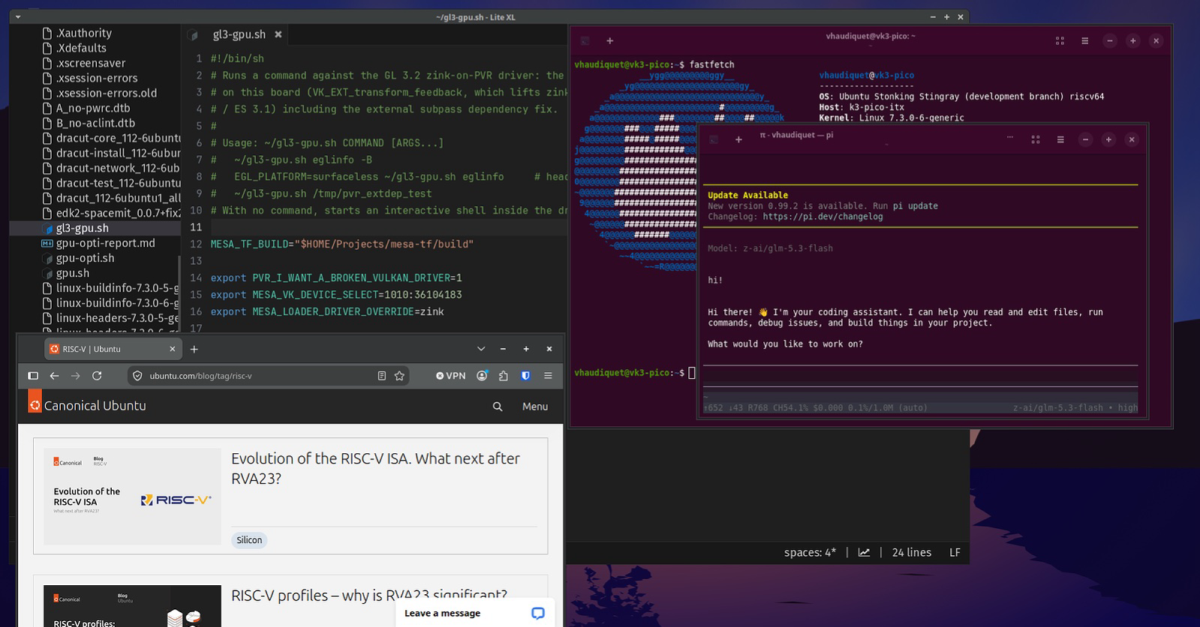
RISC-V is getting a more straightforward route to the Ubuntu desktop. Experimental Ubuntu Desktop images are now available for the architecture, with official images expected when Ubuntu 26.10 Stonking Stingray arrives on October 15.
Ubuntu already supported RISC-V, so this announcement is specifically about desktop images. Previously, amd64 and arm64 had them while riscv64 did not. For Linux enthusiasts interested in trying different hardware, closing that gap is welcome news.
The SpacemiT K3 Pico-ITX board is the hardware focus here. It will gain official support with Ubuntu 26.10, and installation documentation already covers firmware updates and installing the operating system onto internal UFS storage or an NVMe drive. The developers describe the board as providing a responsive desktop experience, although that is their assessment rather than my own testing.
There is also an experimental Xubuntu Minimal image, which remains unofficial and unsupported. Its lighter XFCE desktop makes it a more practical option for testing through QEMU. Apparently, GNOME can take more than 30 minutes to load under emulation. I love GNOME, but that is a long time to wait just to reach your desktop.
Getting everything working required changes to the image build process, a RISC-V build of Flutter for the installer, and kernel patches for the K3, particularly for display support. Developers also worked on Firefox and desktop snaps. Initial images may still lack App Center, Prompting Client, and other components while that work continues.
Some of the image-building changes have reached Ubuntu 26.04 as well. Official support for the K3 has not arrived for that release, though developers expect it later. For now, the available images remain experimental, with known issues and no official support.
What interests me most is the prospect of more choice. A desktop computer needs more than an interesting processor to be useful. Installation, browser compatibility, working displays, and available applications all shape the experience. These are the details that determine whether someone keeps using a machine after the initial excitement wears off.
I would not rush to replace a working PC based on this announcement alone. Still, as someone who enjoys Linux, I would much rather see RISC-V hardware become something people can install a familiar desktop on and actually explore. Ubuntu’s progress makes that prospect more appealing.
Support independent tech journalism
NERDS.xyz is independently owned and operated. If you enjoy my coverage of Linux, AI, hardware, cybersecurity, and tech culture, consider supporting the site on Ko-fi.
Support NERDS.xyz