
Canonical has released Ubuntu 25.10, codenamed “Questing Quokka.” While it is an interim release, it feels like a clear setup for next year’s long-term support version. The focus is on tightening security, improving accessibility, and refining the plumbing that keeps Linux running smoothly.
The biggest improvements happen under the hood. Canonical has introduced Rust-based versions of sudo and coreutils, both built with memory safety in mind. These tools are designed to prevent the kinds of memory-related bugs that have haunted traditional C code for decades. The original versions are still available, but this move shows where Canonical wants to take Ubuntu. “I’m particularly pleased with the progress on memory-safe utilities, and the enhancements to our TPM-backed full disk encryption,” said Jon Seager, VP of Ubuntu Engineering at Canonical.
The new sudo-rs comes from a collaboration with the Trifecta Tech Foundation. “Seeing sudo-rs landing in Ubuntu is a huge achievement we’re very excited about,” said Erik Jonkers, Chair at Trifecta Tech Foundation. He explained that the goal is to make “essential building blocks like sudo more secure and robust for everyone.” Ubuntu 25.10 also includes uutils-coreutils, a modern Rust rewrite of GNU core utilities built to improve stability without breaking compatibility.
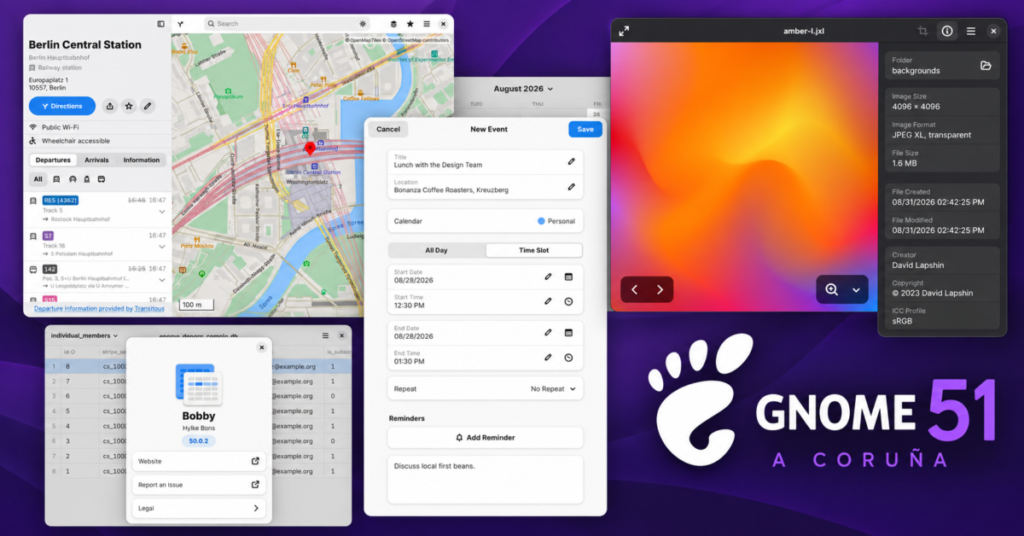
On the desktop side, GNOME 49 debuts with a cleaner design, lock screen media controls, and improved accessibility. The same desktop generation also appeared in Fedora Linux 43, giving readers a useful point of comparison. Two new apps are included by default: Loupe, a new image viewer, and Ptyxis, a modern terminal emulator. Users who select “install restricted extras” during setup will notice better Bluetooth audio quality and hardware-accelerated screen recording. Accessibility improvements continue with refined keyboard navigation, screen reading, and a more visible accessibility menu on the login screen.
Developers get plenty of updates. Ubuntu 25.10 ships with OpenJDK 25, Python 3.14 RC3, Golang 1.25, GCC 15, and Rust 1.85. A preview of Zig and .NET 10 is also included. Canonical has improved its .NET Snapcraft plugin for monorepo projects and PowerShell now runs on more architectures, including arm64 and IBM’s s390x.
Underneath it all is the Linux 6.17 kernel, which introduces nested virtualization for Arm platforms such as NVIDIA Grace and AmpereOne. This makes it easier for developers to run complex cloud environments or create virtual testing setups. “With Ubuntu 25.10 enabling nested virtualization on Arm-based platforms both in the cloud and on-premises, developers and operators can advance development and deployment of this powerful capability,” said Bhumik Patel, Director of Server Ecosystem Development at Arm.
The release also includes early support for Intel TDX, a confidential computing feature that isolates workloads at the hardware level. TPM-backed full disk encryption has been improved with new passphrase options and better recovery key management, making it more practical for those who value data protection.
Ubuntu 25.10 also moves to the new RVA23 profile for RISC-V builds, aligning with the latest standards to ensure compatibility across new hardware. “Our collaboration with Canonical strengthens the RISC-V software ecosystem and advances the adoption of RISC-V in enterprise applications from IoT to HPC,” said Andrea Gallo, CEO of RISC-V International.
Ubuntu 25.10 is available now at ubuntu.com/download. Because Ubuntu 25.10 is an interim release, readers should weigh its shorter support window before installing it on a system that needs long-term stability. Its clearest value is as a preview of technologies Canonical may carry into the next LTS release.
Support independent tech journalism
NERDS.xyz is independently owned and operated. If you enjoy my coverage of Linux, AI, hardware, cybersecurity, and tech culture, consider supporting the site on Ko-fi.
Support NERDS.xyz