Giving an AI agent access to company systems raises a fairly obvious question. Who stops it from doing something it should not? Asking the agent to follow instructions is one thing, but businesses need controls that hold up when the software makes a bad decision.
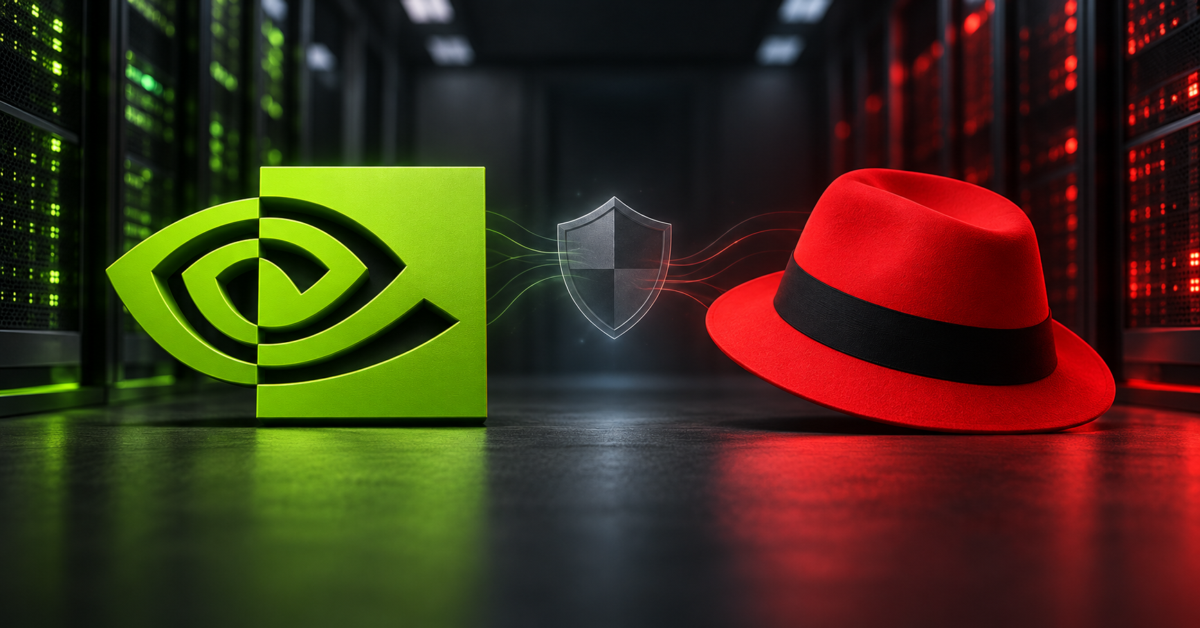
Red Hat and NVIDIA are building around that concern with an expanded collaboration covering agent security, access to AI models, and hardware support. Announced at NVIDIA GTC in Berlin, the updates center on Red Hat AI Factory with NVIDIA, with OpenShell providing the foundation for work on agent runtime safety.
The most interesting part of the announcement is also the easiest to understand. An AI agent should not be responsible for deciding whether its own actions cross a boundary.
“An agent shouldn’t be enforcing its own boundaries — those controls belong outside the agent, in the runtime and the infrastructure beneath it. NVIDIA’s expanded work with Red Hat combines a secure agent runtime, governed inference and deep hardware support to give enterprises a trusted, high-performance blueprint for agentic AI across the open hybrid cloud,” said John Fanelli, vice president, Enterprise Software, NVIDIA.
That is a sensible starting point. If a company gives software the ability to take actions, it needs an independent way to restrict those actions. A model deciding that something is acceptable should not automatically make it permissible.
Red Hat is working with NVIDIA on the OpenShell Reference Architecture and supporting it through integrations with Red Hat AI Factory with NVIDIA. The companies describe OpenShell as an open source agent sandbox runtime, with both serving as leading contributors. Their work targets standardized guardrails, visibility into agent operations, and runtime safety.
A sandbox gives software a constrained environment in which to operate. For businesses evaluating autonomous agents, the appeal is straightforward: give the agent enough room to perform its assigned work while placing limits around that environment. The effectiveness still depends on the controls and how administrators configure them.
There is an availability detail worth watching here. Red Hat says it is actively working with NVIDIA and the community to integrate the OpenShell Reference Architecture into Red Hat AI and Red Hat AI Factory with NVIDIA as a native platform capability. That portion of the announcement describes ongoing work, so customers should not assume the entire vision already ships as a built-in feature.
The collaboration also addresses how employees and applications access AI models. A joint reference design includes self-service model discovery, access policies, rate limiting, subscription entitlements, quotas, and cost attribution. Put more plainly, businesses get a blueprint for controlling who can use particular models, how much they can consume, and where the expense belongs.
The design combines technologies including vLLM, llm-d, NVIDIA Dynamo, and NVIDIA NIM microservices. Red Hat and NVIDIA say separating access governance from model execution allows organizations to maintain operational controls while serving models across hybrid cloud environments.
That separation makes practical sense. Permission to use a model, a budget for using it, and the computing resources running it are related concerns, but each needs its own controls. An agent that stays within its assigned task can still become expensive if its activity goes unchecked.
On the model side, Red Hat says NVIDIA Nemotron 3.5 Super VL is fully supported in vLLM and Red Hat AI Factory with NVIDIA. It also points to model compression and speculative decoding techniques intended to reduce response latency while preserving accuracy. The announcement does not provide enough benchmark detail to judge those performance claims independently.
Hardware support rounds out the news. Red Hat is targeting support at launch for upcoming NVIDIA architectures, including Vera Rubin, and says Red Hat Enterprise Linux for NVIDIA now supports Vera CPUs. Those processors target workloads that include agent tool orchestration and sandbox execution.
For me, the security work is the stronger story. Businesses considering autonomous AI need to know what an agent can access, which actions the surrounding infrastructure permits, and how they can inspect its behavior. Faster hardware does not answer those questions.
Red Hat and NVIDIA are outlining a useful approach, but a reference architecture is not proof that an agent is safe. The real test is whether the deployed controls keep working when an agent makes the wrong decision.
Support independent tech journalism
NERDS.xyz is independently owned and operated. If you enjoy my coverage of Linux, AI, hardware, cybersecurity, and tech culture, consider supporting the site on Ko-fi.
Support NERDS.xyz