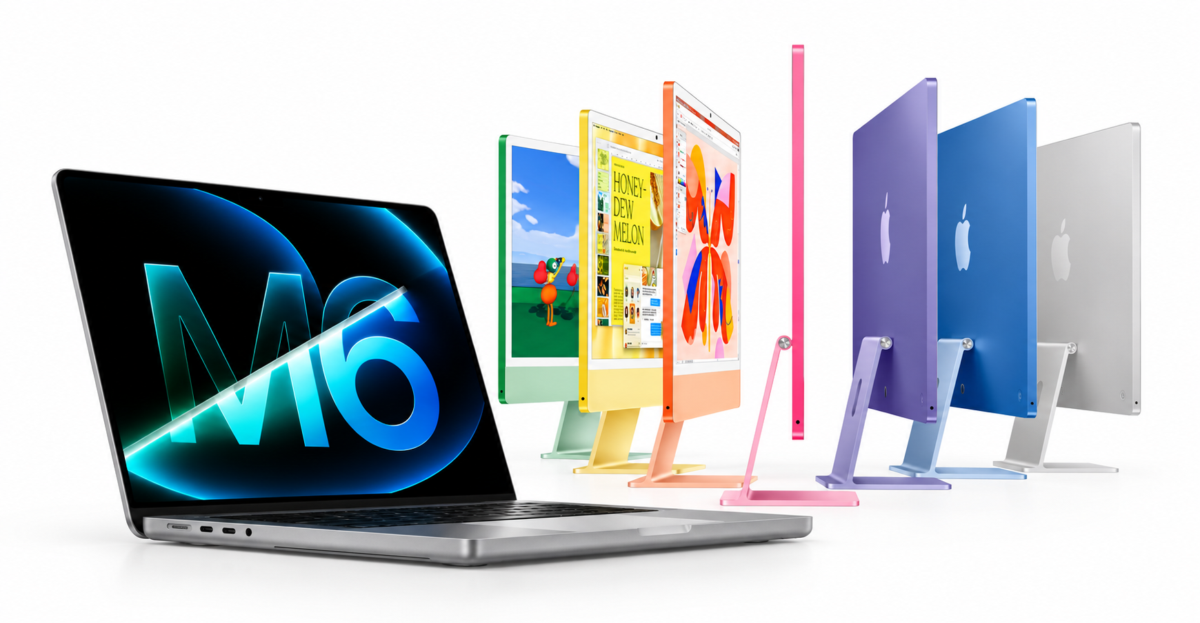
Apple has announced two new Macs today, bringing its M6 processor to the 14-inch MacBook Pro and 24-inch iMac. Both computers offer faster performance, improved connectivity, and greater artificial intelligence capabilities. The hardware sounds impressive, but Apple’s increasing reliance on AI also introduces some questions about what buyers are actually getting for their money.
The new MacBook Pro starts at $1,999, while the iMac begins at $1,499. Preorders open tomorrow, October 28, with both computers arriving November 6. Apple is clearly targeting people with older Macs, particularly those still using Intel processors or first-generation Apple silicon.
The M6 chip features a 12-core CPU and 12-core GPU in the MacBook Pro, adding two cores to each compared to M5. Apple claims graphics performance improves by up to 30 percent, while certain AI workloads run up to 25 percent faster. A new Dual 16-core Neural Engine reportedly delivers up to 1.9 times the performance of its predecessor.
Those improvements are welcome, but the comparisons become more interesting when Apple brings the original M1 into the conversation. According to the company, the M6 MacBook Pro can deliver up to 13 times faster time-to-first-token performance when processing prompts with large language models compared to the M1 MacBook Pro.
Ray-traced rendering in Blender can be up to 11.7 times faster, while compiling projects in Xcode improves by up to 2.5 times. Of course, the M1 debuted six years ago, so comparing a brand-new processor against technology from 2020 is going to produce some impressive numbers.
Against M5, Apple’s own testing shows improvements closer to 20 to 30 percent in several of those applications. That is still progress, but probably not enough to convince someone who purchased a MacBook Pro last year to replace it.
The new laptop includes 16GB of unified memory as standard, configurable up to 32GB, with memory bandwidth reaching 170GB/s. That should be plenty for many people, although the maximum memory configuration could become a limitation for developers hoping to run particularly demanding AI models locally.
Battery life reaches a claimed 24 hours, which Apple says is the longest ever offered in a Mac. Fast charging can restore up to 50 percent of the battery in approximately 30 minutes when using a compatible 96W USB-C adapter.
The 14-inch Liquid Retina XDR display remains, offering up to 1,600 nits of peak HDR brightness and an optional nano-texture finish. There is also a 12MP Center Stage camera, six-speaker audio, Wi-Fi 7, and Bluetooth 6.
Apple includes three Thunderbolt 4 ports, HDMI, MagSafe 3, an SDXC card slot, and a headphone jack. Interestingly, Thunderbolt 5 is absent. For a laptop starting at nearly $2,000, that is a little disappointing, especially for people using high-performance external SSDs and docks.
Meanwhile, the iMac receives its own M6 upgrade without abandoning the familiar colorful design. The entry-level $1,499 configuration includes a 10-core CPU and 10-core GPU, while the $1,699 model increases both to 12 cores.
Apple claims up to twice the graphics performance and five times faster local AI prompt processing compared to the M4 iMac, depending on the workload. The company also claims performance can be up to 18 times faster than its most popular Intel-based iMac, although that comparison involves a much older computer rather than a recent model.
The iMac retains its 24-inch 4.5K Retina display, 12MP Center Stage camera, and six-speaker audio system. Buyers can choose blue, green, pink, yellow, purple, orange, or silver.
Wireless connectivity improves with Wi-Fi 7 and Bluetooth 6, while SSD performance can be up to twice as fast. Apple also offers 2.5 Gigabit Ethernet, but only on the more expensive 12-core configuration. Similarly, getting four Thunderbolt 4 ports requires that higher-end model.
I would have preferred to see faster Ethernet available across the lineup. Even a relatively inexpensive desktop can benefit from 2.5Gb networking, particularly when transferring large files to network-attached storage. Still, the iMac remains an appealing option for someone who wants a complete desktop computer without purchasing a separate display, speakers, or webcam.
What interests me most about these announcements, however, is how aggressively Apple is promoting artificial intelligence. Both Macs ship with macOS 27 Golden Gate, which introduces Siri AI and additional Apple Intelligence features.
Apple says Siri can understand personal context, search through emails and messages, answer questions about what appears on the screen, and perform actions across applications. Safari can organize tabs automatically, monitor websites for changes, and even generate custom extensions from natural-language descriptions. Shortcuts can create automations based on a user’s instructions, while Photos gains additional AI editing capabilities.
Some of that sounds genuinely useful, but there is an important detail buried in Apple’s announcements. Siri AI remains in beta with macOS 27.2, despite Apple positioning AI as one of the primary reasons to purchase these computers.
Customers are being asked to spend between $1,499 and $1,999 before upgrades, while one of the headline software features is still considered unfinished. That does not mean Siri AI is necessarily unreliable, but it does mean buyers should approach Apple’s promises with realistic expectations.
There is another issue that could become even more controversial. Apple acknowledges that certain AI features relying on server-side models have daily usage limits, including Siri AI, Image Playground, intelligent photo editing, and cloud-based AI models used through Shortcuts.
More importantly, Apple says expanded access to those features will eventually be available for a fee. Someone could spend $2,000 on a new MacBook Pro, only to discover that using some of its advertised AI capabilities beyond certain limits will eventually require paying Apple additional money.
To be fair, running sophisticated AI models in the cloud costs money, and Apple is hardly alone in charging for additional computing resources. The M6 also supports local AI processing, which does not necessarily require those same cloud services.
Still, Apple has not announced how much expanded access will cost, what the paid tiers might include, or precisely how restrictive the daily limits will be. Those are details customers deserve to understand before deciding how much value to place on the company’s AI promises.
Apple is also promoting its Apple Upgrade leasing program. The MacBook Pro starts at $38.99 per month, while the iMac starts at $28.99 per month, based on 36-month terms through Klarna.
Those payments sound attractive, but customers should understand that this is a lease rather than a traditional installment purchase. Making all the scheduled payments does not automatically mean owning the computer. There is a separate purchase option, and ending a lease early can result in additional charges.
Ultimately, these new M6 Macs look like worthwhile upgrades for people still using Intel hardware or older Apple silicon. Faster processors, better wireless connectivity, and improved local AI performance are all welcome. For M4 and M5 owners, however, the case for upgrading is much weaker.
Apple has improved the hardware without dramatically changing the overall experience, and that is perfectly fine. What concerns me more is the possibility of increasingly expensive computers becoming gateways to additional subscription fees.
When someone buys a $2,000 Mac, how much of its advertised intelligence should they have to pay for again? Apple has not answered that question yet, and it could ultimately matter more than another 30 percent improvement in benchmark performance.
Support independent tech journalism
NERDS.xyz is independently owned and operated. If you enjoy my coverage of Linux, AI, hardware, cybersecurity, and tech culture, consider supporting the site on Ko-fi.
Support NERDS.xyz