
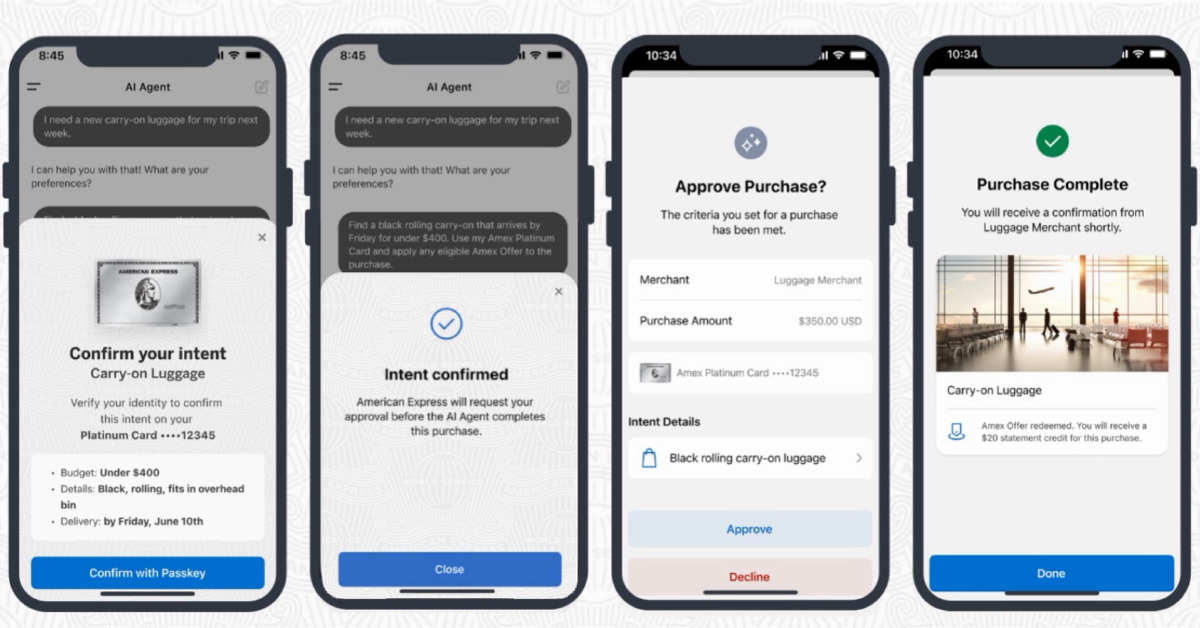
Letting an AI shop for you sounds convenient until it buys something you never wanted. American Express is trying to address that problem with Intent Intelligence, a newly published framework for recording what customers authorize before an agent spends their money.
The framework is available through the company’s Agentic Commerce Experiences Developer Kit, known as ACE. Amex is still developing integrations, so this announcement should not be mistaken for a shopping feature that every cardholder can start using today.
Its recommended approach gives the card issuer authenticated purchase instructions before the transaction. Those instructions can include a maximum budget, merchant preferences, deadlines, and conditions such as buying an item only when it comes back in stock. Customers can also approve a specific cart.
A Create Intent API captures the request, and the customer authenticates their identity and signs off on the instructions. The system then creates an Intent ID and a Proof of Intent Token representing the approved constraints.
That token can be used to obtain a digital payment credential for checkout instead of exposing the customer’s actual card number. The authorized intent helps restrict the credential, while the ID and token can support checks throughout the purchase process.
“Building trust into AI-powered transactions is critical to the adoption of agentic commerce,” said Luke Gebb, Head of Global Innovation at American Express. “Providing authorized purchase intent before an agent transacts can give issuers greater confidence that an agent is acting as a customer intended, while also helping issuers proactively manage risk and reduce the chance of costly disputes across the payments ecosystem.”
Disputes are a big part of this proposal. An agent might change an approved cart or add the wrong product, while a customer could challenge a purchase they actually authorized. Having a record of the instructions could help issuers assess risk beforehand and evaluate complaints afterward.
I can see the appeal, but the confirmation process needs to be clear. If I ask an agent to buy a graphics card for less than $500, I want to know whether that includes shipping and taxes, which seller it will use, and whether it can substitute another model. A spending limit alone would not stop it from buying the wrong card.
There is also a difference between accurately recording approval and correctly understanding a request. If the AI misinterprets what I said, presenting those mistaken instructions for a quick sign-off could leave me approving something I never intended. I would want to know how that situation gets resolved before handing over purchase authority.
Amex’s technical post says purchase summaries should omit personal details unrelated to the transaction. That is welcome, although it leaves questions about how long participants retain the remaining information and who can access it.
American Express hopes publishing the framework will help advance a common industry approach. It also says it is engaging with EMVCo on secure card-based agent transactions and supporting the x402 Foundation’s work on internet-native payment standards.
For me, the real test will be customer service. Controls that prevent bad purchases would be useful, but when something slips through, consumers need a straightforward way to fix it. I would be more comfortable letting an AI spend my money if I knew I would not have to argue with another AI to get it back.
Support independent tech journalism
NERDS.xyz is independently owned and operated. If you enjoy my coverage of Linux, AI, hardware, cybersecurity, and tech culture, consider supporting the site on Ko-fi.
Support NERDS.xyz