
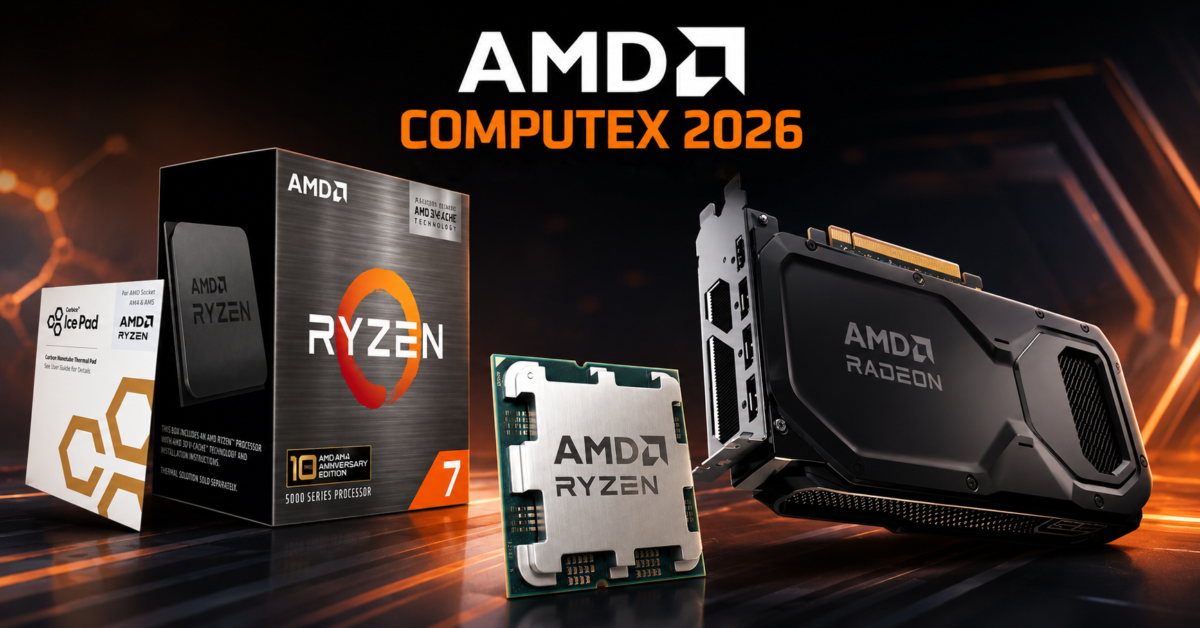
AMD just made one thing very clear at Computex 2026: it still cares about PC gamers that actually upgrade their systems over time.
While much of the tech industry remains obsessed with AI buzzwords, AMD used its Computex keynote to focus on something refreshingly practical. The company celebrated 10 years of Socket AM4, extended AM5 support through 2029, announced new Ryzen X3D processors, and expanded its RDNA 4 graphics lineup with the Radeon RX 9070 GRE.
For longtime PC builders, the biggest announcement might not have been a new chip at all. It was AMD confirming that Socket AM5 will remain supported through at least 2029. In an era where motherboard compatibility often feels disposable, that commitment matters.
AMD is also somehow keeping AM4 alive in 2026. To celebrate the platform’s 10th anniversary, the company introduced the Ryzen 7 5800X3D 10th Anniversary Edition. The original 5800X3D was one of the most beloved gaming CPUs AMD ever released thanks to its 3D V-Cache technology, and many gamers still use it today.
The anniversary edition launches June 25 for $349 and even includes a Carbice Ice Pad thermal interface material bundle. While that extra accessory feels a bit gimmicky, the larger message is obvious: AMD knows AM4 users are not in a hurry to abandon their systems.
Meanwhile, AM5 users are getting a new processor too. AMD announced the Ryzen 7 7700X3D, an eight-core gaming chip with 104MB of cache and boost speeds up to 4.5GHz. The processor launches July 16 for $329.
Truthfully, the Ryzen 7 7700X3D itself is not the most exciting product AMD has ever announced. But that is probably beside the point. AMD appears far more interested in making AM5 look like a safe long-term investment, especially for gamers tired of replacing motherboards every few years.
That strategy could resonate with enthusiasts frustrated by short-lived desktop platforms elsewhere in the industry.
AMD also expanded its RDNA 4 graphics lineup globally with the Radeon RX 9070 GRE. The GPU features 48 compute units, 12GB of memory, and targets 1440p gaming. AMD claims it delivers 21 percent faster 1440p performance than competing products.
The RX 9070 GRE launches June 2 for $549. That pricing puts it in an awkward middle ground, however. Budget gamers may still find it too expensive, while enthusiasts willing to spend more could end up eyeing higher-end cards instead. Still, AMD clearly wants broader RDNA 4 adoption, and this card helps fill out the stack.
AMD also talked up EXPO Ultra Low Latency memory technology, promising modest gaming performance gains with certified memory kits. Realistically, though, most gamers are probably going to care far more about socket support and upgrade flexibility than slightly lower memory latency.
And AMD is probably smart to lean into that.
For years, PC builders have complained about expensive platform transitions and limited upgrade paths. At Computex 2026, AMD reminded everyone that longevity can still be a selling point.
Support independent tech journalism
NERDS.xyz is independently owned and operated. If you enjoy my coverage of Linux, AI, hardware, cybersecurity, and tech culture, consider supporting the site on Ko-fi.
Support NERDS.xyz