

For a long time, the AI infrastructure conversation has revolved almost entirely around GPUs. Faster accelerators, more of them per server, and ever larger clusters have dominated the narrative. Quietly, though, a different bottleneck has been tightening, one that GPUs alone cannot solve. Memory capacity and efficiency are becoming just as critical, especially as AI workloads move from training into large scale inference.
That is the context that makes SK hynix completing Intel Data Center Certification for a 256GB DDR5 RDIMM actually worth paying attention to. This is not flashy consumer hardware and it is not a speculative roadmap slide. It is a real, validated server memory module based on 32Gb DRAM dies, approved to run on Intel’s Xeon 6 platform, and ready for deployment in production data centers.
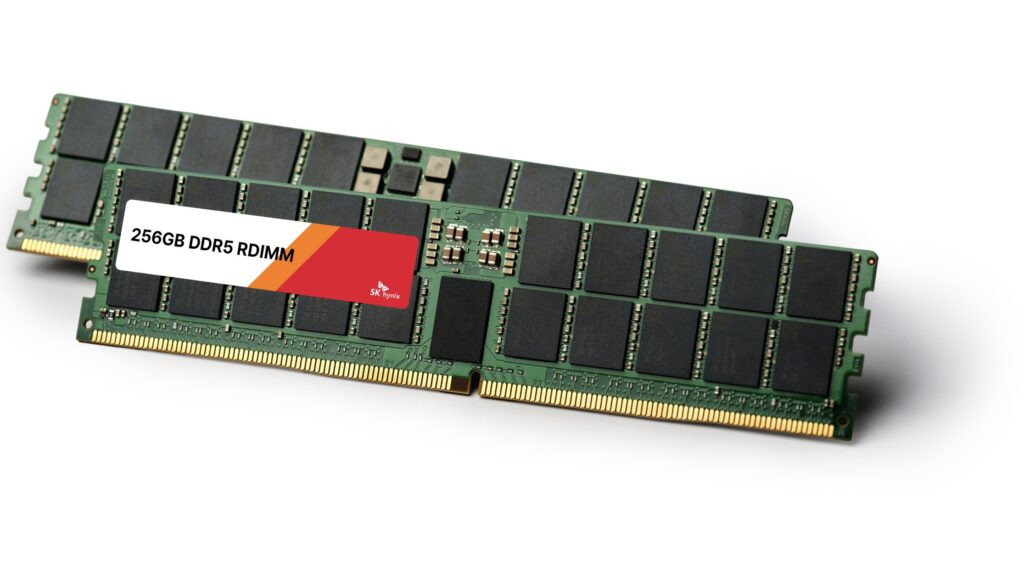
What matters here is density. A 256GB DDR5 RDIMM allows servers to pack far more memory into the same physical footprint. For AI inference workloads, that translates directly into handling larger models, bigger context windows, and more concurrent requests without constantly shuffling data back and forth between memory and storage. At scale, that difference adds up fast.
SK hynix is the first vendor to complete Intel’s Data Center Certified process for this class of module on Xeon 6. That certification still carries weight in enterprise environments, particularly among conservative buyers that prioritize stability and compatibility over early adoption. Passing validation in Intel’s Advanced Data Center Development Lab signals that this is not just a lab demo or a marketing exercise. It is hardware that system builders can confidently ship.
The technical details also point to why memory density is becoming a frontline issue for AI. According to SK hynix, servers equipped with the new 256GB DDR5 RDIMM deliver up to sixteen percent higher inference performance compared to systems using 128GB modules built on the same 32Gb die technology. That gain does not come from faster clocks or exotic tricks. It comes from keeping more data resident in memory, closer to the processor, and reducing stalls.
Power efficiency is the other half of the story. By using 32Gb DRAM chips, the new module reportedly consumes around eighteen percent less power than earlier 256GB server memory based on 16Gb DRAM. In an era where power and cooling costs are shaping data center design as much as compute density, performance per watt is no longer a secondary metric. It is a deciding factor.
This also intersects with Intel’s broader positioning. Xeon 6 needs a strong memory ecosystem to remain competitive in AI driven server deployments. While accelerators often get the headlines, CPUs still orchestrate inference pipelines, manage memory, and handle a wide range of data intensive tasks. High capacity DDR5 that is fully certified on the platform helps Intel make the case that Xeon based systems can scale efficiently without brute force hardware expansion.
SK hynix, for its part, is leaning hard into the idea that memory is no longer a passive component. As inference models grow more complex and more stateful, memory increasingly determines how many requests a system can handle and how responsive it feels under load. Bigger, more efficient DIMMs mean fewer servers, fewer slots populated, and simpler scaling strategies.
There is plenty of marketing language wrapped around this announcement, including talk of being a “full stack AI memory creator.” That phrasing can safely be ignored. What cannot be ignored is the underlying trend. AI infrastructure is becoming memory bound in ways that were easy to overlook when training workloads dominated the discussion. Inference changes the equation, and it is forcing vendors to rethink where performance really comes from.
This is not a revolutionary leap, but it is a meaningful one. High capacity DDR5 modules like this are the kind of unglamorous progress that quietly reshapes data centers over time. Fewer boxes doing more work with less power is exactly what operators want, even if it does not make for flashy keynote demos.
For anyone watching how AI infrastructure is actually evolving beyond hype and benchmarks, this certification is a small but telling signal. The next phase of AI scaling is going to be about memory just as much as compute, and vendors that solve that problem early will have a real advantage.
Support independent tech journalism
NERDS.xyz is independently owned and operated. If you enjoy my coverage of Linux, AI, hardware, cybersecurity, and tech culture, consider supporting the site on Ko-fi.
Support NERDS.xyz