
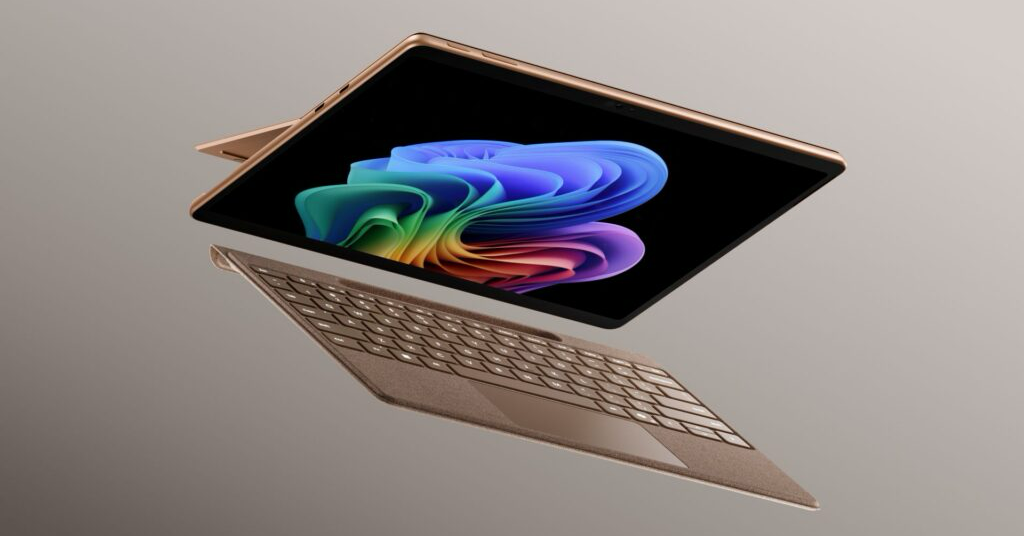
Microsoft has announced new versions of Surface Pro and Surface Laptop, and both devices are powered by Qualcomm’s latest Snapdragon X2 processors. The company is promising faster graphics performance, long battery life, AI capabilities, and the premium design Surface users have come to expect.
The new Surface Pro starts at $1,499 and remains Microsoft’s flagship 2-in-1 device. Available in Platinum, Black, and Dune, it combines the flexibility of a tablet with the functionality of a full Windows PC. Buyers can choose between Snapdragon X2 Plus (10-core) and Snapdragon X2 Elite (12-core) processors, paired with up to 64GB LPDDR5x RAM and up to 1TB of removable Gen4 SSD storage.
Microsoft says the Snapdragon X2-powered Surface Pro delivers up to 53 percent faster graphics performance than the previous generation while offering up to 15.5 hours of local video playback and up to 11.5 hours of active web usage. The device features a 13-inch OLED or LCD HDR touchscreen, Wi-Fi 7 connectivity, Qualcomm’s Hexagon NPU capable of 80 TOPS for AI workloads, and Adreno graphics. Other highlights include a 1440p ultrawide front-facing camera, a 10MP rear camera, dual USB4 ports, and support for the latest Surface keyboards, including the Surface Pro Flex Keyboard.
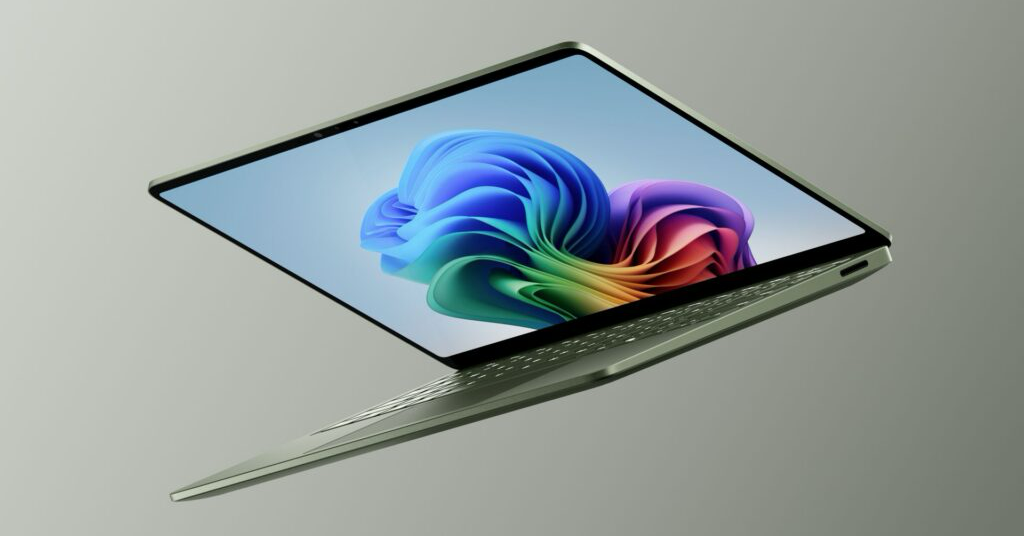
The new Surface Laptop starts at $1,599 and comes in both 13.8-inch and 15-inch configurations. Like the Surface Pro, it can be configured with either Snapdragon X2 Plus or Snapdragon X2 Elite processors, up to 64GB LPDDR5x memory, and up to 1TB of removable Gen4 SSD storage. Microsoft says graphics performance is up to 58 percent better than the previous generation.
The 13.8-inch model offers up to 20 hours of local video playback and up to 16 hours of active web usage. It features a 13.8-inch LCD HDR touchscreen, Wi-Fi 7, a 1080p Full HD camera, two USB4 ports, USB-A 3.2, a 3.5mm audio jack, and the familiar Surface Connect port. It weighs just 3 pounds.
Those who need a larger display can opt for the 15-inch model, which delivers up to 19 hours of local video playback and up to 14 hours of active web usage. Along with the larger LCD HDR touchscreen, Microsoft includes a MicroSDXC Express card reader, making the bigger model particularly attractive for photographers, videographers, and other creative professionals who frequently work with removable media. The 15-inch version weighs 3.67 pounds.
As expected, Microsoft is leaning heavily into AI. Both Surface devices include Qualcomm’s Hexagon NPU capable of delivering 80 TOPS of AI performance, allowing AI workloads to run locally instead of relying entirely on the cloud. Microsoft says the new systems are designed to seamlessly move AI tasks between local hardware and cloud services when appropriate.
The company is also highlighting expanded haptic experiences across Windows 11. The Surface Laptop touchpad and Surface Slim Pen now provide tactile feedback designed to make interactions feel more natural while improving accessibility and responsiveness.
Repairability and sustainability continue to receive attention as well. The new Surface devices feature enclosures made from 100 percent recycled aluminum, and Microsoft is introducing a Surface Repair Tool that can help users diagnose problems and perform guided repairs on supported components.
Personally, I’m glad to see ARM continue its rise in the PC market. A few years ago, Windows on Arm felt more like an experiment than a serious platform. Today, Microsoft is shipping premium Surface hardware with up to 12-core Snapdragon X2 processors, 80 TOPS of AI performance, up to 64GB RAM, and battery life that rivals what many users have come to expect from Apple Silicon. That’s no longer an experiment.
Between Qualcomm’s increasingly capable silicon and Microsoft’s commitment to Windows on Arm, it’s becoming clear where the industry is headed. Better battery life, cooler operation, integrated AI acceleration, and impressive performance make ARM a compelling alternative to traditional x86 processors. At this point, I believe ARM is the future of personal computing, and these new Surface devices are further proof that the transition is well underway.
The new Surface Pro and Surface Laptop are available starting today from Microsoft directly, while Surface for Business availability begins July 14.
Support independent tech journalism
NERDS.xyz is independently owned and operated. If you enjoy my coverage of Linux, AI, hardware, cybersecurity, and tech culture, consider supporting the site on Ko-fi.
Support NERDS.xyz