

Artificial intelligence is supposed to make customer service better. Faster answers. Fewer hold times. Less frustration. That is the pitch, anyway.
But if you actually ask customers how they feel about AI handling their support issues, the enthusiasm drops pretty quickly.
New research from Pegasystems, conducted with YouGov, suggests companies leaning hard into generative AI have not earned consumer trust. Not even close.
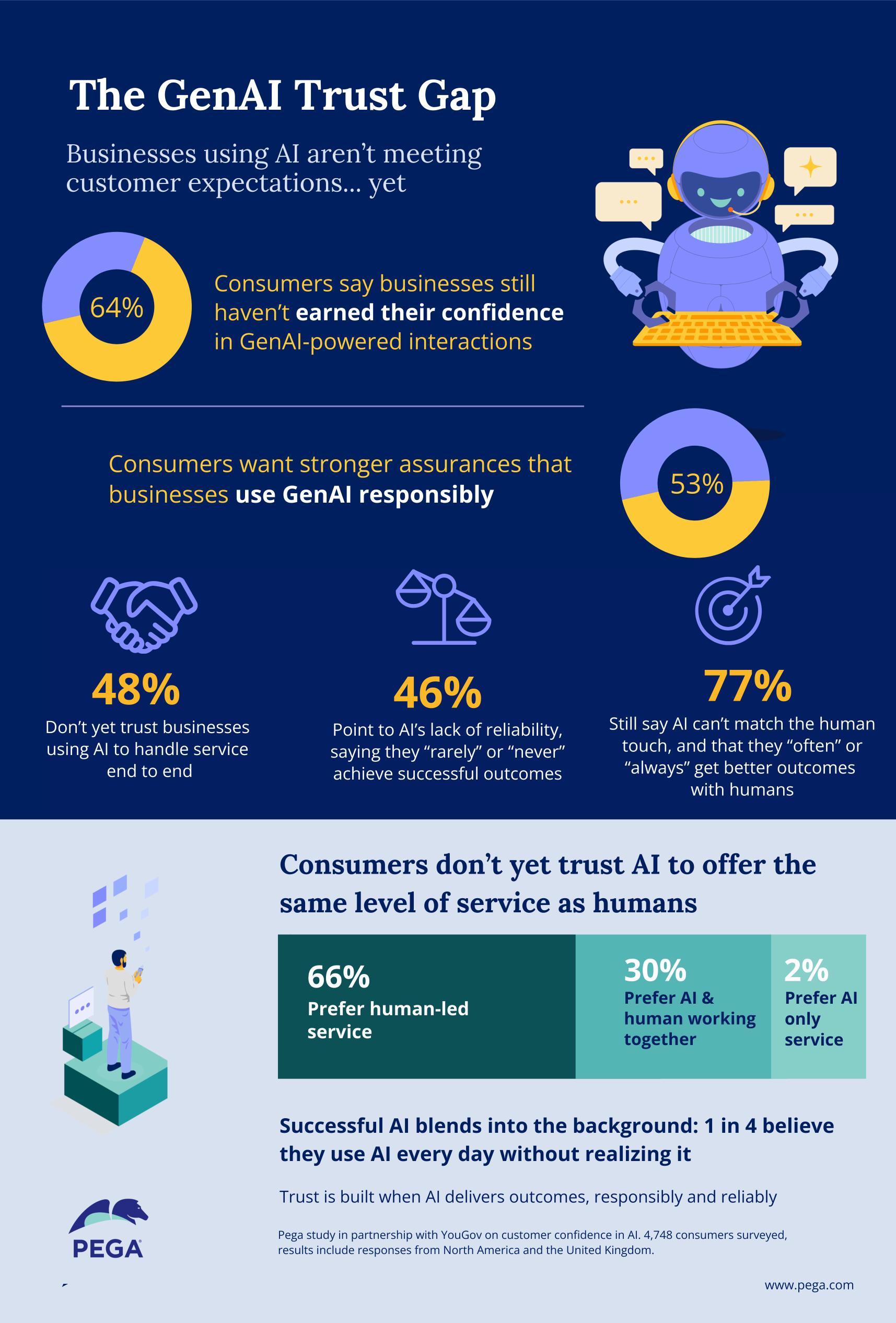
The study surveyed more than 4,700 people in North America and the United Kingdom. The numbers paint a clear picture. Sixty four percent of respondents say they are either not very confident or not at all confident in the way businesses use GenAI when interacting with them. That is not a rounding error. That is a warning sign.
It gets worse. Fifty three percent say they lack confidence that organizations use GenAI responsibly. So even beyond performance, there is concern about how the technology is being handled in the first place.
Why the skepticism? A lot of it comes down to results.
Forty six percent of consumers say they “rarely” or “never” get successful outcomes through AI powered customer service interactions. Nearly half, 48 percent, say they do not trust businesses to let AI handle their service experience from start to finish.
That tracks with what many of us have experienced. You open a chat window, type a detailed explanation, and get a canned response that barely relates to your issue. You rephrase. It loops. Eventually, you hunt for the tiny link that says “talk to a human.”
And speaking of humans, customers still prefer them. A striking 77 percent say they “always” or “often” get better outcomes when dealing strictly with a human. Sixty six percent prefer human led support. Just 2 percent want AI-only service.
That 2 percent number should make executives pause.
This does not mean consumers hate AI. In fact, the data hints at something more nuanced. About one in four respondents believe they probably use AI every day without even realizing it. When it works quietly in the background and simply delivers results, people seem fine with it.
Simon Thorpe, director at Pega, put it bluntly. “AI can be transformational for customer service – but it has to live up to customer expectations,” he said. He pointed to too many first hand examples of deployments that lead to dead ends and frustration, and argued businesses need to move beyond simple chatbots toward “predictable AI agents that consistently get work done on behalf of customers.”
That is the key. Customers are not rejecting technology. They are rejecting bad experiences.
There is a big difference between AI that helps an agent resolve your issue faster and AI that replaces a human with a script reader that cannot think. Companies chasing cost savings by pushing everything to bots may save money in the short term, but trust is harder to win back once it is lost.
AI in customer service is not going away. The question is whether businesses will treat it as a tool to support humans or as a shortcut to eliminate them. Based on this research, customers have made their preference clear.
Support independent tech journalism
NERDS.xyz is independently owned and operated. If you enjoy my coverage of Linux, AI, hardware, cybersecurity, and tech culture, consider supporting the site on Ko-fi.
Support NERDS.xyz