Apple has unveiled new Mac mini and Mac Studio computers, and the message could not be clearer. The company believes local artificial intelligence will become a major reason to buy a desktop Mac.
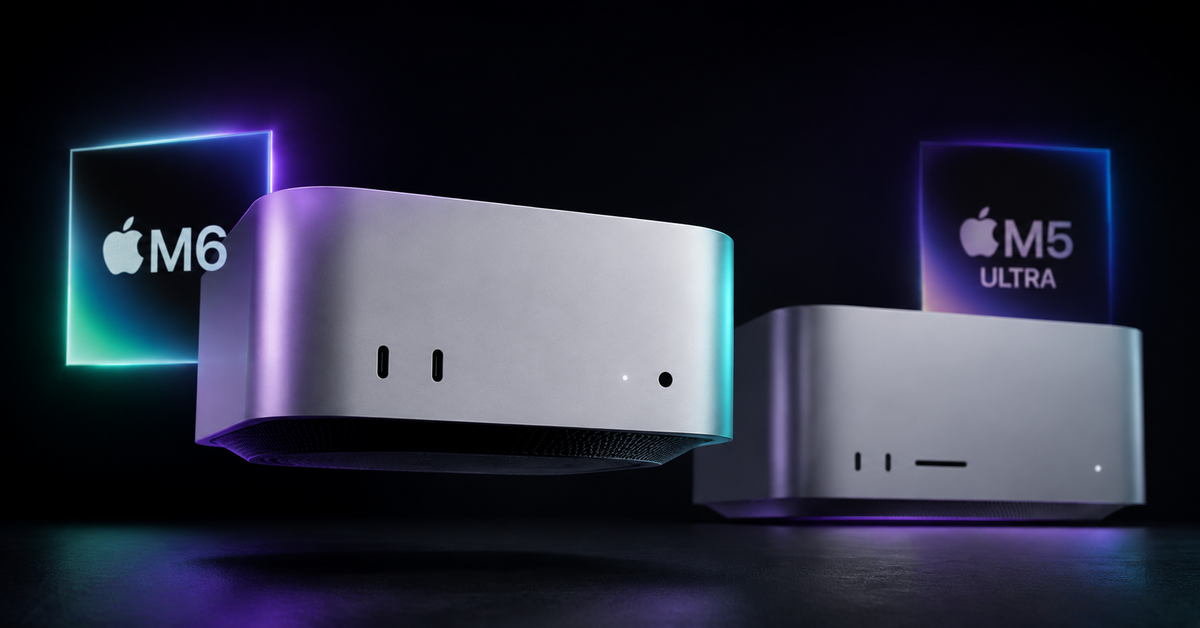
The smaller machine can now be configured with the new M6 or M5 Pro, while Mac Studio moves to M5 Max and M5 Ultra. All four chips promise faster traditional computing, but Apple spent much of its announcement discussing AI models, agents, Neural Accelerators, and the benefits of keeping demanding workloads on the device.
M6 is Apple’s first chip manufactured using a 2 nanometer process. It has a 12 core CPU, a 12 core GPU, and two 16 core Neural Engines. Apple says the CPU offers up to 1.2 times faster multithreaded performance than M5, while the GPU provides nearly 30 percent more peak AI compute.
The M6 Mac mini comes with 16GB of unified memory and can be configured with up to 32GB. Memory bandwidth reaches 170GB per second. Apple claims AI performance can be up to four times faster than on the M4 Mac mini, though results will vary considerably depending on the application and model being used.
Buyers who need more can choose M5 Pro. That version offers up to an 18 core CPU, a 20 core GPU, 64GB of unified memory, and 307GB per second of memory bandwidth. It should be the more useful option for video production, software development, and other jobs that need sustained performance rather than occasional AI features.
Apple also upgraded connectivity. Both Mac mini models include WiFi 7, Bluetooth 6, and 2.5Gb Ethernet, with 10Gb Ethernet available as an option. The M6 configuration has three Thunderbolt 4 ports, while M5 Pro gets three Thunderbolt 5 ports. HDMI, two front USB C ports, and a headphone jack remain present.
Mac mini with M6 starts at $899, while the M5 Pro model begins at $1,699. That new entry price deserves attention. The M4 Mac mini debuted at $599, making it one of the easiest Macs to recommend. Starting at $899 changes the value proposition considerably, especially for people who only need a small computer for web browsing, office work, media, and other ordinary tasks.
The new Mac Studio targets a very different buyer. Its M5 Max configuration includes an 18 core CPU, up to a 40 core GPU, as much as 128GB of unified memory, and 614GB per second of memory bandwidth. Apple says it can process prompts in LM Studio up to 3.9 times faster than the previous M4 Max model.
M5 Ultra is the headline component. Apple created it by connecting two dual die M5 Max chips through its UltraFusion technology, resulting in the first quad die processor in the M series. It can be configured with a 36 core CPU, an 80 core GPU, and a massive 512GB of unified memory. Memory bandwidth reaches 1.2TB per second.
That enormous memory pool matters because it lets developers and researchers run very large AI models locally. Instead of sending data to a cloud service and paying for usage by the token, organizations can keep both the model and its data on their own hardware. Local operation can also help when privacy, latency, or internet availability matters.
Apple says M5 Ultra offers up to 4.3 times the peak AI compute of M3 Ultra and up to 1.8 times faster graphics. It can also play as many as 33 streams of 8K ProRes 422 video at 30 frames per second. These are impressive numbers, but they describe specialized workloads that most Mac owners will never encounter.
Mac Studio now includes faster PCIe Gen 6 storage, WiFi 7, Bluetooth 6, and Thunderbolt 5. Multiple systems can be connected using Thunderbolt 5 and RDMA to share larger AI jobs. Apple claims a cluster of four Mac Studio computers can provide up to three times the inference performance of one.
Mac Studio with M5 Max starts at $2,499. The M5 Ultra version begins at $5,499, and configurations with 512GB of memory will arrive in late October. These are workstation prices, but Apple is at least offering capabilities that would be difficult to match in a conventional desktop with the same amount of directly accessible memory.
Both computers will run macOS 27 Golden Gate, which includes new Apple Intelligence tools and the long delayed Siri AI. Apple says Siri AI will launch as a beta later this year. Developers will also have access to Core AI, Core ML, Metal, MLX, and Xcode for running and adapting models on Apple silicon.
Preorders begin today, August 25, and both machines will reach customers on September 22. The new Mac Studio looks like a serious tool for people who already know why they need one. The M6 Mac mini is more complicated. I own an M4 Mac mini and would love to upgrade, but the new model is simply too expensive. At $899, Apple has taken one of its best values and repositioned it around an AI future that many consumers have not asked for yet.
Support independent tech journalism
NERDS.xyz is independently owned and operated. If you enjoy my coverage of Linux, AI, hardware, cybersecurity, and tech culture, consider supporting the site on Ko-fi.
Support NERDS.xyz