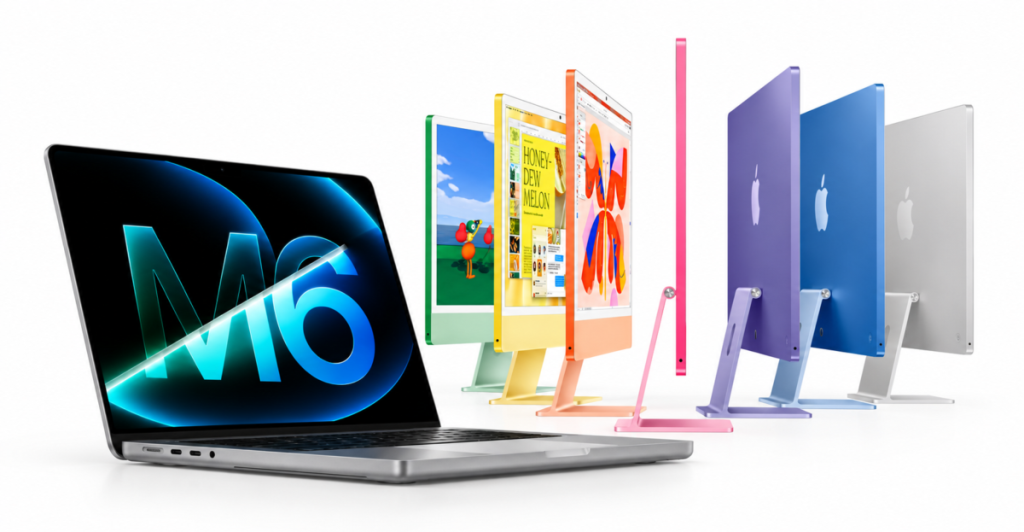

Touch is finally here on the MacBook Pro, and I’m excited to see it. Being able to reach out and interact directly with macOS is easily the biggest draw of Apple’s redesigned laptop, which also brings a tandem OLED display, M5 Pro or M5 Max chips, and a lighter enclosure. Available in 14 and 16 inch models, it starts at $2,899. Preorders open today, with availability beginning November 6.
The touchscreen supports familiar gestures such as scrolling, pinching to zoom, and dragging content between windows. macOS automatically translates touches into clicks, so many existing apps can accept basic input immediately.
More ambitious uses depend on software built for the experience. Logic Pro will offer a playable onscreen keyboard, while Final Cut Pro will let editors select ranges and position clips with their fingers. Apple also names Lightroom, DaVinci Resolve, Blender, Shapr3D, and Microsoft Office among third-party apps getting touch support, although the release says those apps will arrive later this year.
A redesigned hinge aims to keep the display steady when tapped. Apple has even added video stabilization to smooth the camera feed during touch use on calls. That addresses a practical concern, but comfort will still matter. Reaching across a keyboard occasionally is different from doing it throughout the workday.
The panel, branded PROLED XDR, offers peak HDR and SDR brightness of up to 2,000 nits, a claimed 10,000,000:1 contrast ratio, and adaptive refresh rates ranging from 10Hz to 120Hz. Support for both P3 and Adobe RGB should appeal to photographers and designers, while an optional nano-texture finish reduces glare.
Dynamic Island also comes to the Mac, providing access to Live Activities, music controls, and Siri AI. Spotlight can move there too, but only when Siri AI is available and enabled.
Despite the additions, the smaller laptop weighs 3 pounds and the larger version weighs 4 pounds, depending on configuration. Display sizes are 14.2 and 16.3 inches, respectively. Apple rates battery life at up to 24 hours, though actual results will depend on workload and configuration.
Inside, M5 Pro and M5 Max target demanding tasks such as video editing, software development, 3D rendering, and local AI processing. Configurations reach up to 128GB of unified memory and 16TB of storage. The announcement makes broad performance claims without providing much comparative benchmark data.
The port selection remains useful: three Thunderbolt 5 connections, HDMI, an SDXC card slot, MagSafe, and a headphone jack. M5 Pro supports up to three external displays, while M5 Max supports four. Wi-Fi 7 and Bluetooth 6 handle wireless connectivity.
Audio gets attention as well, with revised woofers and tweeters in the six-speaker system. Dedicated tuning for closed-lid use could be a practical improvement for people who connect their laptop to an external monitor.
The machines run macOS 27 Golden Gate, but buyers should read the AI conditions carefully. Siri AI requires macOS 27.2 and is available in beta. Certain Apple Intelligence features that rely on server processing have daily usage limits. Apple says expanded access will eventually carry a fee, without specifying a price.
The $2,899 starting price gets you the 14 inch M5 Pro model, while the 16 inch version begins at $3,399. M5 Max raises those entry prices to $4,499 and $4,799.
I want to see how well developers put this screen to work. Adjusting a photo or rotating a 3D model directly could feel natural, but small controls designed for a mouse might prove frustrating. At these prices, thoughtful app support needs to follow the hardware.
Support independent tech journalism
NERDS.xyz is independently owned and operated. If you enjoy my coverage of Linux, AI, hardware, cybersecurity, and tech culture, consider supporting the site on Ko-fi.
Support NERDS.xyz