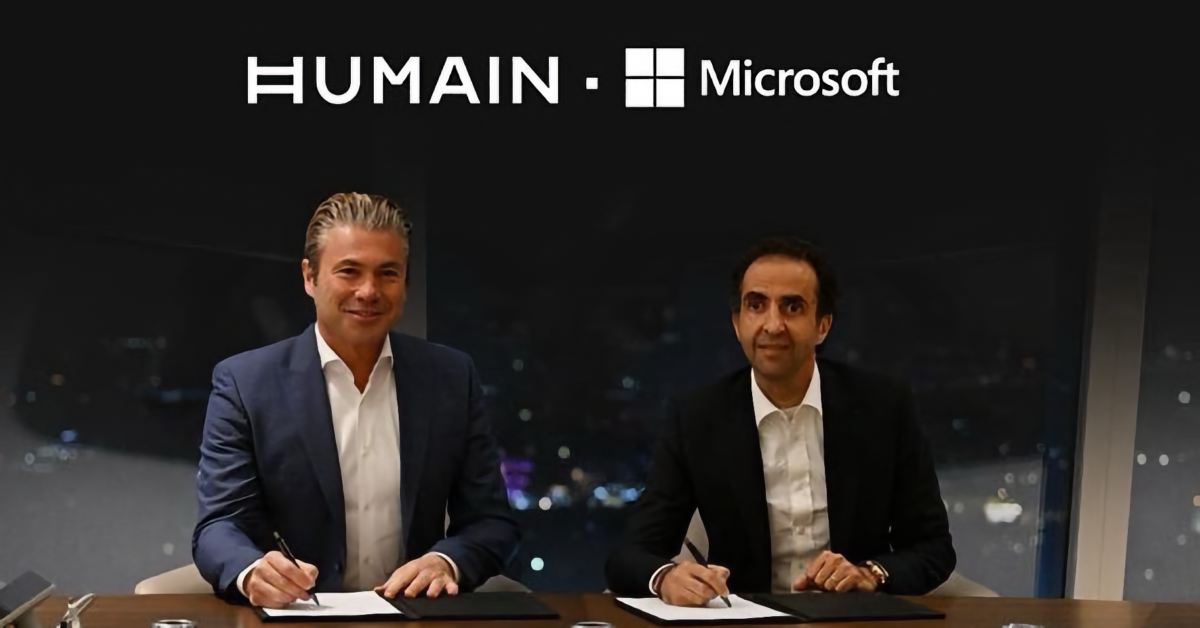
Microsoft is getting even closer to Saudi Arabia as the company expands its artificial intelligence ambitions in the Kingdom. This time, the relationship goes beyond cloud infrastructure.
Microsoft and HUMAIN have announced a long-term strategic collaboration that could bring HUMAIN’s Arabic-language ALLAM models into Microsoft Foundry and the Microsoft 365 Copilot ecosystem. The companies also plan to put their engineers together to help organizations deploy AI systems.
On the surface, this is another enterprise AI partnership. Look a little closer, however, and there is considerably more to consider. Much more…
HUMAIN isn’t just another privately owned AI startup. The company was launched in 2025 by Saudi Arabia’s Public Investment Fund as part of the country’s effort to build a domestic AI industry. PIF describes HUMAIN as operating across the entire AI stack, including data centers, cloud infrastructure, models, and applications. Crown Prince Mohammed bin Salman chairs HUMAIN, while PIF holds the company.
Under the new collaboration, the companies intend to make ALLAM available through Microsoft Foundry. Developers and businesses could then use the Arabic-language models to create and customize AI applications and agents. Microsoft 365 Copilot customers could also eventually create specialized agents using ALLAM.
That’s notable because it would put technology from a Saudi state-backed AI company directly into Microsoft’s broader enterprise AI ecosystem.
The relationship isn’t limited to models either. HUMAIN’s AI specialists and Microsoft’s Forward Deployed Engineers are expected to work alongside organizations implementing AI. That could involve identifying use cases, integrating AI into existing workflows, configuring deployments, and moving projects from experiments into production environments.
Microsoft and HUMAIN say they eventually want to explore additional cooperation involving productivity software, devices, AI models, infrastructure, and joint sales efforts.
For Saudi Arabia, the appeal isn’t difficult to understand. The country has been spending heavily to establish itself as a global AI hub and reduce its economic dependence on oil. PIF explicitly describes HUMAIN as part of that strategy.
For Microsoft, however, deeper involvement in Saudi Arabia comes with questions the company has faced before.
Human Rights Watch previously urged Microsoft to suspend plans for a Saudi cloud data center until the company could demonstrate how it would address potential human rights risks. The organization specifically raised concerns about government surveillance, privacy, Saudi data protection laws, and the treatment of dissidents.
Those concerns become particularly interesting as Microsoft gets more deeply involved with a company tied directly to the Saudi state.
Microsoft has defended its approach. In its 2025 proxy materials filed with the SEC, the company said it conducted a human rights assessment with an independent third party and concluded that its planned Saudi cloud region could operate consistently with Microsoft’s commitments to fundamental rights.
Microsoft also says it has safeguards for government requests for customer information. The company says it reviews legal demands, discloses customer information only when legally compelled, doesn’t provide governments with direct or unfettered access to customer data, and doesn’t provide governments with its encryption keys.
That doesn’t automatically resolve the broader concern, however. Look, folks, Microsoft isn’t merely opening a Saudi office or selling some software licenses. Its engineers could be working alongside HUMAIN engineers and customers to deploy AI, while HUMAIN’s models could become available through Microsoft products used by businesses and public-sector organizations.
Microsoft President Brad Smith says the partnership will help Saudi organizations build AI that understands local language and context while satisfying enterprise and public-sector security and governance requirements.
The unanswered question is how those requirements interact with Microsoft’s own privacy and human rights commitments, particularly when dealing with government customers.
There is also a bigger picture here. Saudi Arabia has been assembling an enormous collection of American technology partners around its AI ambitions. Nvidia agreed to supply HUMAIN with 18,000 Blackwell chips as part of plans for much larger AI infrastructure deployments. AMD and Amazon Web Services have also announced multibillion-dollar collaborations connected to Saudi Arabia’s AI expansion.
None of this means Microsoft’s collaboration with HUMAIN will necessarily result in privacy abuses. It does mean the partnership deserves more scrutiny than the usual corporate announcement about bringing another AI model to another platform.
Arabic-language AI could be extremely useful to millions of people and businesses. The question isn’t whether Microsoft should support Arabic AI. It’s how much influence a state-backed company should have within Microsoft’s increasingly important AI ecosystem, and what protections will exist when corporate promises about privacy collide with the laws and interests of the Saudi government.
Support independent tech journalism
NERDS.xyz is independently owned and operated. If you enjoy my coverage of Linux, AI, hardware, cybersecurity, and tech culture, consider supporting the site on Ko-fi.
Support NERDS.xyz