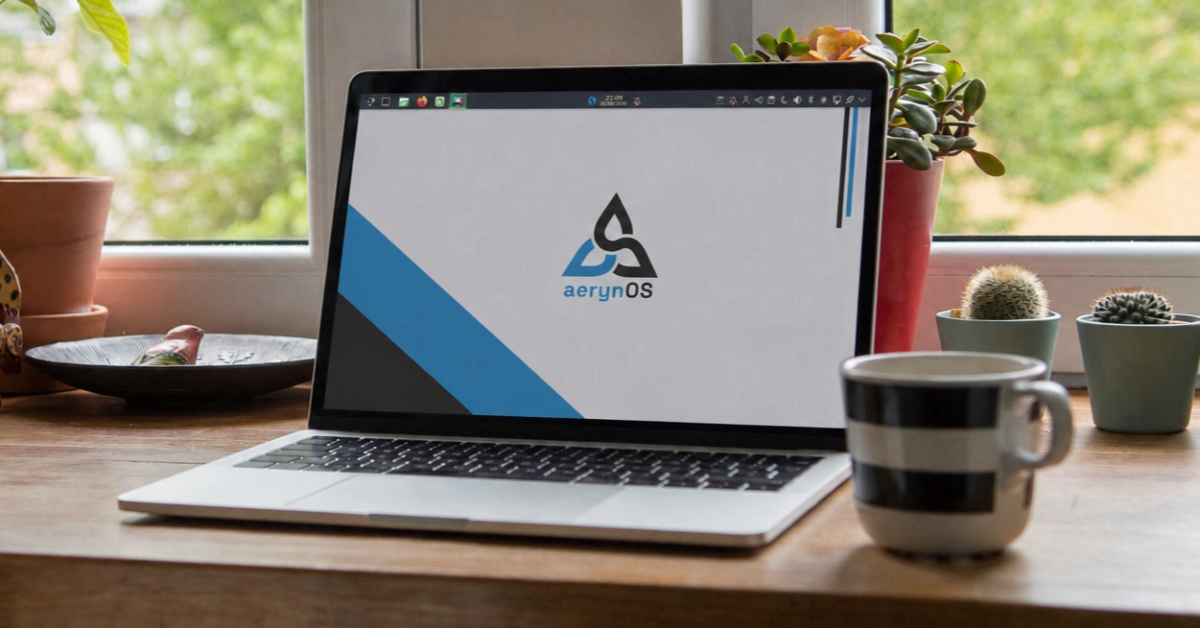
AerynOS has released a fresh progress update alongside the new AerynOS 2026.08 ISO (download here), and this one is less about flashy promises and more about fixing the machinery underneath the Linux distribution.
That may not sound exciting, but it is exactly the sort of work that can determine whether a young Linux project survives. Package management, repository formats, update reliability, storage support, and hardware testing are not glamorous topics. They are still far more important than a redesigned wallpaper or another theme.
The biggest change is the arrival of Versioned Repositories phase 2. This gives AerynOS a way to update its on-disk repository format and moss package manager without forcing users through a complicated migration process.
In practical terms, users should be able to continue running normal updates while the distribution changes important internal formats behind the scenes. The goal is an install once and update forever model, where older systems do not become stranded simply because the package manager or repository layout has evolved.
Users only need to keep running sudo moss sync -u until no additional updates are available. That is the sort of boring simplicity a rolling Linux distribution should aim for.
AerynOS is also adding experimental OpenZFS support for user-managed data drives. The distribution already supports Btrfs and Bcachefs, so OpenZFS gives users another storage option.
The feature is still experimental, and the developers are asking early adopters to test it on real hardware. That is sensible, especially with a filesystem as complex as OpenZFS. Nobody should treat early support as a green light to move irreplaceable data without backups.
The new ISO includes a long list of package updates. Highlights include KDE Plasma 6.7.3, COSMIC Desktop 1.5.0, Firefox 153.0.1, Thunderbird 153.0.1, Mesa 26.1.6, Wine 11.14, QEMU 11.0.3, and systemd 261.2.
AerynOS now ships Linux 7.1.5 for its stable and gaming branches, while the LTS branch moves to Linux 6.18.40. The project says it had to respond quickly to a period of increased Linux kernel vulnerability disclosures, with new builds first landing in the volatile repository before moving into unstable after testing.
The move to systemd 261.2 is more than a routine version bump. AerynOS has reworked its systemd packaging so manually enabled or disabled services should no longer be overwritten during moss package transactions.
Systemd components such as systemd-boot, systemd-coredump, systemd-homed, systemd-container, systemd-resolved, and systemd-udev are also being split into separate packages.
Existing users should pay attention before rebooting. Network interface names may change, meaning a device previously called eth0 could appear under a predictable name such as enp12s0. Anyone running custom network configurations should check them first.
The moss package manager also receives reliability improvements. Developers fixed problems involving cached assets in its content-addressable store and added more verification checks.
Those checks may slightly reduce file deployment speeds for now, but they should provide stronger guarantees that downloaded assets are complete and stored correctly. Users who previously encountered unexplained errors with sudo moss state verify are being told to run it again with the updated version.
AerynOS has also added native reflink support for XFS. Reflinks allow files with different names, ownership, and permissions to reference the same underlying data, reducing unnecessary storage duplication.
Filesystems without reflink support, including ext4 and F2FS, will continue using hardlinks. The team is also developing an optional read-only EROFS metadata image approach that could provide similar benefits without requiring a reflink-capable filesystem.
NVIDIA support is getting attention as well. Driver version 610.43.03 has landed in the repositories, bringing improved DLSS support and fixes for sleep and wake-from-suspend behavior.
The awkward part is that nobody on the core team currently owns an NVIDIA GPU. Community testers have therefore become essential, and the developers say those volunteers are already catching issues that would otherwise have gone unnoticed.
Outside the operating system itself, AerynOS continues experimenting with Codeberg as a possible alternative to GitHub. The project has moved development of its new website to Codeberg, where contributors are building it with Hugo and the Hextra theme.
The developers have not committed to a complete GitHub departure. They are using the website project as a practical test of Codeberg’s development and CI tools before deciding whether more repositories should move.
One problem is GitHub Discussions, which does not have a direct Codeberg equivalent. AerynOS would need to decide whether Zulip is enough or whether a separate forum platform makes sense.
The new website is also taking a more restrained approach to marketing. The team says it wants to focus on features that already exist instead of filling pages with claims about future performance.
That is refreshing. Linux projects often describe themselves as incredibly fast, secure, modern, and innovative long before the software is ready for ordinary users. AerynOS appears to understand that stable infrastructure and honest documentation matter more than breathless slogans.
The new AerynOS 2026.08 ISO includes the latest repository and tooling changes, Linux 7.1, an updated GNOME-based live environment, and installation options for KDE Plasma 6.7.3 and COSMIC Desktop 1.5.0.
AerynOS is still a work in progress, and nobody should confuse frequent technical progress with mainstream readiness. Still, the project appears to be spending its time on the right problems.
Repository upgrades, package reliability, filesystem support, kernel maintenance, and hardware testing will not generate endless social media hype. They may, however, give AerynOS a better chance of becoming a Linux distribution people can actually trust.
Support independent tech journalism
NERDS.xyz is independently owned and operated. If you enjoy my coverage of Linux, AI, hardware, cybersecurity, and tech culture, consider supporting the site on Ko-fi.
Support NERDS.xyz