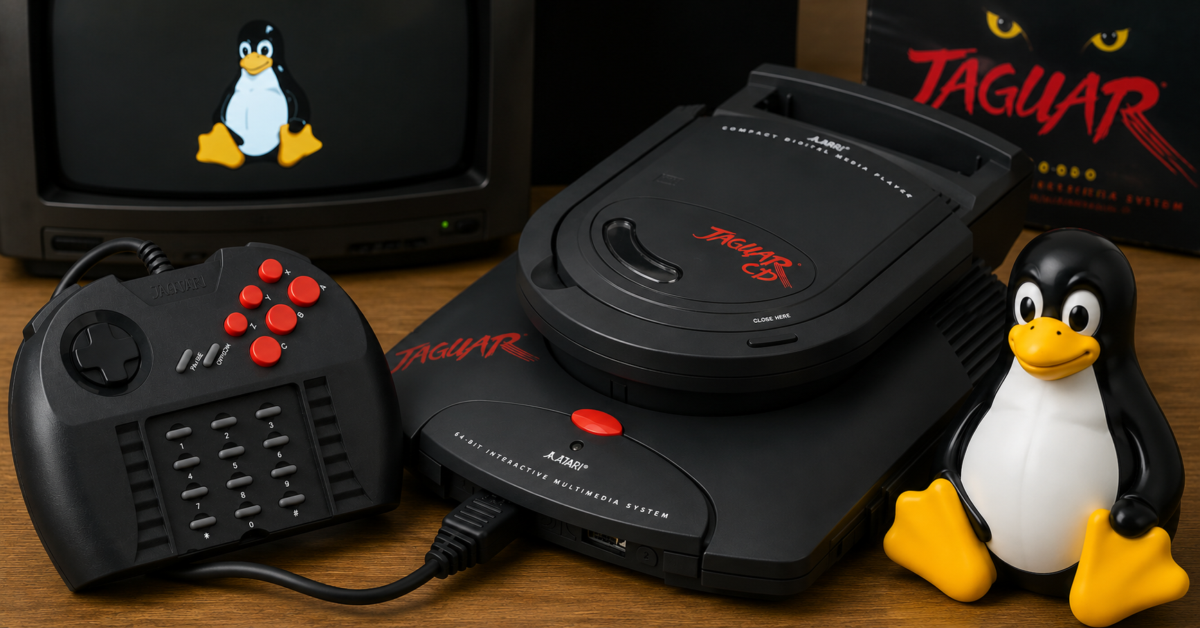
Most people remember the Atari Jaguar as a commercial flop. Released in 1993 with bold claims of being a 64-bit powerhouse, the console never came close to challenging the Sony PlayStation or Sega Saturn. More than 30 years later, however, it has unexpectedly become the latest machine to join Linux’s long list of supported hardware.
I have a soft spot for the Atari Jaguar because I actually own one (it’s in my basement somewhere). My dad picked it up on clearance from Nobody Beats the Wiz years ago, back when retailers were practically giving the console away after its commercial failure. It never became the gaming powerhouse Atari promised, but I never imagined that decades later I’d be writing about someone successfully booting Linux on the very same hardware sitting in my collection.
Thanks to developer cakehonolulu, Linux now boots on the Atari Jaguar. That sentence still sounds ridiculous, but it’s true.
This isn’t an emulator trick or a fake boot screen. It’s a genuine port of uClinux, the version of Linux designed for processors without a memory management unit. The Jaguar’s Motorola 68000 processor gives the project a starting point because Linux still includes support for the 68000 family, but that’s about where the easy part ends.
The Jaguar has just 2MB of RAM, no MMU, unusual memory mapping, custom Tom and Jerry chips, and hardware that was never intended to run a modern operating system. Getting Linux running required writing platform-specific code, creating new timer and console drivers, squeezing every possible byte out of memory, relocating interrupt vectors, building a custom toolchain, and even tracking down compiler bugs that generated instructions the original 68000 couldn’t execute.
Instead of calling it quits when things inevitably broke, cakehonolulu kept pushing forward. One particularly clever optimization stores Linux’s read-only sections directly in cartridge ROM while keeping writable data in RAM, allowing the kernel to fit within the Jaguar’s tiny memory budget. The developer also assembled a BusyBox-based userspace that eventually drops to a working shell.
The result is remarkable. Linux boots, initializes the hardware, launches BusyBox, and provides an interactive shell on a game console that most people stopped thinking about decades ago.
Just as impressive as the technical achievement is the documentation. Rather than dropping a video and saying “look what I did,” cakehonolulu published an extensive write-up explaining the entire process, including the mistakes, the debugging, and the solutions. It’s the kind of engineering blog post that teaches as much as it celebrates the finished project. Read it in full here.
Projects like this are one of the reasons I love the Linux community. Nobody needed Linux on the Atari Jaguar. There is no business case for it, and nobody is getting rich from making it happen. It exists because one developer wondered whether it could be done and had the talent and determination to see it through.
If you’re into Linux, retro computing, or simply appreciate brilliant engineering, cakehonolulu’s write-up is well worth reading. Even if you never plan to boot Linux on a Jaguar yourself, it’s hard not to admire the amount of skill and persistence that made this unlikely project a reality.
The project has no practical market, and that is part of its value. It documents unfamiliar hardware, preserves knowledge, and demonstrates how far a careful port can stretch a modern kernel.
Support independent tech journalism
NERDS.xyz is independently owned and operated. If you enjoy my coverage of Linux, AI, hardware, cybersecurity, and tech culture, consider supporting the site on Ko-fi.
Support NERDS.xyz