
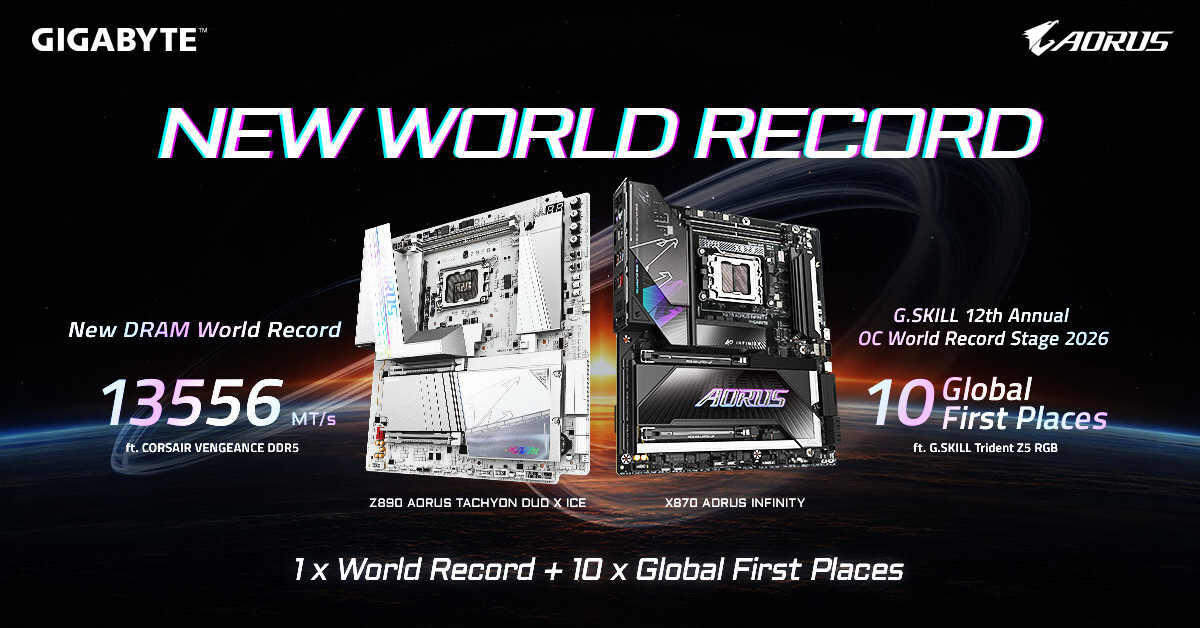
PC hardware companies love chasing ridiculous benchmark numbers, but every once in a while an overclocking stunt still manages to make me stop and stare. That happened this week at COMPUTEX 2026, where GIGABYTE and CORSAIR pushed DDR5 memory to an absurd 13,556 MT/s.
Yes, really.
The record was achieved using CORSAIR VENGEANCE DDR5 memory paired with the GIGABYTE Z890 AORUS TACHYON DUO X ICE motherboard. GIGABYTE’s overclocking team managed to pull it off during G.SKILL’s 12th Annual OC World Record Stage event in Taipei.
If you are a normal person, you are probably wondering whether this means your next gaming PC is suddenly going to become twice as fast. The answer is no. Extreme overclocking records like this are less about real-world gaming performance and more about pushing hardware beyond sane limits just to see what is possible.
Still, there is something undeniably fun about it.
Modern PC hardware launches can sometimes feel repetitive. Another GPU. Another motherboard. Another RGB-filled gaming laptop. But competitive overclocking still has a bit of that old-school enthusiast energy where engineers and hardware nerds gather around exotic cooling setups and try to break records simply because they can.
GIGABYTE did not stop at the DDR5 frequency record either. The company says its team also secured 10 global first-place overclocking finishes during the competition using AMD Ryzen 9 9950X3D processors and the new X870 AORUS INFINITY motherboard.
Of course, almost nobody buying a gaming PC in 2026 will ever run memory anywhere close to these speeds. Stability matters more than headline-grabbing numbers for everyday users. But that is not really the point of events like this. These showcases exist to prove engineering capability, generate buzz, and remind enthusiasts that PC hardware can still be exciting.
And you know what? Seeing DDR5 hit 13,556 MT/s is pretty exciting, even if it is completely impractical.
Support independent tech journalism
NERDS.xyz is independently owned and operated. If you enjoy my coverage of Linux, AI, hardware, cybersecurity, and tech culture, consider supporting the site on Ko-fi.
Support NERDS.xyz