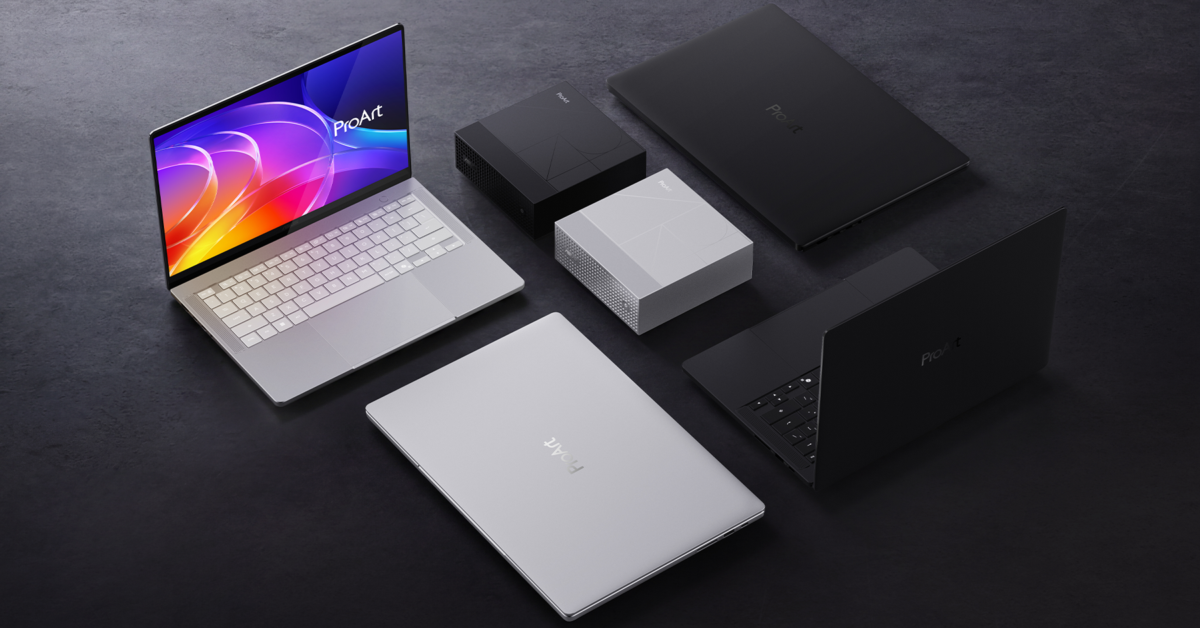
At Computex 2026, ASUS unveiled a new lineup of ProArt systems powered by NVIDIA’s RTX Spark platform, and the company clearly believes local AI is about to become the next big thing for creators and developers.
The new lineup includes the ProArt P16 laptop, ProArt P14 laptop, and an all new ProArt Mini PC. ASUS says these systems are designed for AI creators, developers, and creative professionals who want serious AI performance without relying entirely on cloud services.
ALSO READ: Microsoft unveils Surface Laptop Ultra with NVIDIA RTX Spark and local AI ambitions
That means running large local language models, generating AI video locally, rendering complex 3D scenes, editing massive video files, and accelerating creative workloads directly on the device itself.
One thing ASUS strangely avoids saying outright is that these are effectively Windows on ARM systems. The new ProArt lineup uses NVIDIA’s Grace CPU architecture, which is ARM based rather than traditional x86 processors from Intel or AMD. For folks following the Windows ecosystem, that makes this announcement pretty notable.
Windows on ARM laptops have existed for years, but they have usually focused on battery life and portability instead of raw creator performance. ASUS and NVIDIA are now trying to change that narrative by positioning ARM powered Windows machines as legitimate tools for professional AI workflows, gaming, rendering, and advanced content creation.
The centerpiece is NVIDIA RTX Spark, which ASUS describes as a superchip that combines an NVIDIA Blackwell RTX GPU with a 20 core NVIDIA Grace CPU using NVIDIA’s NVLink C2C interconnect technology. ASUS says the platform can deliver up to 1 petaflop of AI compute while supporting as much as 128GB of unified memory.
Unified memory could end up being one of the biggest advantages here. Instead of splitting workloads between separate pools of system memory and VRAM, the architecture allows AI models and creative applications to access a much larger shared memory pool more efficiently. That becomes increasingly important when dealing with massive AI models or huge video and 3D projects.
ASUS is making some huge claims too. According to the company, these systems can render 90GB plus 3D scenes, generate 4K AI video locally, edit 12K 4:2:2 video, and run 120 billion parameter language models with up to one million tokens of context.
If those numbers hold up in real world use, that would represent a pretty major jump for local AI computing on consumer creator systems.
The new ProArt P16 and P14 laptops are also thinner and lighter than previous generations. ASUS says the latest P16 is 13 percent thinner and 16 percent lighter than the previous model while still offering all day battery life.
Both laptops feature ASUS Lumina Pro OLED displays with Delta E < 1 color accuracy for professional creative work. The larger P16 supports up to a 4K 120Hz OLED panel with NVIDIA G SYNC, while the smaller P14 goes up to 3K resolution. ASUS also says the displays can reach brightness levels up to 1,600 nits.
AI software is naturally a huge part of the pitch. ASUS is bundling applications like MuseTree, StoryCube, and ProArt Creator Hub to help optimize creative workflows and accelerate local AI generation tasks.
The company is also leaning heavily into local AI instead of cloud dependent workflows. That could appeal to creative professionals who are uncomfortable uploading sensitive projects, client assets, or unfinished work to external AI services.
The ProArt Mini PC may actually end up being the most interesting product in the lineup. Despite its tiny 150 × 150 × 51 mm chassis, ASUS says the system can still deliver the same 1 petaflop AI target while supporting up to 128GB unified memory.
The small desktop system also includes 10GbE networking and PCIe Gen 5 storage expansion, which could make it attractive for studios, developers, edge AI deployments, or even folks building compact local AI labs at home.
Of course, a lot of unanswered questions remain. ASUS has not announced pricing yet, and sustained thermal performance will matter much more than flashy marketing slides. Running giant AI models locally sounds impressive, but real world battery life, fan noise, heat output, and software compatibility will ultimately determine whether these systems live up to the hype.
There is also the broader question of whether people actually want AI agents deeply embedded into their PCs in the first place. Tech companies keep insisting this is the future, but many folks remain skeptical about how useful these AI features will actually be outside of demos and marketing videos.
Still, ASUS is making one thing very clear here. Windows on ARM is no longer being pitched as just a thin and light laptop platform. Companies now want it to become the foundation for the next generation of AI powered creator PCs.
Pricing and availability have not yet been announced.
Support independent tech journalism
NERDS.xyz is independently owned and operated. If you enjoy my coverage of Linux, AI, hardware, cybersecurity, and tech culture, consider supporting the site on Ko-fi.
Support NERDS.xyz