
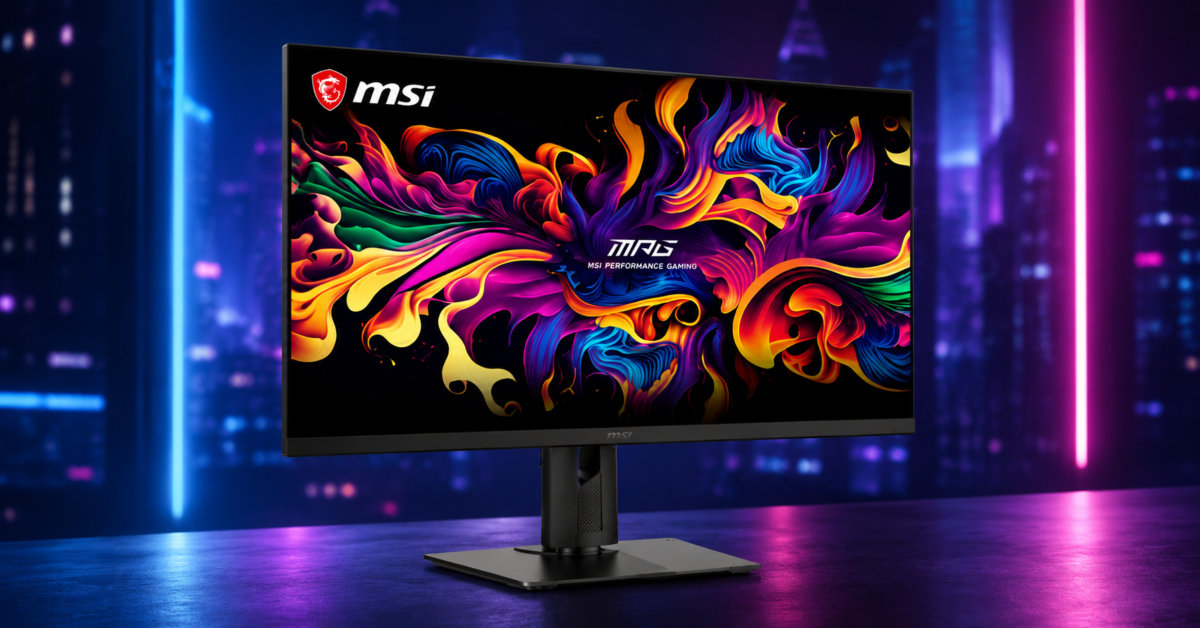
If you thought gaming monitors had already gone too far, MSI is here to prove otherwise. At COMPUTEX 2026, the company unveiled the MPG OLED 322URDX36, a 31.5-inch QD-OLED gaming monitor that sounds almost ridiculous on paper. We are talking about a 4K panel running at 360Hz, plus the ability to switch into lower resolutions with even higher refresh rates.
And yes, that means up to 680Hz.
The new display is being billed as the world’s first “Triple Mode” QD-OLED gaming monitor. MSI says gamers can swap between three display configurations depending on the game they are playing. There is 4K at 360Hz for folks wanting maximum image quality, 2K at 520Hz for competitive gaming, and Full HD at a frankly absurd 680Hz for esports players chasing every possible frame.
At some point, you have to wonder whether human beings can even meaningfully benefit from these refresh rates. Still, gamers love big numbers, and monitor makers clearly know it.
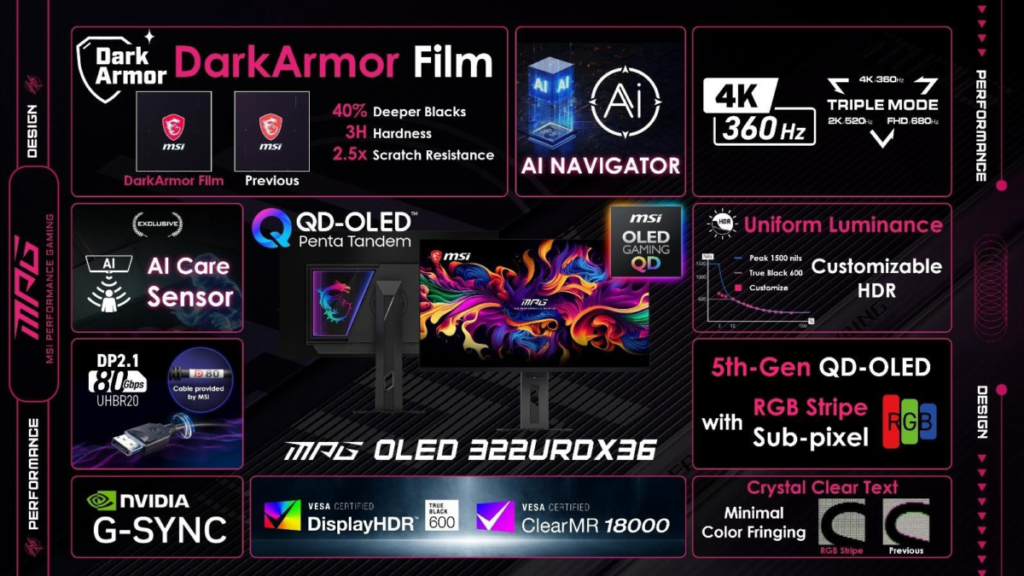
The monitor uses a fifth-generation QD-OLED panel with something called Penta Tandem technology. MSI says the RGB Stripe sub-pixel layout helps reduce color fringing while improving text clarity, which is important because OLED monitors have historically struggled a bit when it comes to desktop text rendering. If you spend your day gaming and working on the same display, that matters.
MSI is also touting a new DarkArmor Film coating that supposedly improves black levels by 40 percent while increasing scratch resistance by 2.5 times. OLED panels already deliver excellent contrast, so it will be interesting to see how noticeable that improvement actually is in real-world use.
HDR performance looks solid on paper too. The MPG OLED 322URDX36 can reportedly hit 1500 nits peak brightness and carries VESA DisplayHDR True Black 600 and ClearMR 18000 certifications. That should translate into a very sharp and vibrant gaming experience, especially in darker titles where OLED panels tend to shine.
One of the more practical additions is the AI Care Sensor. MSI says it uses human detection to help protect the OLED panel in real time without compromising user privacy. Burn-in anxiety still hangs over OLED gaming monitors, so companies continue experimenting with ways to reduce the risk without annoying users.
Connectivity looks modern as expected. The display includes full-bandwidth DisplayPort 2.1a with UHBR20 support, which is increasingly important for pushing these extreme refresh rates and resolutions. There is also USB-C with 98W power delivery, making it easier for laptop users to run a cleaner single-cable setup.
The monitor also works with MSI’s Gaming Intelligence software, allowing users to tweak display profiles and monitor settings through an app instead of fumbling through on-screen menus.
As someone who appreciates high-end displays but also remembers when 60Hz was considered perfectly fine, I cannot help but view products like this with a mix of fascination and skepticism. Still, there is no denying that OLED gaming monitors have become one of the most exciting categories in PC hardware. The image quality jump over traditional LCD panels is immediately noticeable, and companies like MSI keep finding ways to push the technology even further.
Whether anybody truly needs 680Hz is another question entirely.
Support independent tech journalism
NERDS.xyz is independently owned and operated. If you enjoy my coverage of Linux, AI, hardware, cybersecurity, and tech culture, consider supporting the site on Ko-fi.
Support NERDS.xyz