
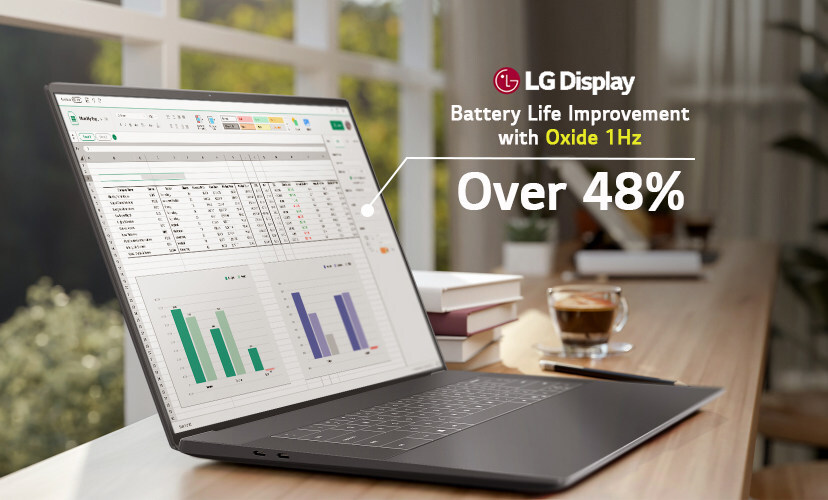
Laptop battery life is one of those things that never quite feels solved. No matter how much progress gets made, you still end up hunting for a charger sooner than you’d like. Now, LG Display is promising a pretty big improvement, announcing mass production of a laptop panel that can scale anywhere from 1Hz to 120Hz.
The idea is simple enough. When you’re doing something static like reading email or staring at a document, the screen drops all the way down to 1Hz to save power. Start watching video or playing a game, and it ramps back up to 120Hz for smoother motion. In theory, that kind of flexibility should cut down on wasted energy.
LG Display is putting a bold number behind it too, claiming up to 48 percent better battery life compared to current solutions. That’s the part that’s going to get attention, and honestly, it should. If laptops suddenly lasted noticeably longer on a charge, people would care.
But this is also where things get a little fuzzy. We’ve heard big battery claims before, and they don’t always hold up once you get out of controlled testing. Real-world usage is messy. You’ve got a dozen browser tabs open, apps running in the background, and who knows what else quietly eating power.
To be fair, this isn’t just marketing fluff. The company is using oxide-based TFT tech along with its own circuit design tweaks to make the low refresh rate actually practical on an LCD panel. That’s not nothing. And while variable refresh rate itself isn’t new, getting all the way down to 1Hz on a laptop display is still pretty unusual.
There’s also a real product tie-in here. Dell is expected to use this panel in its Dell XPS laptops, which at least tells us this isn’t some distant concept. It’s heading into machines people will actually buy.
Looking ahead, LG Display says it plans to bring similar tech to OLED panels starting in 2027. That could be the more interesting play long term, especially since OLED already has its own power-saving advantages depending on what’s on screen.
For now, this feels like one of those “could be great, could be nothing” situations. The promise is there, and the idea makes sense. But until people get their hands on these laptops and see how they behave day to day, it’s hard to know if this is a real improvement or just another spec to pad a product page.
Either way, if battery life actually moves the needle here, you won’t need a press release to tell you. People will notice pretty quickly.
Support independent tech journalism
NERDS.xyz is independently owned and operated. If you enjoy my coverage of Linux, AI, hardware, cybersecurity, and tech culture, consider supporting the site on Ko-fi.
Support NERDS.xyz