
A hospital should be one of the last places where anyone has to worry about encountering a weapon. Unfortunately, MLK Community Healthcare in South Los Angeles has decided that screening visitors for concealed guns and other threats is now a necessary part of operating a medical facility.
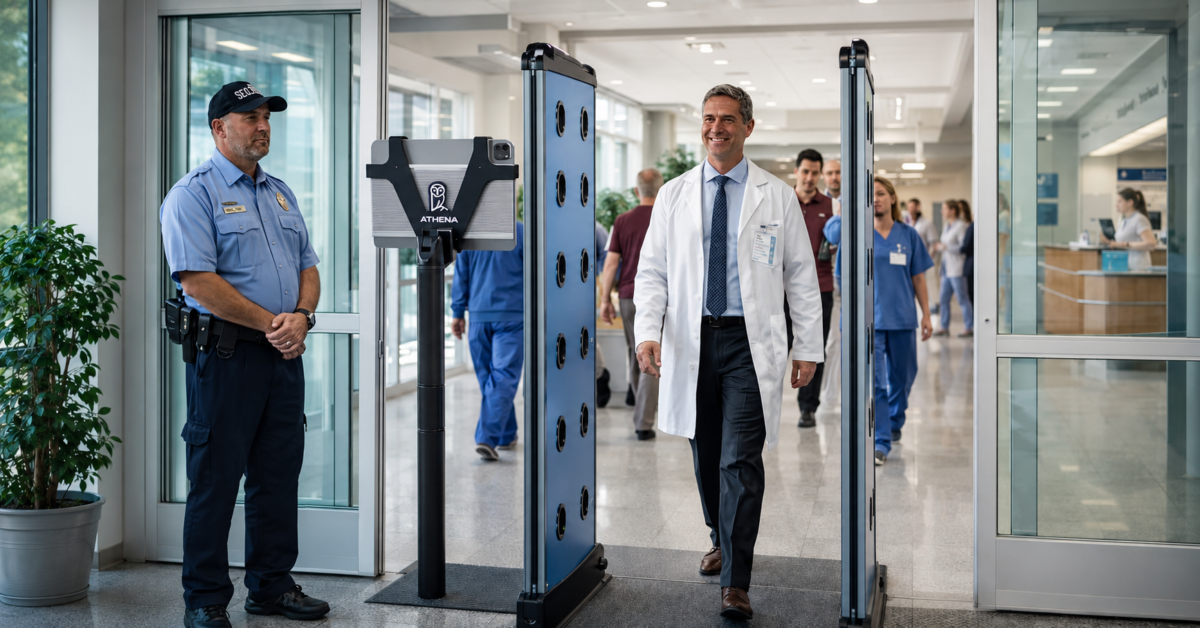
The nonprofit healthcare system has installed the Apollo 500 Weapons Detection System from Athena Security at its hospital. The AI-powered walk-through system is designed to screen people entering busy facilities without creating the same delays associated with traditional metal detectors.
Athena says the system can identify concealed weapons while allowing patients, employees, and visitors to continue walking through an entrance. When the platform identifies a possible threat, security personnel can conduct additional screening.
“Everyone deserves to feel safe going to work every day. Likewise, patients and their loved ones should feel at ease when seeking care at their local healthcare facility,” said Lisa Falzone, co-founder and president of Athena Security. “By leveraging our expertise in the security space and utilizing emerging technology like AI, we’ve created a weapons detection system platform that is potentially saving lives while creating less disruption in the day-to-day activities at healthcare facilities.”
That “potentially saving lives” claim should be treated as marketing rather than an independently established fact. Weapons detection systems may provide another layer of security, but their effectiveness depends on accuracy, staffing, training, response procedures, and whether every practical entrance is actually monitored.
MLK Community Healthcare says it evaluated multiple systems before selecting Athena’s technology.
“When it came time to comply with California’s AB 2975 workplace violence prevention requirements and implement a weapons detection solution, we conducted an extensive evaluation of the available systems,” said Trenton Jackson, director of public safety and support services at MLK Community Healthcare.
“Athena’s Apollo 500 Healthcare Weapons Detection System stood out as the best overall value, combining effective weapons detection with the operational capabilities and healthcare-focused workflows our hospital needed,” Jackson continued. “Throughout the installation and testing process, Athena has been a responsive collaborator. They’ve worked with us every step of the way to ensure that the weapons detection platform technology works as it should and integrates smoothly into our hospital operations.”
California Assembly Bill 2975 directs the state’s Occupational Safety and Health Standards Board to amend hospital workplace violence rules by March 1, 2027. Those standards must include automated weapons screening at specified hospital entrances, trained personnel to operate the equipment, procedures for people who refuse screening, and protocols for responding when a weapon is discovered.
Hospitals will also need to ensure that screening does not prevent patients from receiving medical care. That creates a difficult balance, particularly around emergency departments, where staff may have only seconds to respond to a medical crisis.
Athena says an unnamed Illinois healthcare system detected more than 200 weapons at its hospitals during 2025 using the company’s technology. Because that figure comes from Athena’s own case study, readers should not assume it has been independently verified. The company also does not explain in the announcement what types of objects were included in the total or how many alerts turned out to be false positives.
There is something particularly sad about seeing this technology installed at a hospital carrying the name of Dr. Martin Luther King Jr., one of the country’s most prominent advocates of nonviolence. A place bearing his name, devoted to healing residents of South Los Angeles, must now prepare for the possibility that someone will arrive carrying a weapon.
The hospital is not wrong for taking precautions. Employees, patients, and families deserve protection, and healthcare workers should not be expected to accept violence as another part of the job. California already requires hospitals to document violent incidents under its workplace violence prevention rules for healthcare facilities.
Still, the need for an AI-powered weapons checkpoint at the entrance to a community hospital should not be celebrated as a technological achievement. It is an upsetting response to a much larger social failure.
Athena gets to sell another security system, and MLK Community Healthcare may become safer because of it. The depressing part is that a hospital named for a man who preached nonviolence now apparently needs machines watching for guns at the door.
Support independent tech journalism
NERDS.xyz is independently owned and operated. If you enjoy my coverage of Linux, AI, hardware, cybersecurity, and tech culture, consider supporting the site on Ko-fi.
Support NERDS.xyz