
For years, Norton was mostly associated with antivirus software, VPNs, and identity protection. Now, the company wants to insert itself into another deeply personal part of people’s lives: parenting.
Today, Norton launches Norton Family Assistant, a new AI-powered agent designed to help families manage what the company describes as the “chaos of modern parenting.” The tool connects to services like Gmail, calendars, school platforms, messaging apps, and extracurricular tools to organize schedules, reminders, and family logistics into one centralized AI experience.
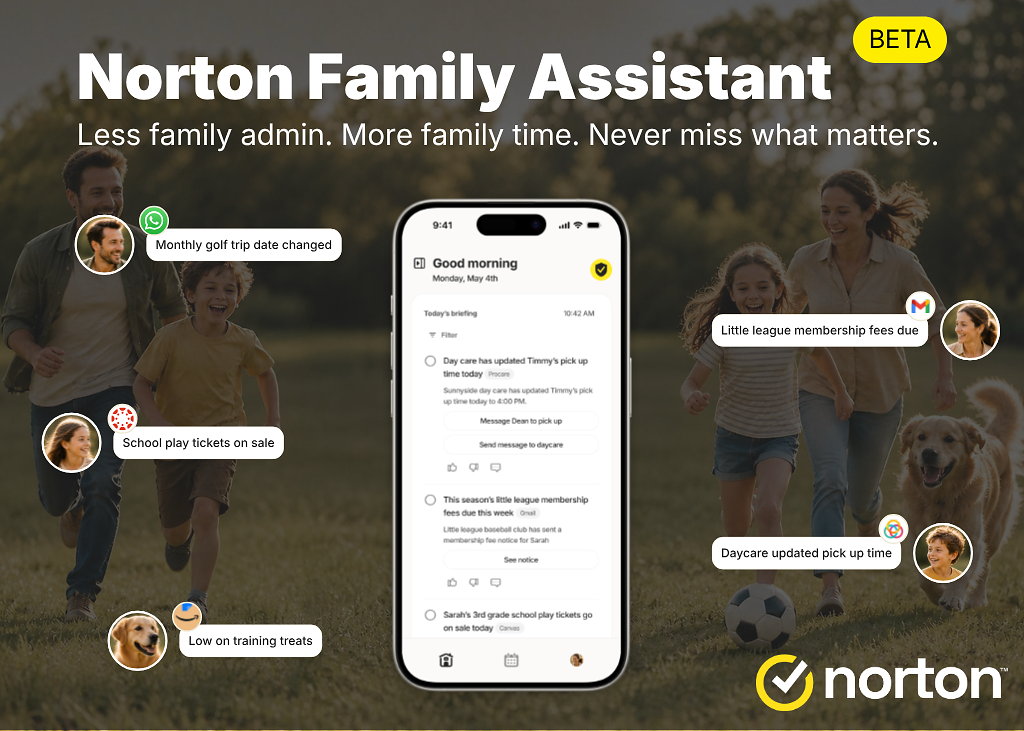
On paper, the idea sounds useful enough. Many parents are drowning in school emails, appointment reminders, sports schedules, parent group chats, and random notifications spread across dozens of apps. Trying to keep track of everything can feel like a second full-time job.
But Norton’s vision also raises some uncomfortable questions.
The company is not just pitching a passive assistant that summarizes information. Norton says the AI can actually take actions on behalf of parents. According to the announcement, the system could help coordinate pickups, complete permission forms, organize meal planning, and manage scheduling conflicts.
That is where things start getting a little unsettling.
To work properly, an AI agent like this would need deep access to highly sensitive information. We are talking about family calendars, private emails, school communications, children’s activities, personal schedules, and potentially even location-related logistics. Centralizing all of that inside an AI platform creates a massive amount of trust pressure.
Norton clearly understands people may be nervous about this. The company spent a large portion of the announcement talking about privacy, security, and something it calls the “Gen Agent Trust Hub,” a platform supposedly designed to keep AI agents safe, private, and accountable.
The company says family information remains separated between users and is not used to train AI models. That is reassuring if true, but consumers are increasingly skeptical of broad AI trust claims. Tech companies love creating impressive-sounding branding around AI safety, but branding alone does not eliminate risk.
There is also the practical side of all this.
Parents already deal with endless apps, subscriptions, portals, and fragmented services. It is fair to ask whether adding yet another AI layer into the mix actually simplifies life or just introduces new complications. If the AI misunderstands an email, misses an important event, or incorrectly schedules something, families could quickly lose confidence in it.
And unlike asking an AI chatbot a casual question, mistakes involving children, school schedules, transportation, or medical appointments can have real-world consequences.
The timing of the announcement is not surprising, though. The tech industry is rapidly shifting from simple AI chatbots toward “agentic AI,” meaning systems that can actively perform tasks instead of merely answering questions. Nearly every major tech company now seems eager to build AI agents capable of accessing inboxes, calendars, files, and apps.
Norton is trying to position itself as a trustworthy middleman in that future.
Whether families are ready for AI to manage large portions of their daily lives is another story entirely.
To Norton’s credit, the company is at least targeting a real problem. Modern parenting really has become digitally exhausting. But asking overwhelmed parents to hand over even more personal information to an autonomous AI system may not be the comforting solution the company thinks it is.
Support independent tech journalism
NERDS.xyz is independently owned and operated. If you enjoy my coverage of Linux, AI, hardware, cybersecurity, and tech culture, consider supporting the site on Ko-fi.
Support NERDS.xyz