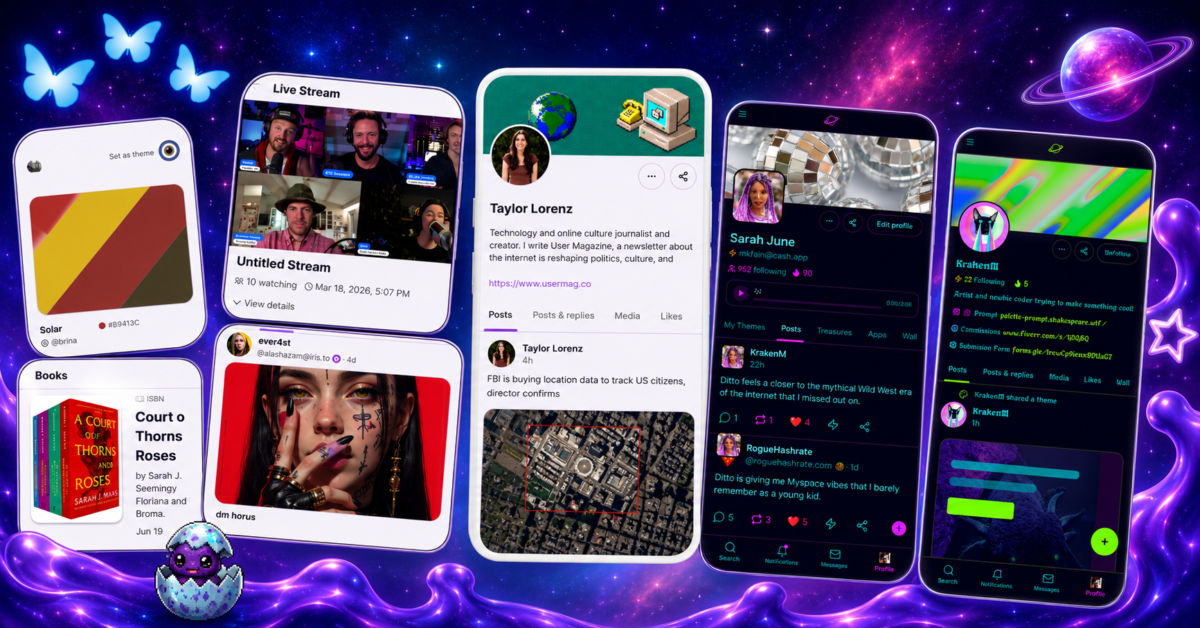
Another social platform is launching, but this one is aiming squarely at people who miss when the internet felt personal instead of algorithmically optimized. Soapbox has officially launched Ditto, an open source decentralized social platform that blends elements of Nostr, Bluesky, and Mastodon into a single customizable experience.
The pitch is pretty simple: social media has become sterile. Feeds are controlled by opaque algorithms, profiles all look nearly identical, and users never truly own their identities or content. Ditto wants to push in the opposite direction by reviving some of the chaotic creativity that defined the earlier web.
And apparently, some folks are already comparing it to MySpace.
Unlike modern social platforms that lock users into rigid layouts and branding, Ditto heavily emphasizes personalization. Users can customize themes, colors, fonts, layouts, and backgrounds, while also sharing designs with the broader community. The company clearly wants users to treat profiles as personal spaces again instead of interchangeable templates.
Under the hood, Ditto runs on Nostr, the decentralized social protocol built around cryptographic identity ownership. Rather than accounts being tied to a company controlled database, users control their identities using cryptographic keys. In theory, that means a platform cannot simply revoke access to your online identity on a whim.
Of course, whether average people actually care about cryptographic ownership is another question entirely.
Still, Ditto is trying to make decentralization feel less intimidating and more playful. The platform includes quirky features like encrypted “letters” with custom stationery and animated envelopes, plus virtual pets called Blobbis that evolve alongside users over time. It sounds a little strange, but frankly, strange may be exactly what the modern internet has been missing.
One of Ditto’s more interesting ideas is its attempt to unify fragmented decentralized communities. Users can follow and interact with people across Bluesky and Mastodon from within the app itself, theoretically reducing some of the friction that has made decentralized social media confusing for newcomers.
That said, aggregation alone may not solve the bigger problem. Most mainstream users still gravitate toward centralized platforms simply because that’s where their friends, celebrities, and communities already exist. Decentralized platforms continue to struggle with discoverability, onboarding, moderation consistency, and critical mass.
Soapbox also says Ditto operates without ads, investors, or data sales. The company says funding comes from grants and donations from organizations including OpenSats, the Human Rights Foundation, and And Other Stuff. While that privacy focused approach will likely appeal to some users, sustaining a social platform long term without traditional monetization remains a difficult balancing act.
Another detail that may attract attention is Soapbox founder Alex Gleason previously serving as Head of Engineering at Truth Social. Personally, that does not bother me, and I do not think every technology discussion needs to spiral into politics. At the end of the day, people should evaluate software based on the product itself, not automatically dismiss it because of where someone previously worked.
And frankly, I am excited for Ditto (follow me here). The modern web increasingly feels optimized for engagement metrics instead of personality. Everything is flattened, algorithmically curated, and sanitized. A platform that embraces weirdness, customization, experimentation, and user ownership again sounds refreshing, even if it ultimately ends up remaining a niche product.
Whether Ditto becomes a serious player or simply another niche social experiment remains to be seen. But at a time when many users seem exhausted by algorithmic feeds, engagement bait, AI slop, and increasingly homogenized online spaces, the idea of making the internet feel weird and personal again may resonate more than some people expect.
Ditto is available now on iPhone, Android, and the web.
Support independent tech journalism
NERDS.xyz is independently owned and operated. If you enjoy my coverage of Linux, AI, hardware, cybersecurity, and tech culture, consider supporting the site on Ko-fi.
Support NERDS.xyz
1 thought on “Ditto wants to bring back the weird customizable internet people actually loved”
Comments are closed.