
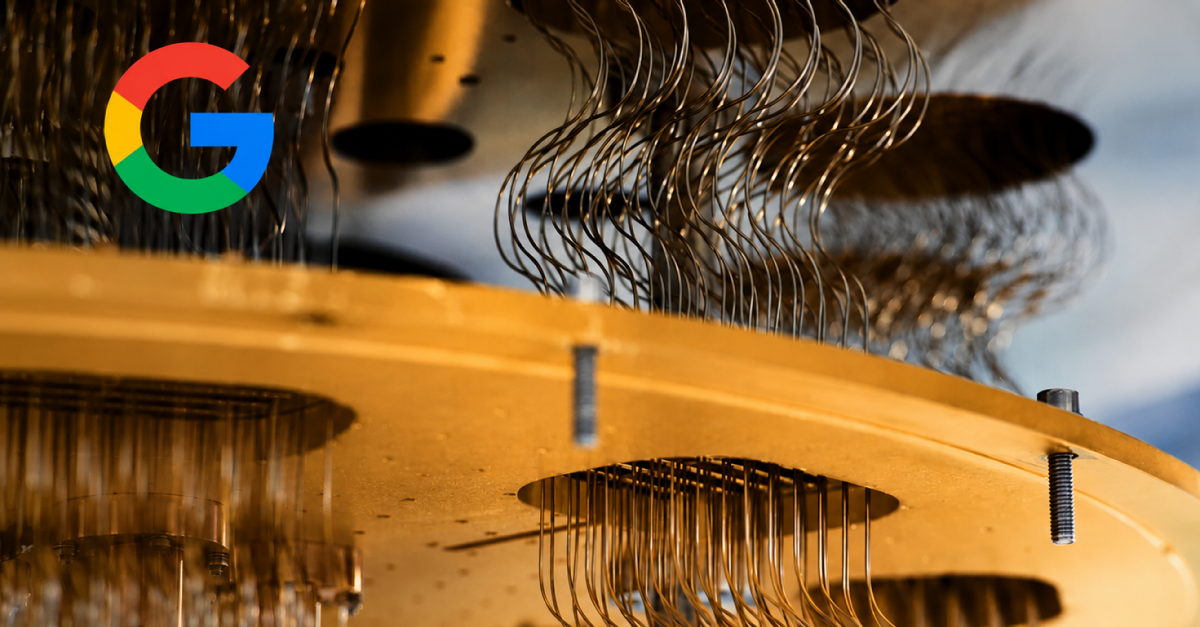
Google is throwing more money at the future of quantum computing, but this time the search giant says it wants to use the technology to better understand biology and improve human health. Today, the company announced a new initiative called REPLIQA, short for Research Program at the Intersection of the Life Sciences and Quantum AI.
The project combines quantum science, artificial intelligence, and biology, which sounds like the sort of thing that could either change medicine forever or become another expensive science experiment that takes decades to pay off. Google says it is committing $10 million through Google.org to fund research at five universities: Harvard University, the Massachusetts Institute of Technology, the University of California San Diego, the University of California, Santa Barbara, and the University of Arizona.
To be honest, folks, I’m a bit surprised by the relatively small amount of money involved. Google is talking about quantum computing, AI, biology, and potentially reshaping medical research, yet the company is only committing $10 million across five universities. For a tech giant that spends billions on AI infrastructure and data centers, that figure feels surprisingly… modest.
Split evenly, that works out to about $2 million per institution, which in the world of advanced scientific research can disappear pretty quickly. It almost feels less like Google making a huge bet on quantum biology and more like the company cautiously dipping its toe into the water to see where the science goes.
Now, according to Google, classical computers still struggle to accurately simulate many biological interactions at the atomic level. That includes things like protein folding, cellular reactions, and how drugs interact with enzymes inside the body. Quantum computers, however, operate using the same quantum mechanics that govern molecular behavior, which theoretically makes them far better suited for those tasks.
The company pointed to research involving quantum sensors and even studies suggesting quantum spin may influence cellular activity. Google also highlighted the possibility of using quantum systems to model enzymes such as P450, which plays a major role in drug development and metabolism.
Of course, folks should probably temper expectations. Google itself admits this is foundational research and not something that will suddenly lead to miracle cures next year. In other words, don’t expect your doctor to prescribe “quantum AI treatment” anytime soon.
Still, it is interesting to see Google positioning quantum computing as something beyond faster math problems or futuristic cybersecurity tools. The company clearly wants people thinking about medicine, biology, and disease research too. Whether that vision actually becomes reality is another story entirely. Quantum computing has been “just around the corner” for years now, and while progress continues, practical real-world use cases remain limited.
Then again, if AI can already help researchers discover patterns humans might miss, combining it with quantum systems could eventually lead to breakthroughs traditional computing simply cannot achieve. Even skeptics would probably agree the potential is intriguing.
Support independent tech journalism
NERDS.xyz is independently owned and operated. If you enjoy my coverage of Linux, AI, hardware, cybersecurity, and tech culture, consider supporting the site on Ko-fi.
Support NERDS.xyz