
Quantum computing announcements can require almost as much patience as the technology itself. There is usually a bigger processor coming, another milestone on the roadmap, and a promise that useful applications are getting closer.
IBM has another update, but this one offers more than a larger number to put in a headline. The company has announced Nighthawk r3, a planned quantum processor designed to support 10,000 quantum operations across 520 programmable qubits. In 2027, IBM intends to connect two of those processors into a single 1,040-qubit system.
That is the plan, anyway. The r3 capabilities are targets, while the performance results IBM is sharing today come from its existing Nighthawk r2 hardware. Keeping those two things separate matters when evaluating what the company has actually accomplished.
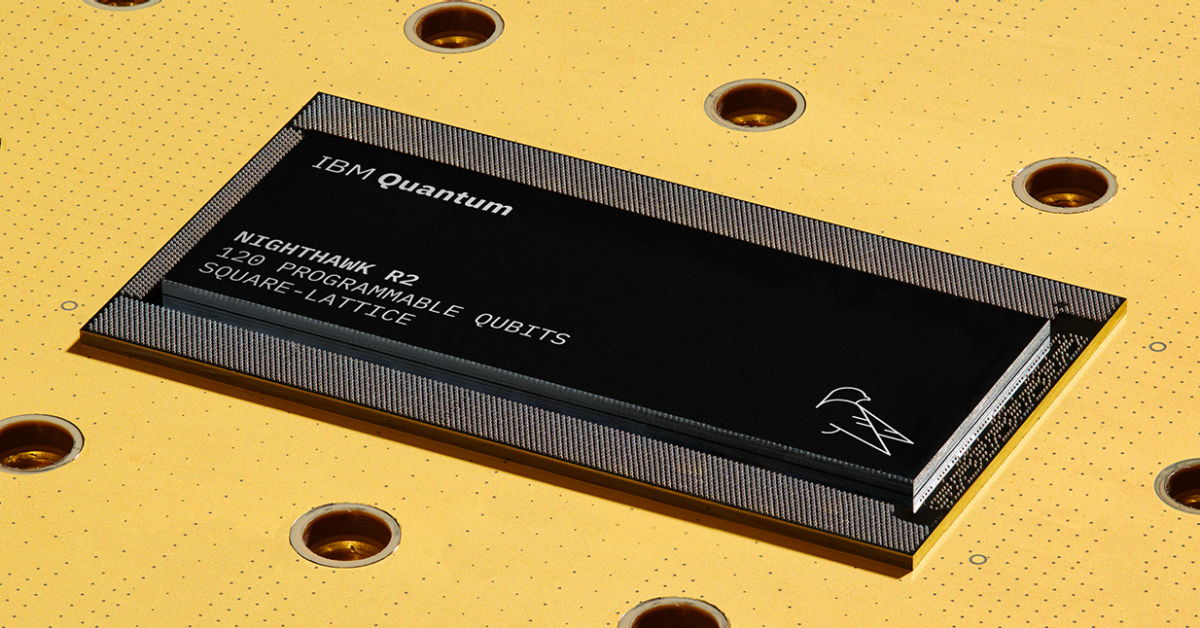
The current Nighthawk r2, introduced in September, supports computations involving more than 7,500 quantum operations on 120 qubits, according to IBM. It can deliver up to 100,000 samples per second, with fast qubit resets reducing the wait between circuit executions.
Why should anyone care about how quickly a quantum computer resets? A quantum application can require millions or billions of samples, so the time between runs adds up. Getting through those repeated executions faster can make an experiment more practical, provided the results remain accurate enough to be useful.
IBM says clients and partners including E.ON, Algorithmiq, and Q-CTRL have executed more than 34 billion circuits on Nighthawk r2. Reported performance improvements reach up to 19 times those of previous IBM quantum processors, although that figure needs some context.
This is not a claim that Nighthawk runs 19 times faster than a conventional computer. It describes improvements over earlier IBM quantum hardware on particular workloads, which is useful information but answers a different question.
For example, E.ON reported a 15x speedup for quantum machine learning work involving energy grid optimization. IBM also reported a 12x speedup when repeating an experiment with Oak Ridge National Laboratory that simulated magnetic materials. Both comparisons were against earlier work using IBM Quantum Heron.
Algorithmiq’s quantum material simulation provides another example. IBM says circuits extending the earlier experiment ran eight times faster on Nighthawk r2, while the new circuits would require an estimated 240 times more memory to simulate at comparable accuracy using leading classical tensor-network methods.
That memory estimate is interesting, but it should not be confused with a measured 240x speed advantage. These comparisons involve specific experiments and methods, and the details matter far more than whichever multiplier looks best in marketing material.
With Nighthawk r3, IBM wants to carry the architecture into larger systems. The processor is designed with 520 programmable qubits and 2,034 total physical qubits, figures that should not be treated as interchangeable. It will also feature 10 chip-to-chip connections called l-couplers.
Those connections are central to the proposed 1,040-qubit system. IBM plans to link two r3 processors, making communication between chips an essential part of the machine’s operation.
There has already been some work toward that goal. IBM says it connected Nighthawk r1 processors using four l-couplers and achieved 99.3 percent quantum state transfer fidelity, with a target of 99.9 percent. It also connected two cryogenic modules into one system, reaching operating temperature in under five days and cooling below 15 millikelvin.
The announcement also addresses the conventional computing resources needed around quantum hardware. IBM Quantum Platform now brings quantum and high-performance classical computing into a managed environment, supporting workflows that depend on both.
IBM says an updated workflow with RIKEN ran roughly five times faster while performing 100 times more computations than the original study. Separately, Cleveland Clinic and RIKEN used the platform to automatically process 608 million samples for modeling biologically relevant structures, reporting processing that was 33 times faster than without workflow automation.
For NERDS.xyz readers, the most interesting part is how much of this announcement concerns making quantum computing practical. Faster resets, better connections between processors, and automated classical processing may sound less exciting than a giant qubit count, but they address the work required to get usable results.
IBM still has to deliver the planned r3 hardware and connected system, and this announcement does not establish that fault-tolerant quantum computing has arrived. The 2027 target gives us something concrete to watch, though, and the existing r2 results give IBM more to point to than a roadmap alone.
Support independent tech journalism
NERDS.xyz is independently owned and operated. If you enjoy my coverage of Linux, AI, hardware, cybersecurity, and tech culture, consider supporting the site on Ko-fi.
Support NERDS.xyz