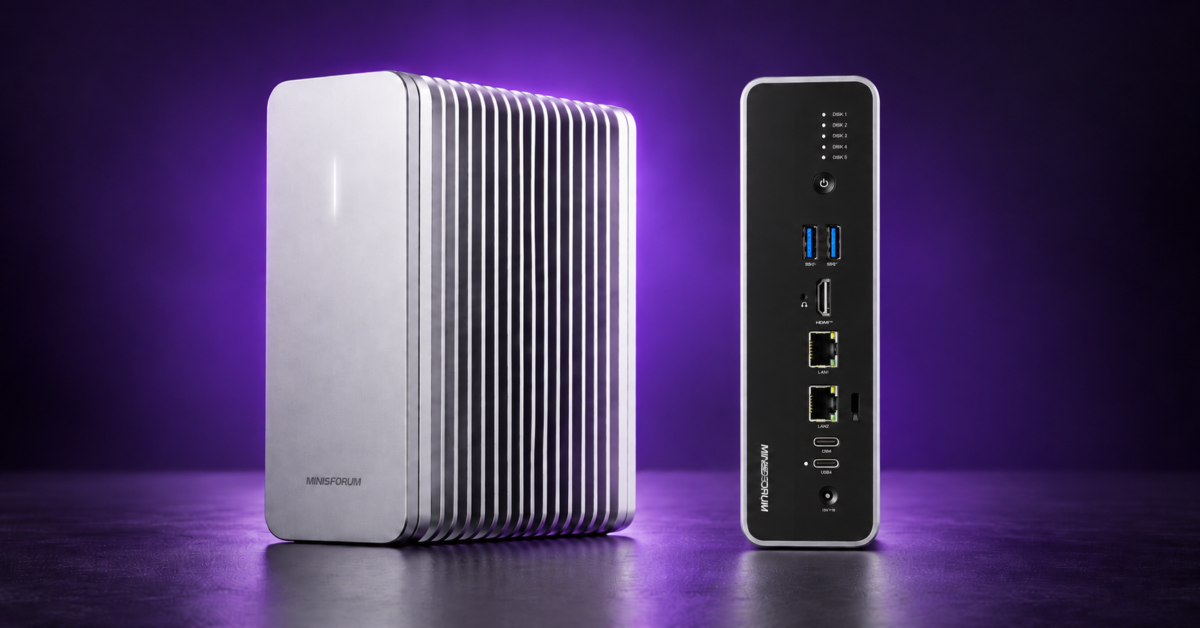
A NAS that sits beside your desk or television should be easy to ignore until you need a file. MINISFORUM is leaning into that idea with the S5, a compact network storage system that combines five NVMe SSD slots with passive cooling, eliminating system fans and mechanical hard drives.
The company today announced availability starting at $599 without data SSDs. That includes 12GB of LPDDR5x memory and a separate 128GB UFS 3.1 flash storage device for the preinstalled MinisCloud OS. The system storage sits outside the five M.2 slots, so a fully populated S5 has six storage devices: five NVMe SSDs for data, plus the UFS device for the OS.
Each slot accepts an M.2 2280 NVMe SSD with a capacity of up to 8TB, bringing maximum raw capacity to 40TB. Usable space will depend on your configuration, particularly if you reserve capacity to protect against drive failure.
There is a limitation behind those slots, however. Each uses a PCIe 4.0 x1 connection, so a fast x4 SSD will not deliver its full advertised throughput. Buyers should keep that in mind when deciding how much to spend on drives.
Networking includes one 10GbE port and one 2.5GbE port, alongside Wi-Fi 7 and Bluetooth 6. The faster Ethernet connection should appeal to people moving video projects, large photo collections, and other bulky files, provided their computers and network equipment can keep up.
MINISFORUM also includes two USB4 ports rated for up to 40Gbps, two external USB 3.2 Gen 2 Type-A ports, and HDMI 2.1 output supporting 4K at 60Hz. One USB4 port accepts USB Power Delivery input as an alternative to the dedicated DC connector.
Inside is an Intel Core 3 304 processor with five cores, five threads, and a maximum turbo frequency of 4.3GHz. Memory runs at up to 7467 MT/s, although the listed maximum capacity is 12GB, a ceiling worth considering if you plan to run several applications or services.
Although MINISFORUM designed the S5 as a NAS, its PC hardware and listed support for Windows 11 Pro and Linux suggest it should also be able to serve as a full desktop computer. With a suitable desktop operating system, monitor, keyboard, and mouse, everyday tasks such as web browsing and office work look like reasonable uses.
The UFS system storage deserves attention if you go that route. It could offer slower desktop storage performance than a good NVMe SSD, depending on the implementation and workload. That does not establish that the S5 will feel sluggish, but desktop responsiveness needs testing before treating it as a replacement for a conventional mini PC.
Installing a desktop OS on an NVMe drive might be preferable, although the supplied specifications do not confirm the supported installation targets or boot arrangements. Windows and Linux appear on the compatibility list; MinisCloud OS is what comes preinstalled.
That NAS-focused software advertises ZFS snapshots, LZ4 compression, Docker applications, multi-user isolation, and backup tools. The new MinisPhotos application is due shortly after launch, with advertised features including semantic search and automatic face and location grouping.
MINISFORUM also pitches the S5 as an Agent NAS. Its described architecture uses cloud models for complex reasoning and a local agent for background execution, while a dedicated NPU provides a claimed 15 TOPS of INT8 performance. Buyers interested in those features should establish what information reaches the cloud and which services their workflows require.
Cooling uses a heat pipe and fins. MINISFORUM says testing at an ambient temperature of 25 degrees Celsius showed approximately 15W of sustained CPU power under combined stress. That is a processor power figure, rather than a measurement of electricity consumption for the complete NAS with five SSDs.
The $599 configuration ships immediately, according to the company. A version with 20TB of SSD storage costs $3,759 and has an estimated shipping window of early November. Both reflect launch discounts from listed regular prices of $749 and $4,699, respectively.
For me, the appeal is fitting shared flash storage and fast networking into a fanless chassis measuring 176.5 × 154 × 60mm. The potential desktop role adds flexibility, but sustained temperatures, software reliability, and real storage performance will determine how useful this little box actually is.
Support independent tech journalism
NERDS.xyz is independently owned and operated. If you enjoy my coverage of Linux, AI, hardware, cybersecurity, and tech culture, consider supporting the site on Ko-fi.
Support NERDS.xyz