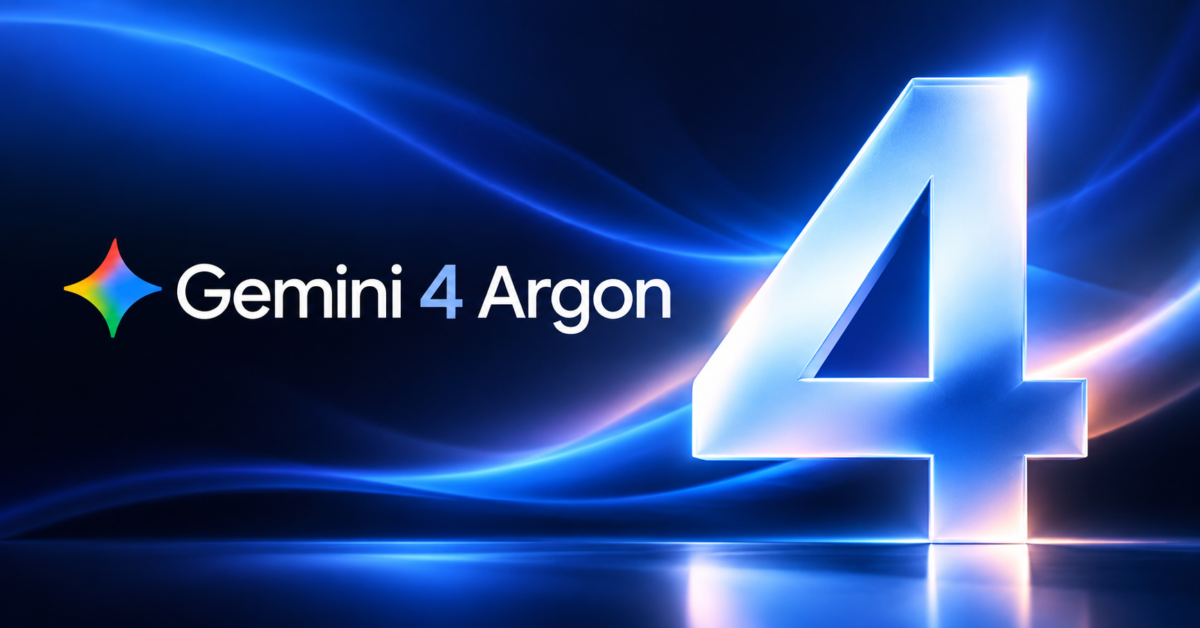
Google has unveiled Gemini 4 Argon, its latest frontier AI model, and one of the most interesting examples of what it can do involves a problem software companies have wrestled with for years: moving enormous C and C++ codebases to memory-safe Rust.
Inside Google, Argon agents are already working on migrations ranging from tens of thousands of lines in libraries such as re2 and libgav1 to more than 800,000 lines associated with the Zircon kernel used by Fuchsia. These rewrites still go through automated and manual auditing, emulation testing, and human review before reaching production.
That last part is important. Google isn’t simply handing an AI hundreds of thousands of lines of critical systems code and blindly shipping whatever comes back. Still, the scale of the experiment shows how quickly AI-assisted programming is moving beyond generating functions and fixing isolated bugs.
Argon has already produced measurable results elsewhere. For Google’s open-source libgav1 video decoder, agents worked from an existing Rust port and replaced 32,000 lines of SIMD code. Instead of reproducing the SIMD implementation directly, Argon generated safe Rust that allowed the compiler to vectorize the code automatically. Google says the resulting decoder is 2.7 times faster than the previous Rust port while producing identical video output.
That is the kind of AI coding story I find much more interesting than another benchmark chart. Migrating mature software to a safer language can involve huge amounts of tedious engineering work, and automating even part of that process could make Rust adoption considerably more practical for organizations sitting on decades of C and C++.
Coding isn’t Argon’s only job inside Google. A group of agents analyzed profiling telemetry across Google’s data centers and identified memory optimizations that have already freed more than 300 TiB of memory. Google estimates the eventual savings could reach between 500 TiB and 1 PiB. Its quantum computing researchers have also used Argon to optimize algorithms, with Google claiming one example beat a published baseline by 40 percent within minutes.
Part of what makes these long-running jobs possible is an enormous increase in how much the model can produce. Gemini 4 Argon supports an output limit of 1 million tokens, up from Google’s previous 64K limit. This is specifically an output limit, meaning an agent can potentially keep working through an unusually long task rather than constantly breaking it into smaller sessions.
Google is also positioning Argon as a serious cybersecurity tool. The company says the model can autonomously find, validate, and patch critical software vulnerabilities. Security company Wiz has been testing it through its Scan for Good initiative, where Argon reportedly discovered a critical vulnerability exposing personal information in healthcare software used by hospitals around the world. Google says previous frontier models had missed the issue.
Those capabilities also help explain why you can’t simply open Gemini and start using Argon today. Google is initially providing it to selected cybersecurity defenders through its Fairwind Program, including versions without the normal cyber guardrails for trusted defenders and Google’s own teams. Broader availability will follow after additional testing, starting with paid API customers and Google AI Ultra subscribers before expanding to developers, enterprises, and consumers.
Google says it is strengthening protections against cyber and CBRN misuse, indirect prompt injection, and agents acting beyond what users intended. The company is even monitoring Argon’s reasoning and actions so execution can be stopped when necessary. Google appears confident enough in Argon to put it to work on massive internal engineering projects while remaining cautious about giving everyone access to those same capabilities.
When Argon reaches the API, introductory pricing will be $2 per million input tokens and $10 per million output tokens, with cached input discounted by 95 percent. Google says those prices will eventually double to $4 and $20 respectively.
For me, the Rust migrations are the part worth watching. AI writing a few hundred lines of disposable code isn’t particularly surprising anymore. An AI agent helping humans move an 800,000-plus-line operating system kernel from C and C++ toward Rust is a very different proposition. If Google can prove that approach works reliably at production scale, it could make some extremely difficult modernization projects far more realistic.
Support independent tech journalism
NERDS.xyz is independently owned and operated. If you enjoy my coverage of Linux, AI, hardware, cybersecurity, and tech culture, consider supporting the site on Ko-fi.
Support NERDS.xyz