Artificial intelligence is already writing code, answering emails, and generating images. Now AI agents are being trusted with something considerably more dangerous: real money.
ASUS and Poesis have completed a week-long experiment in which autonomous AI agents traded in live financial markets using actual capital. The agents conducted investment research, managed risk, and executed trades while operating within predefined rules.
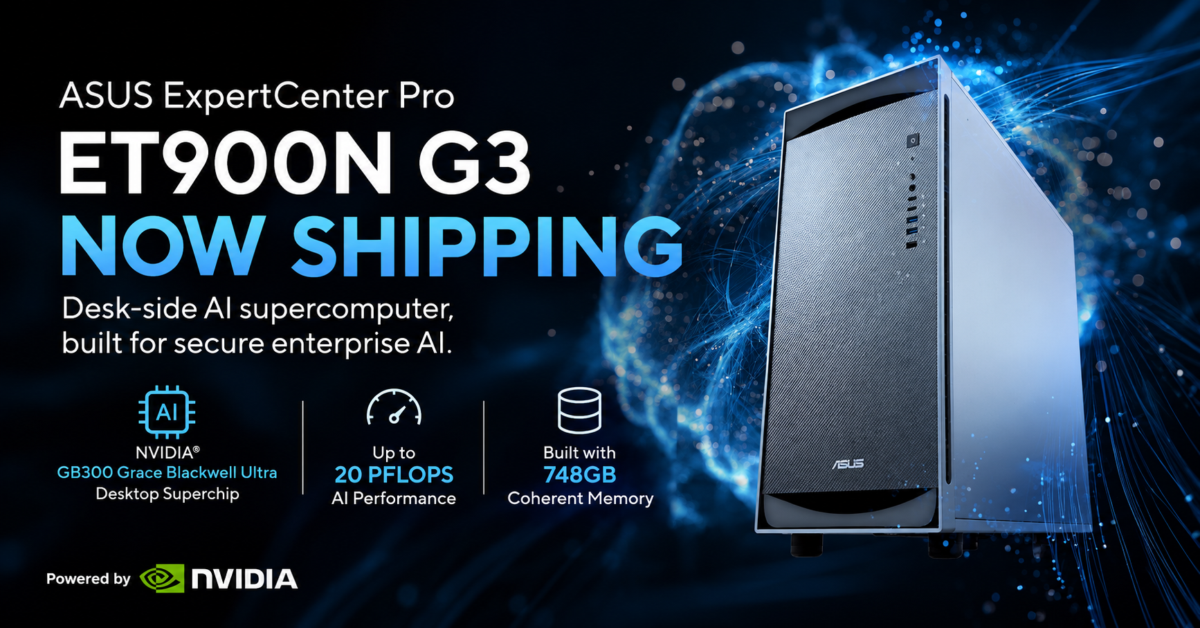
Perhaps the most interesting part is where all of this happened. The entire AI operation ran locally on a single ASUS ExpertCenter Pro ET900N G3 rather than depending on cloud-based AI infrastructure.
The machine is built on NVIDIA’s DGX Station platform and powered by the NVIDIA GB300 Grace Blackwell Ultra Desktop Superchip. ASUS says it offers up to 20 petaflops of AI performance and 748GB of coherent memory.
That was apparently enough horsepower for Poesis to run its collection of models, agents, and workflows on one deskside system. In other words, the AI could analyze the market, perform research, consider risk, and ultimately execute trades without shipping the underlying AI workload off to a remote data center.
“While this was an early-stage experiment, it showed that agents can operate continuously in live markets while remaining within clearly defined constraints,” said Alex Popa, founder and CEO of Poesis.
Poesis describes itself as an AI-native asset manager developing agentic systems for financial markets. Popa previously worked as a partner and portfolio manager at Capital Group, while co-founder Charles Elkan previously served as Global Head of Machine Learning at Goldman Sachs.
There is an important detail missing from the announcement, however. ASUS and Poesis don’t reveal whether the AI agents actually made any money.
There are no returns, benchmarks, drawdown figures, transaction costs, or even a detailed breakdown of the trades. The experiment therefore tells us considerably more about whether autonomous trading agents can operate locally than whether anyone should trust them to manage an investment portfolio.
Autonomous and algorithmic trading itself isn’t new, either. The more interesting development here is how much of an investment workflow can apparently be handed to modern AI agents and squeezed onto a single machine sitting in an office.
That could eventually matter beyond finance. Companies interested in agentic AI may not necessarily want sensitive data, proprietary research, or decision-making processes traveling through third-party cloud services. Powerful local AI systems provide another option, assuming organizations are willing to pay for the hardware and operate it themselves.
For financial firms, the implications are particularly interesting. An autonomous system capable of researching investments, enforcing risk rules, and executing trades locally could potentially reduce dependence on external AI infrastructure while giving firms tighter control over their data.
But successfully placing trades and successfully investing are two very different things. ASUS and Poesis have demonstrated the former. Until we see what happened to the money, we know very little about the latter.
Support independent tech journalism
NERDS.xyz is independently owned and operated. If you enjoy my coverage of Linux, AI, hardware, cybersecurity, and tech culture, consider supporting the site on Ko-fi.
Support NERDS.xyz