
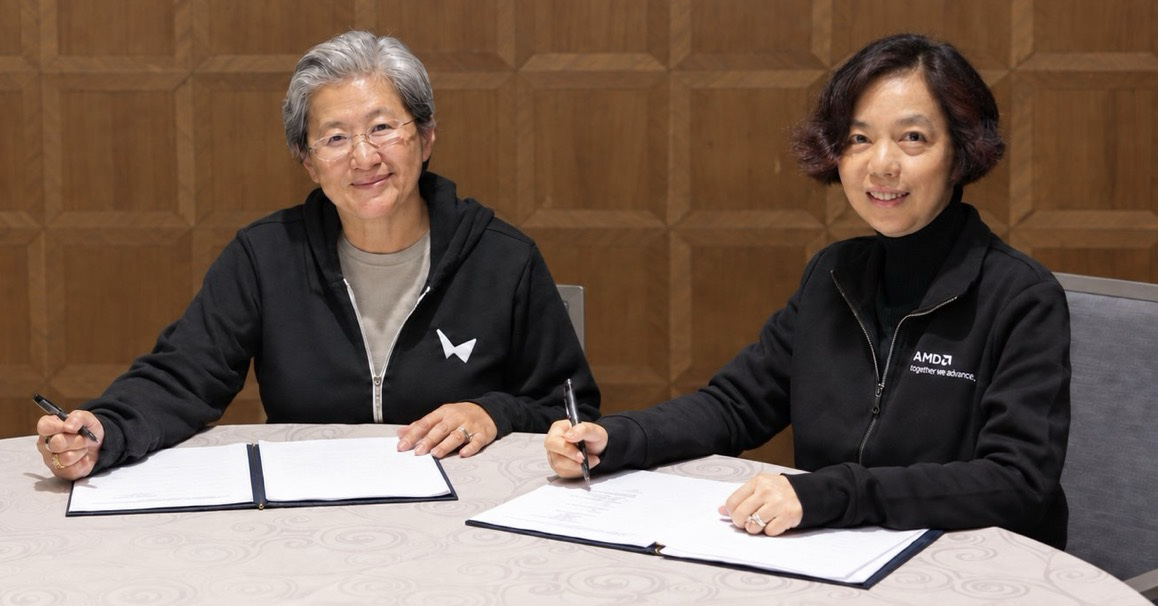
AMD is spending $8.2 billion to acquire World Labs, the AI research company led by Fei-Fei Li. The all-stock deal is expected to close by the end of 2026, assuming regulators approve it and the usual closing conditions are met.
This is not another straightforward chip acquisition. World Labs develops spatial intelligence models capable of generating, reconstructing, and simulating interactive 3D environments from text, images, and video. The company also works on robotic learning and simulation.
That expertise could be valuable as AI moves beyond chatbots and text generation. Robotics, simulation, physical AI, and 3D environments can create very different computing demands, and AMD clearly wants a better view of those workloads before designing the hardware that will eventually run them.
AMD CEO Lisa Su says bringing World Labs into the company will help its engineers understand how AI models are evolving. That could influence everything from future accelerators to software and complete AI systems.
The bigger story may be Fei-Fei Li. You see, once the acquisition closes, Li will become AMD executive vice president and chief scientist, reporting directly to Su. Li is one of the biggest names in AI research and is closely associated with ImageNet, the dataset that helped accelerate modern computer vision research.
Putting her inside AMD gives the company something Nvidia cannot counter simply by releasing a faster GPU. AMD will gain an AI research organization that can work directly alongside the people designing its hardware and software.
There is also an obvious competitive angle. Nvidia has built an enormous advantage around CUDA and the broader ecosystem surrounding its GPUs. AMD has spent years trying to make ROCm and its own AI hardware more attractive to developers, but hardware specifications alone are not enough to break Nvidia’s grip on the market.
World Labs could help AMD think about that problem from the model side instead. If its researchers can show AMD engineers what tomorrow’s AI systems need before those workloads become mainstream, the company may be able to design its products around emerging requirements instead of playing catch-up.
AMD is also emphasizing its commitment to an open AI ecosystem. That positioning is important as companies look for alternatives to Nvidia, although AMD still has plenty of work ahead if it wants its software ecosystem to become as difficult to ignore as CUDA.
World Labs will continue its AI model research after joining AMD. For an acquisition costing roughly $8.2 billion, however, AMD is clearly buying more than research projects.
It is buying access to the people trying to figure out what AI looks like next. With Fei-Fei Li becoming AMD’s chief scientist, the company apparently wants those people sitting inside the building while its next generation of chips is being designed.
Support independent tech journalism
NERDS.xyz is independently owned and operated. If you enjoy my coverage of Linux, AI, hardware, cybersecurity, and tech culture, consider supporting the site on Ko-fi.
Support NERDS.xyz