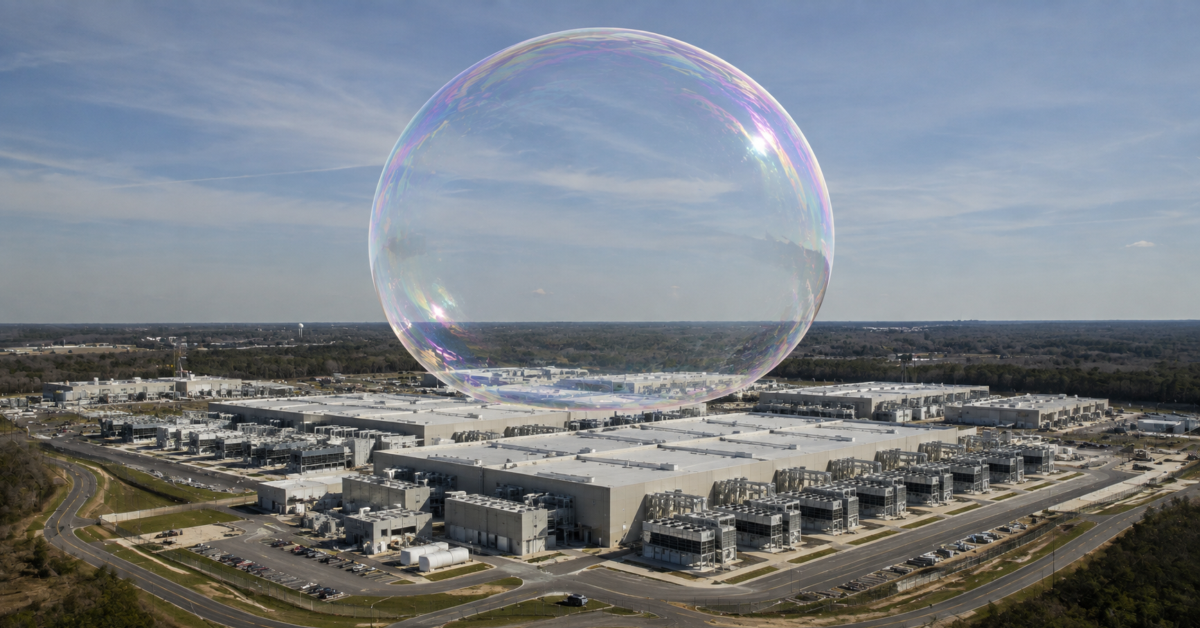
Artificial intelligence may still be in its early days, but the enormous amount of money flowing into AI infrastructure could be telling a very different story. HTX Research argues that while the technology continues to develop and spread, capital spending and valuations are already showing characteristics of a much later-stage investment cycle.
A new HTX Research report examines AI stocks, infrastructure spending, valuations, and the economics of producing AI output. Rather than simply declaring that AI is or is not a bubble, the researchers argue that the technology itself has plenty of room to grow even as the financial side of the boom starts showing warning signs.
The numbers help explain the concern. Citing an estimate from J.P. Morgan Asset Management, HTX Research says five U.S. hyperscalers are expected to spend approximately $697 billion in 2026, with capital expenditures projected to represent around 93 percent of their operating cash flow. In 2023, that figure was roughly 33 percent.
Big Tech isn’t merely spending heavily on AI. An extraordinary portion of the cash these companies generate is now being directed toward the GPUs, memory, servers, networking equipment, and data centers needed to train and operate increasingly demanding AI models.
There is nothing inherently wrong with buying all of that equipment, of course. The bigger question is whether companies can eventually make enough money from their AI products and services to justify the enormous investment.
HTX Research says investors are starting to pay more attention to that question. Earlier stages of the AI boom focused heavily on GPU shortages, model sizes, and rapidly improving capabilities, while the conversation in 2026 is increasingly about token production costs, reliability, actual usage, enterprise adoption, and ultimately free cash flow.
Buying another warehouse full of GPUs can demonstrate a company’s commitment to AI, but spending money isn’t the same thing as generating a return on it. At some point, shareholders are going to want to know exactly what hundreds of billions of dollars in AI infrastructure is producing and whether customers are willing to pay enough for it.
Importantly, HTX Research isn’t arguing that artificial intelligence itself is some giant illusion. Cloud revenue is growing, businesses are adopting AI tools, coding agents are becoming increasingly useful, and semiconductor companies continue selling enormous quantities of hardware.
Instead, the researchers see greater bubble risk in the financial machinery surrounding the technology. That includes aggressive data-center development, external financing, private AI model valuations, and some publicly traded companies carrying valuations that leave little room for mistakes.
We’ve seen something similar before. The internet really did change the world, but that didn’t prevent investors from throwing ridiculous amounts of money at internet companies during the dot-com bubble, including plenty that ultimately disappeared.
HTX Research also examined individual companies involved in the AI boom, including Alphabet, Microsoft, Meta, TSMC, NVIDIA, Amazon, Oracle, Micron, AMD, Arista, and Vertiv. Interestingly, Alphabet comes out particularly well under its framework, with HTX currently viewing the Google parent as offering the most attractive overall risk-reward based on normalized valuation, competitive advantages, cash flow, and potential upside from AI.
That doesn’t mean Alphabet, or any other company mentioned in the research, is guaranteed to outperform. Stock prices can move for countless reasons, and HTX’s analysis is ultimately one firm’s assessment rather than a prediction of what will happen next.
The bigger story is what happens after the spending spree. AI is moving beyond a period when investors rewarded companies simply for accumulating scarce computing resources, and the next phase may depend on how efficiently those resources can turn electricity, silicon, and data into useful products that customers actually want to pay for.
Nearly $700 billion in annual spending is an astonishing commitment to a technology that companies believe will reshape huge portions of the economy. If the revenue and cash flow eventually justify those investments, today’s spending could prove worthwhile. If they don’t, the problem won’t necessarily be that artificial intelligence failed. It could simply mean Big Tech spent too much money too quickly.
Support independent tech journalism
NERDS.xyz is independently owned and operated. If you enjoy my coverage of Linux, AI, hardware, cybersecurity, and tech culture, consider supporting the site on Ko-fi.
Support NERDS.xyz