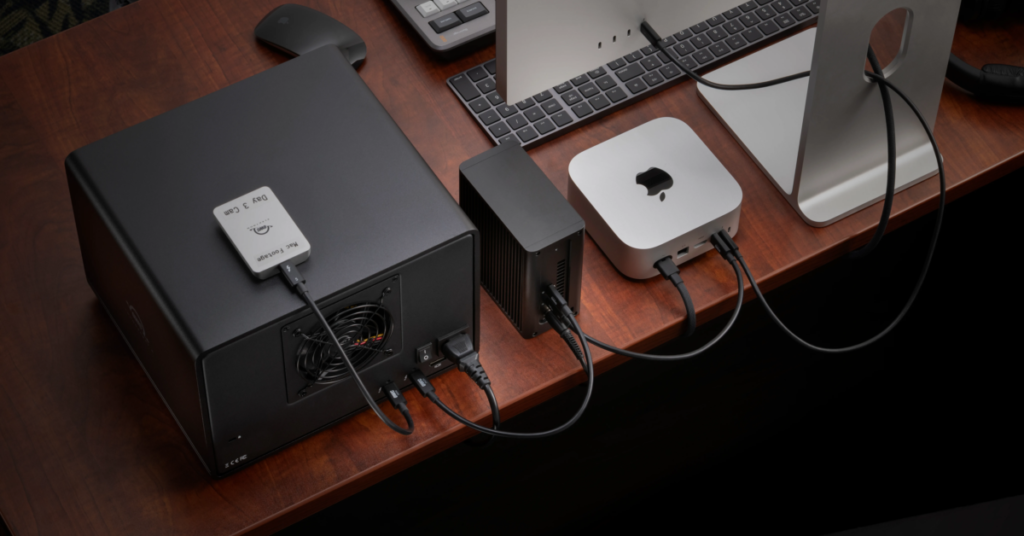
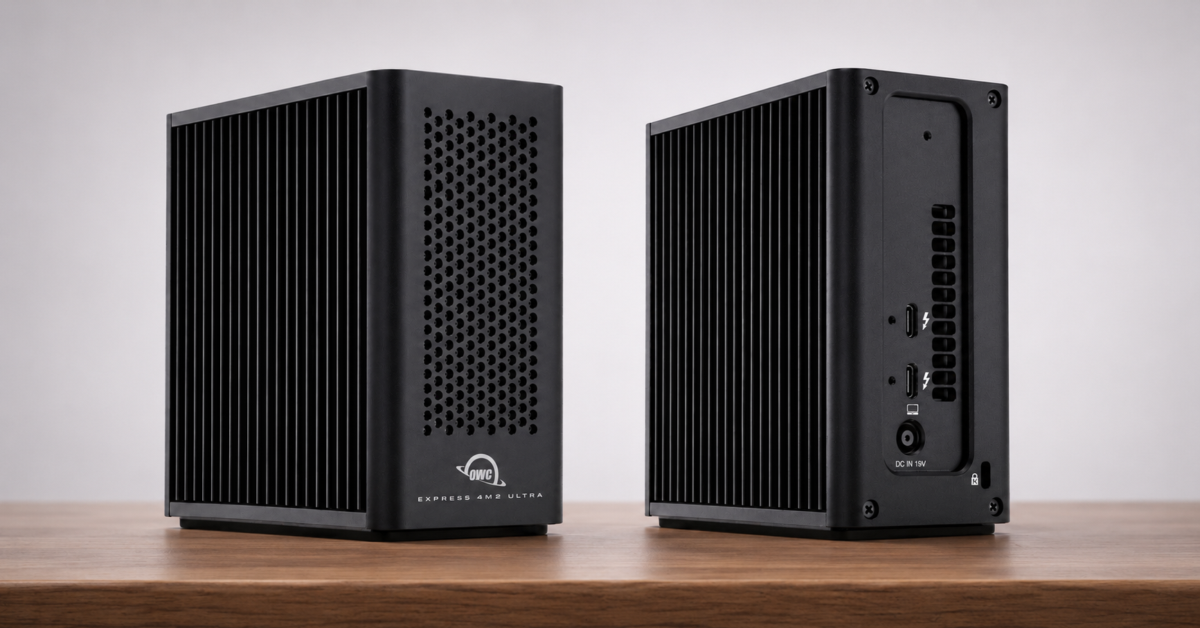
OWC introduced the Express 4M2 Ultra earlier this year as a compact Thunderbolt 5 enclosure for people who wanted to bring their own NVMe drives. Now, the company is offering a simpler option for buyers who would rather skip the installation and configuration work.
The Express 4M2 Ultra can now be purchased with OWC Aura Ultra SSDs preinstalled in 4TB, 8TB, 16TB, and 32TB capacities. These are ready-to-run versions of the same four-bay enclosure I previously covered, with advertised transfer speeds of up to 6622MB per second.
OWC is targeting video editors, photographers, visual effects teams, and other professionals working with extremely large files. The company points to 12K RAW video, 8K multicamera projects, and large photo libraries as potential workloads.
The Express 4M2 Ultra was already available as a do-it-yourself enclosure. Buyers can still install their own SSDs, but the new versions arrive populated with OWC Aura Ultra drives and ready to use.
“We have always believed that technology should adapt to the way people work not the other way around,” said Larry O’Connor, founder and CEO of OWC. “The Express 4M2 Ultra started as the ultimate DIY Thunderbolt 5 RAID platform, and it still is. But now, customers can choose to go with a pre-config solutions leveraging OWC Aura Ultra SSDs that deliver exceptional, OWC Certified performance on day one right out of the box.”
The enclosure contains four M.2 bays supporting single-sided and double-sided M.2 2280 and M.2 2242 M-key drives. SSDs with attached heatsinks are not supported.
Each bay provides a PCIe 4.0 x1 connection, with single-drive performance rated at up to 1,600MB per second. PCIe Gen 3 and newer SSDs are supported, although OWC recommends Gen 4 or later drives for the best results.
The system supports RAID 0, RAID 1, RAID 4, RAID 5, RAID 10, and JBOD through software RAID. RAID 0 will generally deliver the highest performance, but it provides no protection if a drive fails. Other RAID levels trade some capacity or speed for redundancy.
OWC’s advertised 6,622MB-per-second figure should still be treated as a best-case result. Actual performance will depend on the drives, RAID configuration, host computer, file sizes, software, and workload.
The Express 4M2 Ultra uses Intel’s Barlow Ridge JHL9480 controller and supports Thunderbolt 5 and USB4 connections at up to 80Gbps. It also provides up to 15 watts of power delivery and supports UASP.
OWC says the system can drive up to two 8K displays at 120Hz or three 4K displays at 144Hz when paired with compatible hardware. Display support will also depend on the host computer and operating system.
All four drive bays support hot plugging and can be used as boot drives with macOS. SSDs with 512-byte sectors require macOS 10.13 or later. Boot Camp is not supported.
Cooling comes from a temperature-controlled 40mm fan. The fan remains off below 35 degrees Celsius and increases its speed as temperatures rise.
The black aluminum enclosure measures 4.8 inches tall, 4.6 inches long, and 2.4 inches wide. It weighs 1.98 pounds and uses an external 90-watt power supply.
The fully configured models are priced as follows:
- 4TB for $2,399.99
- 8TB for $3,799.99
- 16TB for $5,579.99
- 32TB for $10,299.99
Those prices make it clear this is not ordinary consumer storage. The Express 4M2 Ultra is built for professionals whose work can justify paying thousands of dollars to reduce transfer and editing time.
I have always liked OWC products. They can sometimes be pricey, but you generally get high-quality hardware in return. My experience with OWC gear has reflected that, and the company has earned a strong reputation among people who depend on storage hardware for serious work.
Technically experienced buyers may still prefer the empty enclosure and their own SSDs. For studios that want predictable performance and a system ready to work immediately, however, the fully configured versions remove much of the setup. OWC is not the cheapest option, but it rarely feels cheap.
Readers who want the enclosure without preinstalled drives can start with the earlier Express 4M2 Ultra coverage. Buying it populated trades flexibility for convenience, so comparing OWC’s bundle price with separate NVMe drives is worthwhile.
Support independent tech journalism
NERDS.xyz is independently owned and operated. If you enjoy my coverage of Linux, AI, hardware, cybersecurity, and tech culture, consider supporting the site on Ko-fi.
Support NERDS.xyz