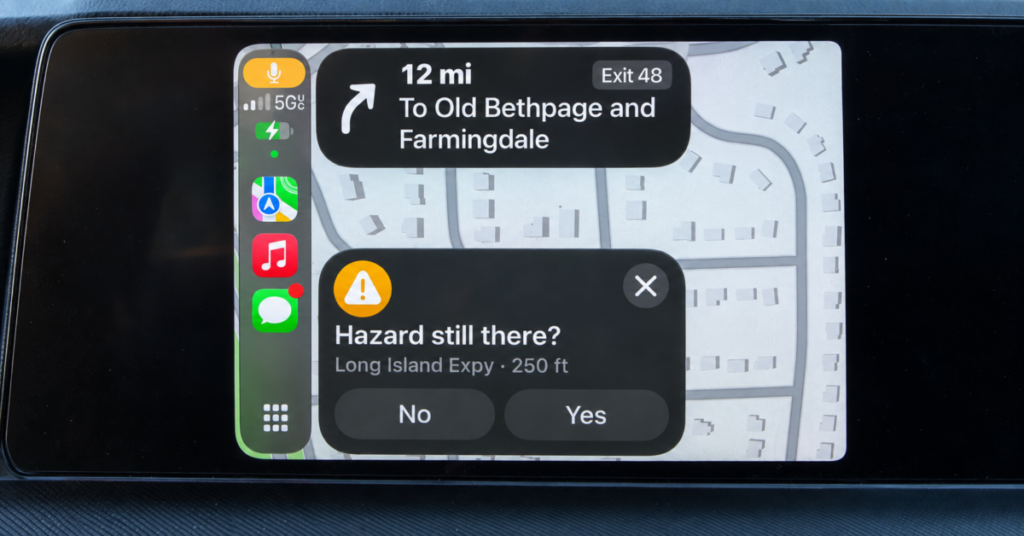
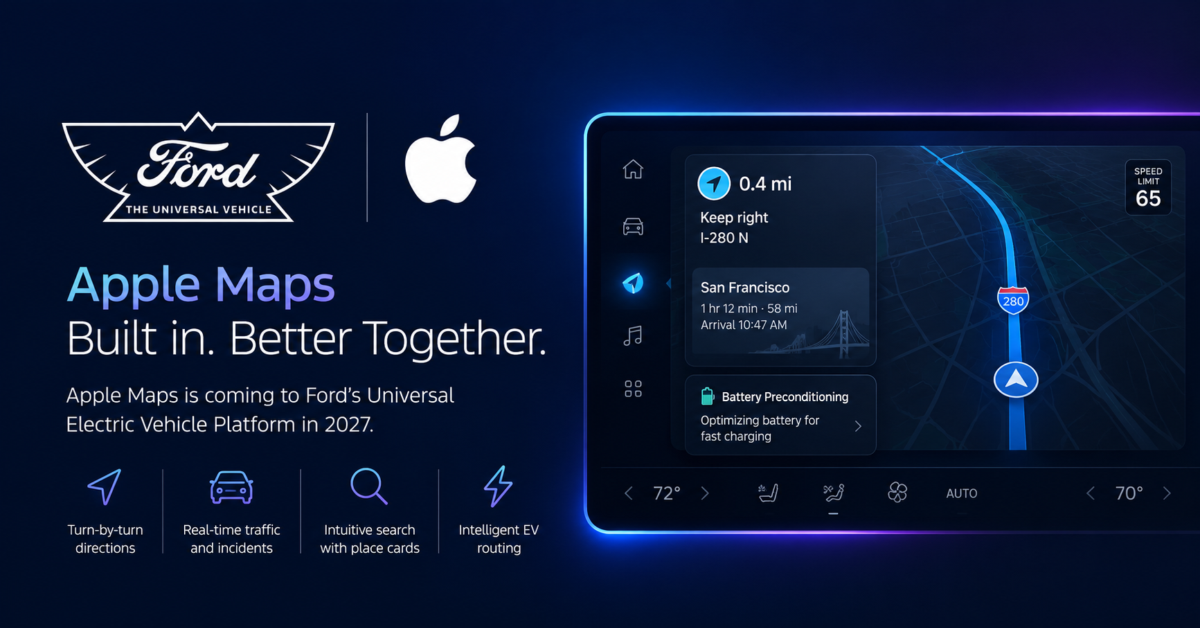
Ford’s upcoming electric vehicle platform will use Apple Maps as its built-in navigation system, giving drivers access to Apple’s mapping technology without needing to connect an iPhone or open CarPlay.
Apple and Ford say the integration will arrive in 2027 as part of the Ford Universal Electric Vehicle Platform. The system will use Apple’s new MapKit for Automotive SDK, which allows automakers to embed Apple Maps directly into a vehicle’s displays while customizing the interface to match their own software.
The first vehicle based on Ford’s new platform is expected to be a midsize electric model priced at around $30,000. Ford has not revealed its final name or complete specifications, but CEO Jim Farley is already positioning affordability as one of its biggest selling points.
Drivers will get turn-by-turn directions, real-time traffic information, incident reports, detailed place cards, search, and multiple routing options. Apple says the system will also support natural-language directions, which should make instructions sound less robotic and easier to follow.
Because Apple Maps will be integrated at the vehicle level, it will also be able to work with EV-specific functions. That includes intelligent route planning and battery preconditioning before the vehicle arrives at a charging station.
This is not simply Apple Maps running through CarPlay. The navigation system will be part of Ford’s own software platform and available directly on the dashboard, even when an iPhone is not connected.
CarPlay will still be supported in Ford vehicles, however, so drivers who prefer to use apps from their iPhones will continue to have that option.
“Apple Maps delivers the best map experience in the world, and we’re excited to bring the power of Maps’ navigation technology to Ford’s innovative Universal Electric Vehicle Platform,” said Eddy Cue, Apple’s senior vice president of Services and Health. “With our new MapKit for Automotive SDK, we’re bringing Maps further into drivers’ daily lives, giving them an incredibly accurate and easy-to-use navigation system that is seamlessly integrated into Ford vehicles.”
Calling Apple Maps the best mapping experience in the world is obviously subjective, but I actually agree with Apple more than many people probably will. I prefer Apple Maps, and it is the navigation app I choose to use all the time. I find the interface cleaner and the directions easier to follow than Google Maps or Waze.
Having Apple Maps built directly into the vehicle should make that experience even better. It will be able to work with the battery, instrument cluster, charging system, and other displays instead of simply projecting a phone interface onto the dashboard.
Ford also plans to use road-level data from Apple Maps while developing the next generation of BlueCruise, its hands-free highway driving system.
The company says Apple’s mapping information will help BlueCruise deliver a more continuous on-ramp-to-off-ramp experience. Development is being handled by Latitude AI, Ford’s wholly owned autonomy subsidiary.
Latitude AI employs around 600 machine learning, robotics, and software specialists. The group is also building what Ford calls the Ford Large Driving Model, which uses millions of miles of real-world driving data to support different levels of automated driving.
“Our new midsize electric vehicle will be priced around $30,000 and redefines what advanced technology can be — simple, useful, and truly attainable for more customers,” said Farley. “We’re proud to embed Apple Maps’ navigation and mapping technology directly into our Universal Electric Vehicle Platform, giving customers the ultimate navigation experience alongside our Ford app, a full suite of software, and next-generation BlueCruise, all enabled by a new zonal architecture.”
Apple says the MapKit for Automotive SDK follows the same privacy principles as the regular Apple Maps app. According to the company, it will not collect location details or map activity from the vehicle in a way that can be connected to an individual user.
The deal gives Ford a ready-made navigation system without forcing it to hand over the entire dashboard experience to Apple. Ford can still control the design, branding, and other software while relying on Apple for maps, traffic data, and routing.
For Apple, the SDK provides another way to expand its presence inside vehicles without depending entirely on CarPlay. It also gives the company a stronger position as automakers invest more heavily in software-defined vehicles.
The larger question is how drivers who prefer Google Maps or Waze will respond to Apple Maps being the default system. Those users will probably continue using CarPlay or Android Auto, assuming both remain available.
For drivers like me who already choose Apple Maps, though, this sounds genuinely useful. Deeper vehicle integration could make it far more capable than the version running on a phone, particularly when it comes to EV routing, charging, battery preparation, and BlueCruise.
That makes Apple Maps feel less like another dashboard app and more like an important part of Ford’s new electric vehicle platform.
Support independent tech journalism
NERDS.xyz is independently owned and operated. If you enjoy my coverage of Linux, AI, hardware, cybersecurity, and tech culture, consider supporting the site on Ko-fi.
Support NERDS.xyz