Building a powerful gaming PC has become more expensive, and memory prices are largely to blame. Ugh. Damn you, AI! AMD and Newegg think a new processor can make the initial cost slightly easier to swallow, although their proposed solution comes with an obvious compromise.
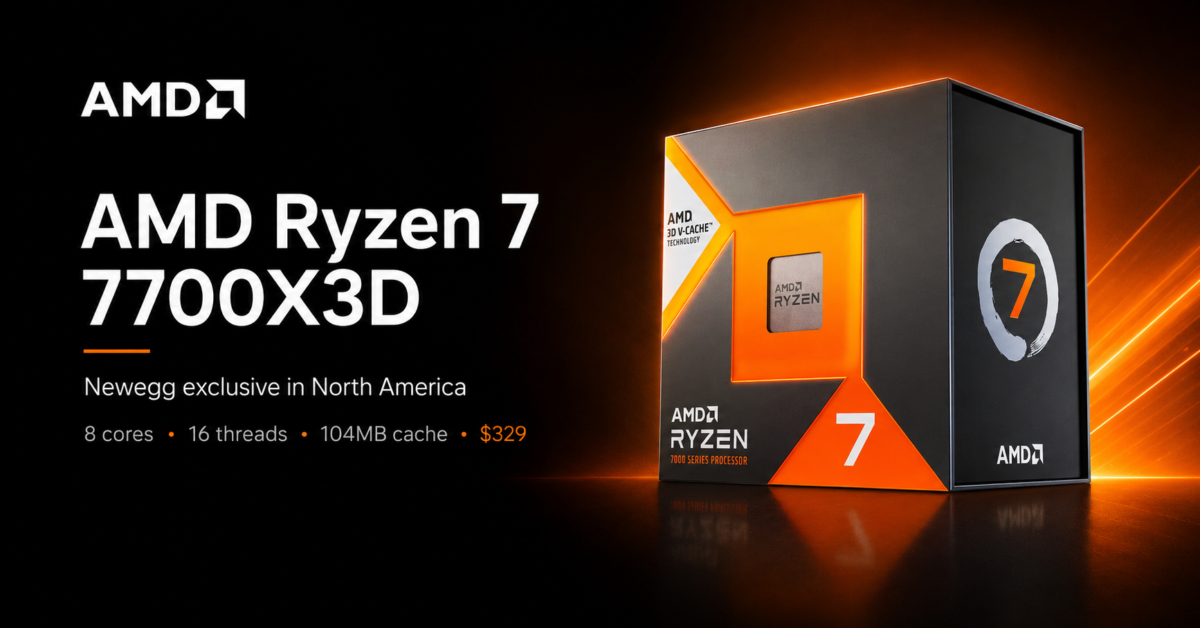
The AMD Ryzen 7 7700X3D is now available for $329. In the United States and Canada, Newegg has exclusive rights to sell the desktop processor through the third quarter of 2026. The exclusivity does not apply to other regions, however.
The processor features eight CPU cores, 16 threads, 104MB of total cache, and boost speeds reaching 4.5GHz.
As its name indicates, the processor uses AMD 3D V-Cache technology. By stacking additional cache onto the chip, AMD can keep more frequently accessed gaming data close to the processor instead of repeatedly pulling it from system memory.
This matters because Newegg is pitching the Ryzen 7 7700X3D as a way to build an AM5 gaming PC with only one DDR5 memory module.
“The Ryzen 7 7700X3D is designed for enthusiasts and high-end gamers seeking AMD 3D V-Cache gaming performance at a more accessible price point, delivering strong gaming performance gains over the Ryzen 7 7700X, with no new motherboard required on the AM5 platform,” AMD explains.
The processor runs at a 4GHz base clock and can boost up to 4.5GHz. It includes 96MB of L3 cache, 8MB of L2 cache, and 512KB of L1 cache. Its default thermal design power is 120 watts.
It supports the AM5 socket and works with a long list of AMD chipsets, including A620, B650, B650E, X670, X670E, B840, B850, X870, and X870E. PCIe 5.0 support is included, and AMD lists Windows 10, Windows 11, Red Hat Enterprise Linux, and Ubuntu among the supported operating systems.
AMD does not include a cooler in the box. The company recommends a liquid cooler for optimal performance, which should be included when calculating the actual cost of a new build.
“With the Ryzen 7 7700X3D, we’re bringing AMD 3D V-Cache gaming performance to more players,” says Travis Kirsch, senior director of client product management at AMD. “It gives gamers an accessible entry point into the AM5 platform, with the longevity and flexibility to upgrade for years to come.”
Newegg is also selling a starter bundle that pairs the processor with a single DDR5 memory stick. The open memory slot lets buyers add a matching module later instead of purchasing a full dual-module kit immediately.
The retailer says the processor’s large cache helps compensate for the reduced memory bandwidth associated with using one module. That may reduce the performance penalty in some games, but it does not make single-channel memory ideal.
Builders should treat the single-stick configuration as a temporary cost-saving measure rather than the preferred permanent setup. Gaming performance can vary widely by title, resolution, graphics card, and how heavily a game depends on CPU and memory bandwidth.
“Memory prices went up this year, and that’s made building a PC harder for a lot of people,” says Jim Tseng, vice president of product management at Newegg. “The 7700X3D brings the same 3D V-Cache found on chips twice its price, and that cache is what lets our builders start with a single stick of memory. It’s a more cost-effective way to address an issue many of our customers are facing today.”
Newegg also plans to offer a configuration featuring a Radeon RX 9070 GRE graphics card. Buyers should carefully compare the complete bundle price against independently selected components, as a cheaper memory configuration does not automatically make the entire package a bargain.
At $329, the Ryzen 7 7700X3D could appeal to gamers who want an eight-core X3D processor without paying for one of AMD’s newer and faster models. Existing AM5 owners may also be able to install it without replacing their motherboard, although checking for a required BIOS update before buying would be wise.
Newegg’s exclusivity is less appealing. Limiting North American availability to one retailer reduces competition and makes it harder for buyers to compare prices, shipping policies, and bundle discounts.
The processor itself looks like a sensible addition to AMD’s lineup. The idea of deliberately building a gaming PC with one memory stick is harder to celebrate. It can lower the amount paid on day one, but buyers should budget for that second module rather than pretending additional cache completely replaces memory bandwidth.
Support independent tech journalism
NERDS.xyz is independently owned and operated. If you enjoy my coverage of Linux, AI, hardware, cybersecurity, and tech culture, consider supporting the site on Ko-fi.
Support NERDS.xyz