
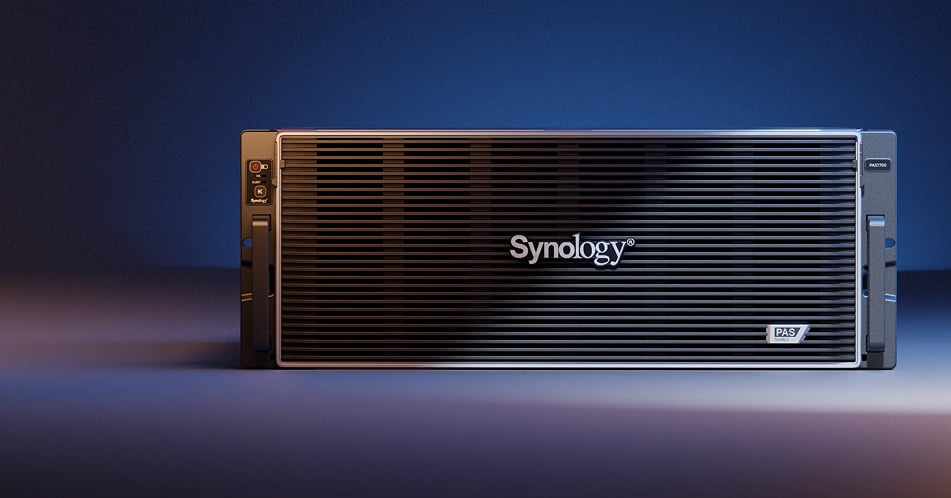
Synology is making a much bigger push into enterprise infrastructure with the launch of the PAS7700, an active-active all-flash NVMe storage system designed for workloads where downtime simply is not an option.
Folks that only think of Synology as a maker of prosumer NAS boxes may be surprised by this thing. The PAS7700 is pure enterprise hardware. Inside the 4U chassis are 48 U.3 NVMe SSD bays and a dual-controller architecture built for nonstop availability. With expansion units attached, the platform can scale all the way to 216 drives and up to 1.65PB of raw storage capacity.
According to Synology, the PAS7700 can deliver up to 2 million IOPS with sub-millisecond latency and throughput reaching 30GB/s. Each controller uses an AMD EPYC 7443P processor with 24 cores, and the system supports up to 2,048GB of combined memory alongside 100GbE networking.
This is clearly aimed at organizations running virtual machines, databases, analytics workloads, large backup environments, and other storage-heavy operations that can punish slower systems.
The active-active design is one of the biggest selling points here. Instead of having one controller sitting idle waiting for disaster, both controllers stay active simultaneously. Synology is pairing that with RAID triple-parity, synchronized memory write protection, IP failover, and protocol-level failover to keep workloads online when hardware problems happen.
The PAS7700 supports a wide range of protocols too, including NVMe-oF, iSCSI, Fibre Channel, SMB, and NFS. That flexibility matters in enterprise environments where storage often has to serve multiple jobs at once.
Security and data protection are also getting a lot of attention. Synology includes support for Self-Encrypting Drives, immutable snapshots, WORM protection, Snapshot Replication, and Hyper Backup. With ransomware attacks still hammering businesses, immutable storage features are becoming less of a luxury and more of a requirement.
Storage efficiency is another major part of the pitch. Synology says advanced deduplication can reduce storage consumption across enterprise workloads, while upcoming tiering support will automatically move colder data onto cheaper storage tiers. In theory, that should help organizations avoid wasting expensive NVMe capacity on inactive data.
There is one detail that may annoy some storage admins, however. Synology says full functionality and support are only guaranteed when using drives from its approved compatibility list. That approach has become increasingly common with enterprise storage vendors, but it is still something buyers should pay attention to before investing heavily in third-party SSDs.
The hardware specs themselves are impressive. Alongside the dual EPYC processors and large memory capacity, the PAS7700 includes PCIe Gen4 expansion slots, redundant 2700W power supplies, hot-swappable drives, and a five-year warranty.
At 66.1dB(A), this definitely is not something you are casually running beside your desk unless you enjoy sounding like you work inside a jet engine.
Synology did not announce pricing, which usually means one thing: if you need to ask, your accountant may already be sweating.
Still, for businesses already comfortable with Synology’s ecosystem and management tools, the PAS7700 could end up being one of the company’s most ambitious products yet. It feels less like a traditional NAS appliance and more like Synology trying to prove it can compete in much bigger enterprise storage conversations.
Support independent tech journalism
NERDS.xyz is independently owned and operated. If you enjoy my coverage of Linux, AI, hardware, cybersecurity, and tech culture, consider supporting the site on Ko-fi.
Support NERDS.xyz