
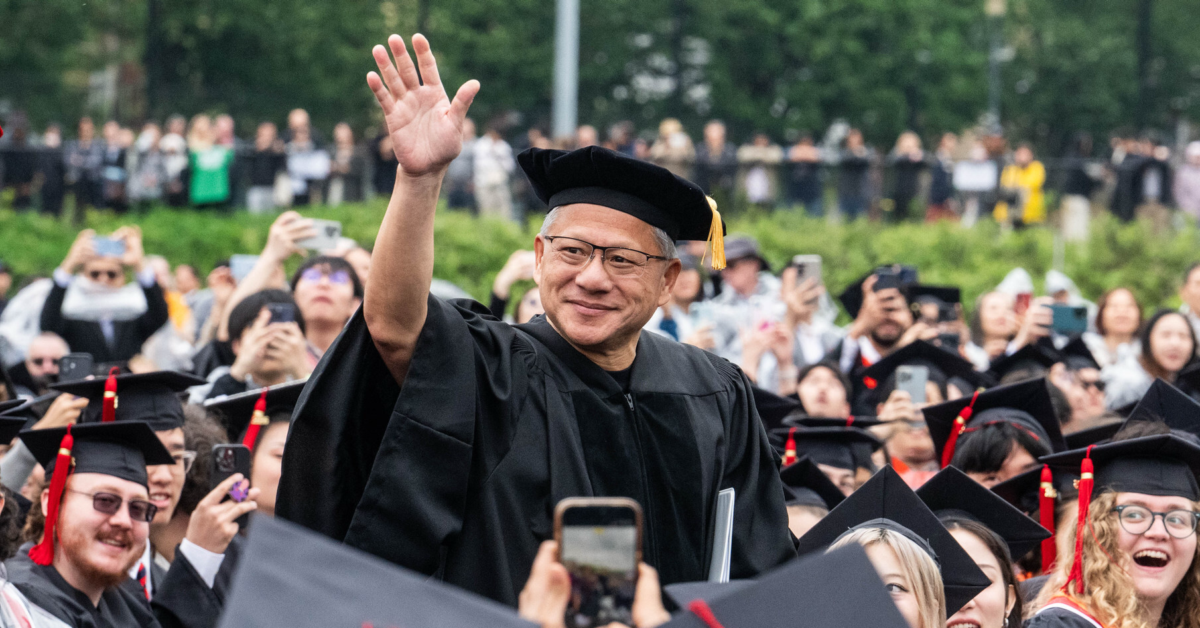
There is something a little funny about Jensen Huang standing in front of thousands of college graduates and telling them to get excited about AI.
After all, the same technology boom that turned NVIDIA into one of the most powerful companies on the planet is also making a lot of young people wonder whether the jobs they trained for will even exist in a few years. That is especially true for careers tied to coding, writing, design, customer support, and other computer-focused work that AI tools are already starting to change in a very real way.
I mean, look, there is an awkwardness to billionaires hyping AI to fresh graduates right now. Hell, it almost feels like giving a motivational speech to cows at a hamburger factory. The message is upbeat, the future sounds exciting, but deep down everybody understands some jobs are absolutely going to disappear.
But Huang was in full motivational-speaker mode Sunday at Carnegie Mellon University, where he delivered the commencement address (watch it here) and received an honorary doctorate.
“You are entering the world at an extraordinary moment,” Huang told graduates. “A new industry is being born. A new era of science and discovery is beginning.”
To be fair, he is probably not wrong.
AI is changing nearly every corner of the tech industry right now. Companies are pouring billions into infrastructure, GPU hardware, cloud services, and automation tools. NVIDIA sits right in the middle of all of it, selling the chips that power many of the AI systems dominating headlines today.
Huang framed that shift as an opportunity rather than a threat.
“No generation has entered the world with more powerful tools — or greater opportunities — than you,” he said. “We are all standing at the same starting line. This is your moment to help shape what comes next. So run. Don’t walk.”
That sounds inspiring, sure, but it also lands a bit differently in 2026 than it might have a decade ago. AI is not just some futuristic concept anymore. Folks are already seeing software generate code, answer customer questions, create artwork, summarize meetings, and even write articles. Companies love talking about AI “assisting” workers, but executives also love saving money.
That is where the anxiety comes from.
Many graduates entering the workforce today are stepping into industries that are actively trying to automate parts of entry-level work. The ladder younger workers traditionally climbed is starting to look a little shakier. It is hard not to notice the irony when some of the loudest AI evangelists are also the people building systems that could shrink hiring in certain fields.
Still, Huang kept the tone positive throughout the speech. He encouraged graduates to stay adaptable and committed to meaningful work, pointing to Carnegie Mellon’s motto, “My heart is in the work.”
“Build something worthy of your education, your potential, and the people who believed in you long before the world did,” Huang said.
And look, there is probably truth in that too. Technology always changes the job market. Some careers disappear, new ones appear, and people adapt. The difference now is the speed. AI feels less like a gradual evolution and more like the tech industry flooring the accelerator while everyone else tries to keep up.
Whether that future turns out exciting or terrifying probably depends on who you ask.
Support independent tech journalism
NERDS.xyz is independently owned and operated. If you enjoy my coverage of Linux, AI, hardware, cybersecurity, and tech culture, consider supporting the site on Ko-fi.
Support NERDS.xyz