
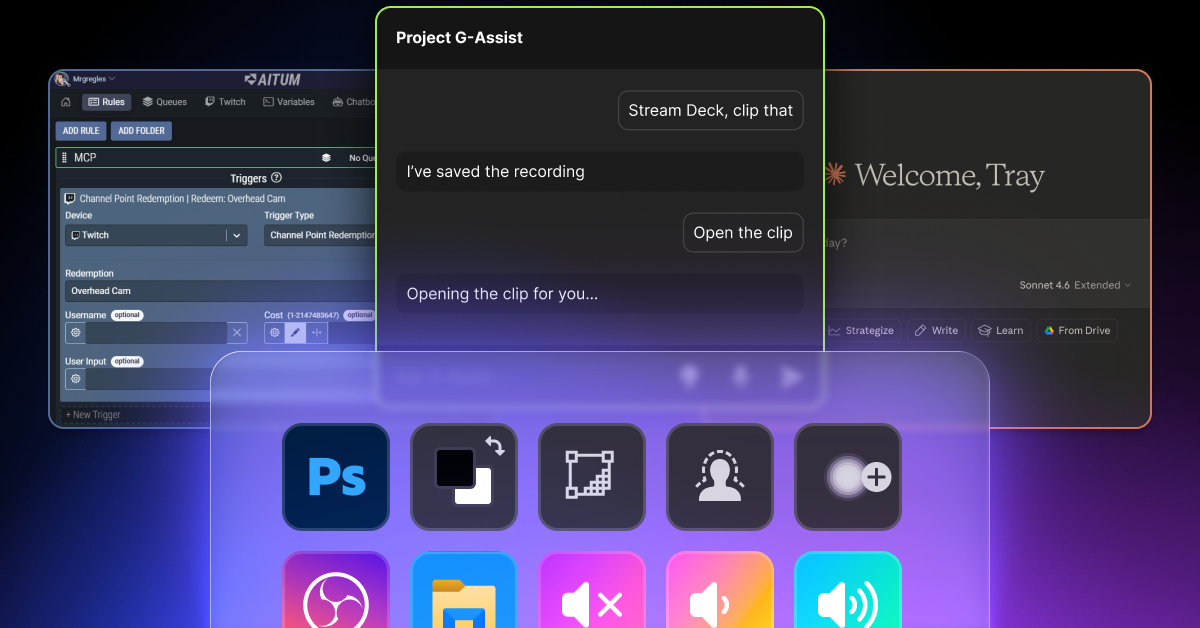
For years, Elgato’s Stream Deck has been one of those gadgets mostly associated with streamers, YouTubers, and productivity nerds obsessed with shortcut buttons. Now, Corsair wants to turn it into something bigger… an AI controller. Yes, really.
The company announced that Stream Deck is gaining MCP support, opening the platform to AI assistants and so-called agentic workflows. The first major integration is NVIDIA Project G-Assist, the local AI assistant designed for GeForce RTX PCs.
That means Stream Deck is no longer just about manually pressing buttons to launch apps or switch scenes. AI can now interact with those actions too.
And unlike a lot of recent AI announcements that feel like companies desperately searching for buzzwords, this one actually fits the hardware pretty naturally.
Stream Deck already controls a ridiculous number of things across a PC setup, including lighting, audio, shortcuts, automations, apps, hardware controls, and streaming functions. MCP support basically lets AI plug into those existing capabilities. Instead of AI sitting trapped in a browser tab or chatbot window, it can now trigger actions tied to physical controls on your desk.
That is a pretty important distinction.
One of the biggest concerns around AI agents is giving them too much control. Most people are understandably uncomfortable with the idea of an assistant freely interacting with their operating system. Corsair’s implementation attempts to address that problem by keeping users in charge of what actions are exposed.
If an action is not added to the configured MCP Deck, the AI cannot access it.
That makes Stream Deck feel less like an uncontrolled AI experiment and more like a permission-based command center.
“The combination of broad system control, a user-curated permission model, and a physical interface with visual feedback makes Stream Deck a genuinely unique input layer for agentic workflows, not just for gaming and streaming, but for anyone building with AI agents that need to actually do things in the real world,” said Thi La, Chief Executive Officer of Corsair.
NVIDIA’s involvement also makes this more interesting than yet another generic AI integration. Project G-Assist runs locally on GeForce RTX hardware instead of depending entirely on cloud processing. For folks worried about privacy, subscriptions, or sending everything to remote servers, local AI still carries real appeal.
The Stream Deck integration also introduces voice control. Users can now speak commands to G-Assist, which can then trigger Stream Deck actions through the MCP framework. NVIDIA says users can either press buttons manually or execute multiple actions through voice requests.
Of course, whether people actually want AI involved in everyday workflows remains an open question. Tech companies clearly believe AI agents are the future, but consumers still seem divided between curiosity and exhaustion.
Still, this feels more grounded than many AI features being pushed today. Stream Deck was already designed around automation and system control. AI simply becomes another layer sitting on top of an existing workflow instead of replacing it entirely.
The new MCP support, NVIDIA Project G-Assist plugin, and Aitum integration are available now. Users need Stream Deck 7.4 or newer alongside an existing Stream Deck device. RTX owners can install G-Assist through the NVIDIA App.
Support independent tech journalism
NERDS.xyz is independently owned and operated. If you enjoy my coverage of Linux, AI, hardware, cybersecurity, and tech culture, consider supporting the site on Ko-fi.
Support NERDS.xyz