
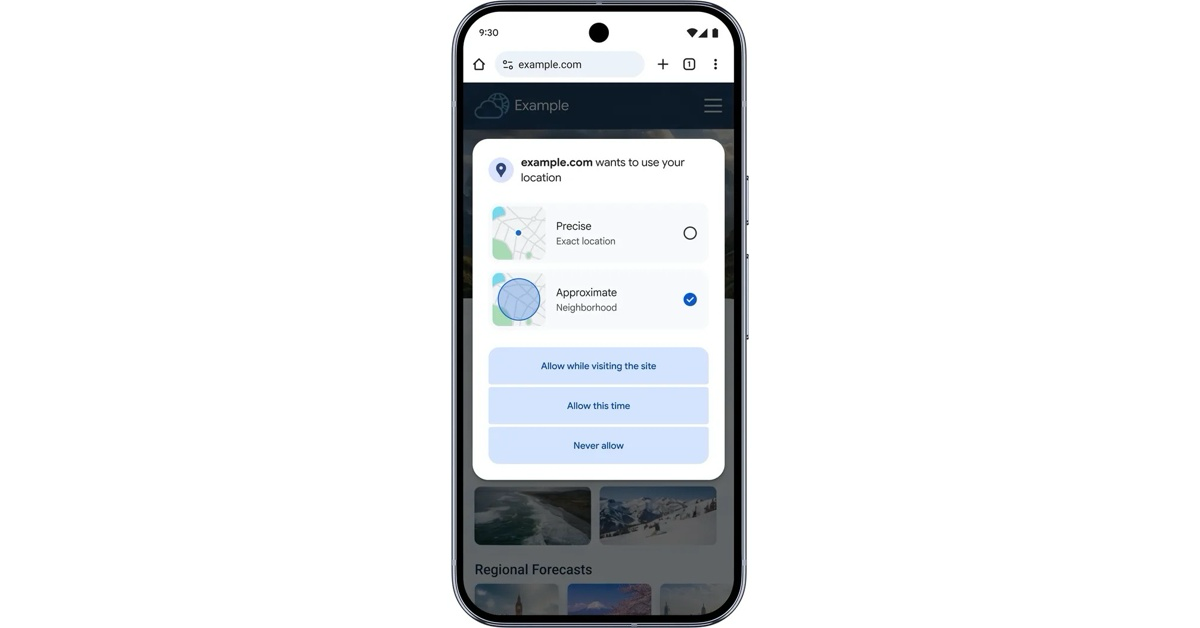
Google is making a change to Chrome on Android that actually feels useful for once. You see, the search giant is introducing approximate location sharing, which means you no longer have to hand over your exact GPS coordinates every time a website asks where you are.
If you have ever tapped “Allow” on a location prompt without thinking much about it, you are not alone. Most of us just want the site to work. But in doing so, we have been giving websites far more information than they usually need.
This update starts to fix that. Now, when a site asks for your location in Chrome on Android, you can choose to share a general area instead of something precise. That is a big deal, even if it sounds small on paper. A weather site does not need your exact position down to the sidewalk. Local news does not either. In many cases, city level accuracy is more than enough.
Of course, there are still times when precise location matters. If you are ordering food, calling a ride, or trying to navigate somewhere, you can still share your exact location. Nothing is being taken away here. It is just giving you the option to be more selective.
That flexibility is what stands out. For a long time, browsers have treated location sharing as all or nothing. Either you trust the site with everything, or you block it entirely and risk breaking functionality. Chrome is finally offering something in between, and it feels overdue.
Google is also working on new tools for developers. Websites will be able to request approximate location specifically, or indicate when they truly need precise data. In theory, that should push developers to think a bit harder before asking for more than they need.
In practice? We will see.
Let’s be honest, many sites and apps tend to grab as much data as they can get away with. It is easier, and more data is always tempting. Whether developers start requesting less precise data on their own will depend on how much pressure Google puts behind this change.
Still, even if nothing else changes, the user side improvement is real.
Being able to share a rough location for everyday browsing makes a lot of sense. Checking the weather, reading headlines, or browsing local deals should not require pinpoint accuracy. This gives users a way to keep things a little more private without breaking the web.
It is also part of a bigger trend. Privacy has become a talking point across the tech industry, especially on mobile. Apple has been leaning into it for years, and Google has been making gradual moves to keep up. This feature fits right into that shift.
Google says approximate location sharing will eventually come to desktop Chrome too. That is worth watching. Desktop browsers still get plenty of location requests, and giving users the same level of control there could have an even bigger impact.
At the end of the day, this is not some flashy AI gimmick. It is a practical change that gives people more say over their own data.
And yeah, I’ll take that any day.
Support independent tech journalism
NERDS.xyz is independently owned and operated. If you enjoy my coverage of Linux, AI, hardware, cybersecurity, and tech culture, consider supporting the site on Ko-fi.
Support NERDS.xyz