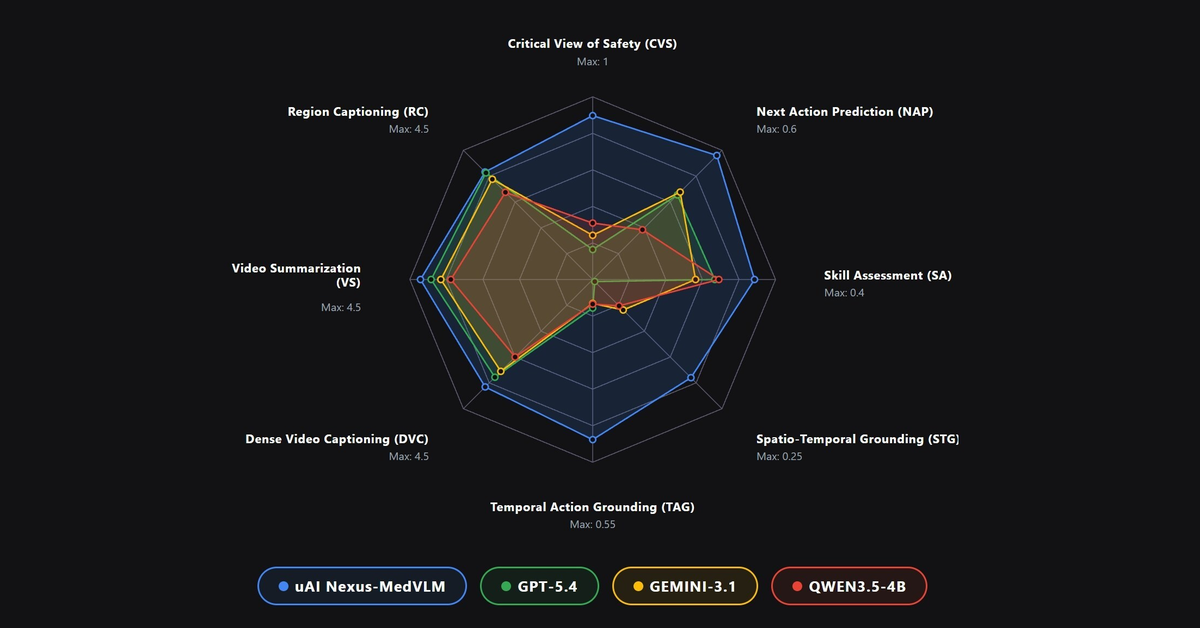
United Imaging Intelligence has open sourced something called uAI NEXUS MedVLM (on GitHub here). At its core, it is a model designed to understand medical videos, things like surgical footage, procedures, and clinical workflows. That alone is niche, but what makes this worth talking about is everything around it.
This is not just a model drop. The company also released a massive dataset called MedVidBench with over 531,000 video instruction pairs, plus a benchmark and leaderboard so developers can actually test against it. That is a big deal. A lot of AI projects show up with bold claims and no real way to measure them. This at least gives folks something concrete to poke at.
SEE ALSO: OpenAI launches ChatGPT for Clinicians, free for doctors in the US
The technical side is where it gets a bit nerdy, but stick with me. The team built a reinforcement learning method called MedGRPO to deal with a real problem. When you train AI across different datasets, some tasks are easier than others, and the model can end up focusing on the easy wins while falling apart on harder ones. Their approach normalizes rewards so everything stays balanced. It sounds small, but it is the kind of fix that can actually make these systems usable.
Now for the headline grabbing claim. The company says its relatively small models, around 4B to 7B parameters, outperform bigger general purpose systems like GPT-4.1 and Gemini 2.5 Flash on medical video tasks.
That sounds wild until you think about it for a second. Those bigger models are not trained to analyze surgical footage frame by frame. So yeah, a model built specifically for that job should win. Even the research basically admits that domain specific tuning is doing the heavy lifting here. This is less about embarrassing the big players and more about showing that specialization still matters.
What does the model actually do? It can identify instruments, track movement, summarize procedures, predict what happens next, and even evaluate surgical performance. That last one is where things start to feel a bit more serious. If an AI can judge how a procedure is being done, that has implications for training and quality control down the road.
There is also a slightly funny detail buried in all of this. The pipeline itself uses models like GPT 4.1 and Gemini in parts of the validation process. So while it is claiming to beat them in one area, it is also leaning on them in another. That is pretty much modern AI in a nutshell.
If you zoom out, the bigger takeaway is pretty clear. General purpose AI is not going to dominate everything. In fields like healthcare, where accuracy really matters, smaller and more focused models can make more sense.
Will this thing end up in hospitals any time soon? Probably not. Healthcare does not move fast, and honestly, it should not. But as an open source project with a real dataset and a clear direction, this feels more substantial than the usual AI noise.
And yeah, for once, it is not just another chatbot trying to write your emails.
Support independent tech journalism
NERDS.xyz is independently owned and operated. If you enjoy my coverage of Linux, AI, hardware, cybersecurity, and tech culture, consider supporting the site on Ko-fi.
Support NERDS.xyz