

OpenAI is taking a more focused swing at healthcare with the launch of ChatGPT for Clinicians, a version of its AI tool built specifically for medical professionals. It’s now available at no cost to verified physicians, nurse practitioners, physician assistants, and pharmacists in the United States.
This isn’t happening in a vacuum. The workload problem in healthcare has been getting worse for years. Doctors are juggling more patients while also drowning in administrative tasks and trying to keep up with an ever-growing pile of medical research. AI has quietly been filling that gap already. A recent American Medical Association survey found that 72 percent of physicians are now using AI in clinical practice, a big jump from 48 percent the year before.
What OpenAI is offering here goes beyond a generic chatbot. ChatGPT for Clinicians is tuned for real-world clinical work like writing documentation, reviewing research, and assisting with care-related questions. It also introduces repeatable workflows, so clinicians can set up tasks once and reuse them, whether that’s drafting referral letters, handling prior authorizations, or generating patient instructions.
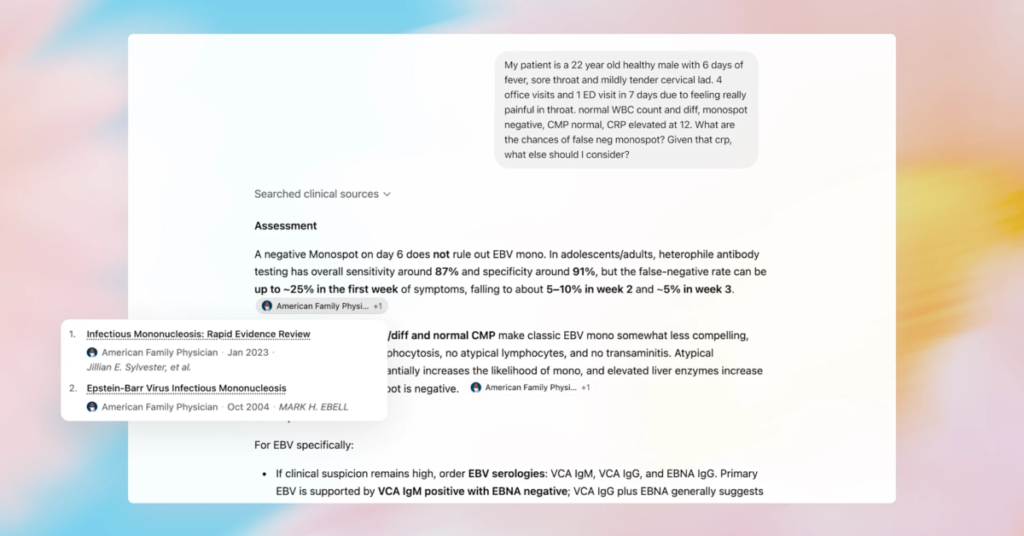
The research side is another big piece. The tool can pull from peer-reviewed medical sources and provide cited responses, which should help with confidence. That said, no AI tool is a substitute for clinical judgment, and OpenAI makes that clear. It’s positioned as support, not a decision-maker.
There are a couple of practical touches that stand out. One is the ability to turn research activity into continuing medical education credits in certain cases. Another is the focus on privacy, with assurances that conversations are not used to train models and optional HIPAA support available through a Business Associate Agreement for eligible users.
OpenAI is also leaning heavily on performance claims. It says its latest model, GPT-5.4, performs better in this clinical environment than earlier versions, competing systems, and even physician-written responses in structured evaluations. According to its testing, physicians rated 99.6 percent of responses as safe and accurate across thousands of conversations. That sounds strong, though real-world use will be the real test.
Alongside the release, OpenAI is introducing HealthBench Professional, a benchmark designed to evaluate how well AI handles clinical tasks like care consults, documentation, and medical research. The idea is to give the broader industry a way to measure progress and identify weaknesses, especially in more complex or high-risk scenarios.
Now, stepping back for a second, the bigger issue here isn’t just paperwork or clinician burnout. The healthcare system in the United States is deeply broken. It’s expensive, confusing, and often inaccessible for the people who need it most. Universal healthcare is something this country should have figured out a long time ago, and the fact that it hasn’t says a lot.
That’s where tools like this get interesting. AI isn’t going to fix systemic problems on its own, but it might help level the playing field a bit. If it can make medical knowledge easier to access, reduce costs, or help clinicians spend more time actually treating patients instead of filling out forms, that’s a step in the right direction. In a best-case scenario, something like ChatGPT for Clinicians could play a small role in making healthcare more equitable, even if it’s not the full solution.
For now, access is limited to verified clinicians in the US, but expansion is planned. OpenAI says it will begin working with international partners to roll this out more broadly, depending on local regulations.
At a high level, this feels like a logical next step. AI tools are already being used informally in healthcare, and this is an attempt to formalize that usage with more structure, safeguards, and purpose-built features. Whether it actually reduces burnout or just adds another layer of tech to manage is still an open question. But if it can reliably cut down on paperwork and give clinicians more time with patients, it will likely find an audience.
Support independent tech journalism
NERDS.xyz is independently owned and operated. If you enjoy my coverage of Linux, AI, hardware, cybersecurity, and tech culture, consider supporting the site on Ko-fi.
Support NERDS.xyz
1 thought on “OpenAI launches ChatGPT for Clinicians, free for doctors in the US”
Comments are closed.