
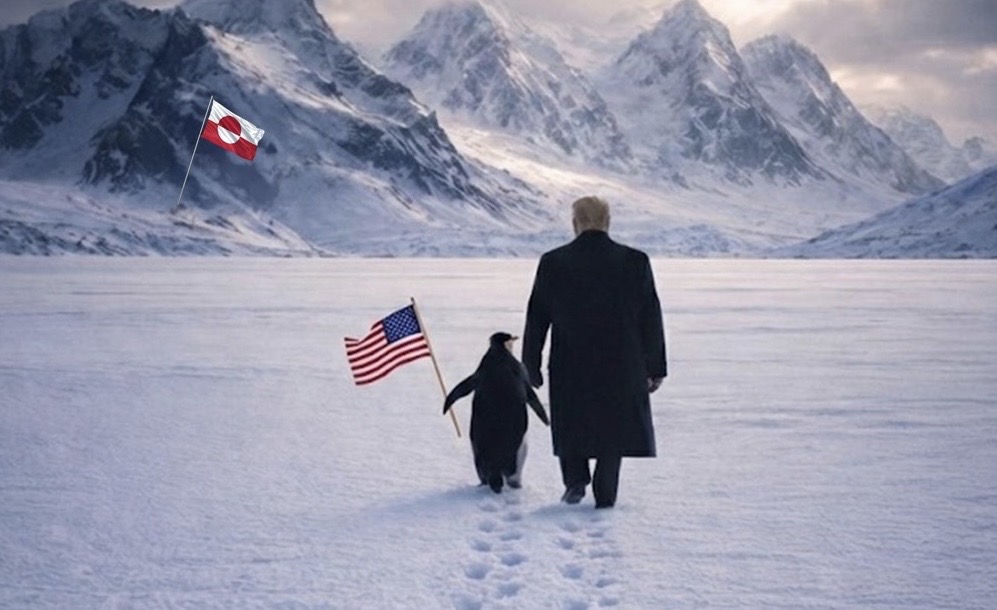
When the official White House account posted “Embrace the penguin” alongside an image of Donald Trump walking across a frozen landscape with a penguin, a lot of nerds did a double take. The penguin is not just a random bird on the internet. For anyone who has spent time around Linux, servers, or even just laptop stickers, it instantly reads as Tux, the mascot of the Linux kernel. For a brief moment, it honestly looked like Trump was accidentally promoting open source.
That moment did not last long. You see, the more you look at the image, the clearer it becomes that this is not about software, and it is definitely not about Linux. It is about power, territory, and a second term president who has been unusually serious about Greenland.
The image itself feels carefully staged. Trump is shown from behind, walking forward, leaving deep footprints in untouched snow. A penguin walks beside him, holding a small American flag. Another flag is planted in the distance. The whole thing looks like a dramatic conquest painting that got run through an AI generator and then dropped onto X for maximum engagement.
There is one big problem though. Penguins do not live in Greenland. They do not live anywhere in the Arctic. They are Southern Hemisphere animals, found in Antarctica and nearby regions. So the penguin is not there because it belongs there. It is there because it is useful.
And that is where the Linux confusion comes in. The penguin softens the image. It makes people laugh. It triggers nerd jokes. It turns a political message into something memeable. While people are busy arguing about Tux and Linux desktops, they are not talking about the flags or the symbolism or the icy landscape that looks a lot like Greenland.
That matters because Trump has not been joking about Greenland in his second term.
During his first presidency, the idea of the United States acquiring Greenland was treated like a bizarre real estate fantasy. This time, it is different. Trump has openly framed Greenland as a national security priority. He has talked about control, access, and influence. He has pressured allies, irritated Denmark, and turned the Arctic into a recurring talking point. He has even floated economic and political consequences for countries that resist American dominance in the region.
This is not a throwaway obsession. Greenland sits at the center of Arctic shipping routes, rare earth resources, and military positioning. As ice melts and global competition heats up, whoever controls access to the Arctic controls a lot more than snow and ice. Trump knows this, and he is not subtle about it anymore.
Seen in that context, the penguin post reads very differently. It is not a Linux joke. It is a visual metaphor for movement and ownership. Trump walks forward. The flag follows. The land is empty. The footprints are deep. The message is simple even if the delivery is strange. America is moving in. The penguin just makes it go down easier.
Linux does not work this way. It spreads because people choose it, not because anyone plants a flag. Penguins do not carry flags. They waddle, they slip, and they mind their own business. But in political imagery, animals are props, and memes are tools.
So no, Trump is not promoting Linux, sadly. He is doing something much more old fashioned. He is sending a message about territory and influence, wrapped in internet culture so people argue about the bird instead of the ice.
In 2026, that is how politics works. You get the meme. You miss the meaning. And by the time you stop laughing, the flag is already in the ground.
Support independent tech journalism
NERDS.xyz is independently owned and operated. If you enjoy my coverage of Linux, AI, hardware, cybersecurity, and tech culture, consider supporting the site on Ko-fi.
Support NERDS.xyz