
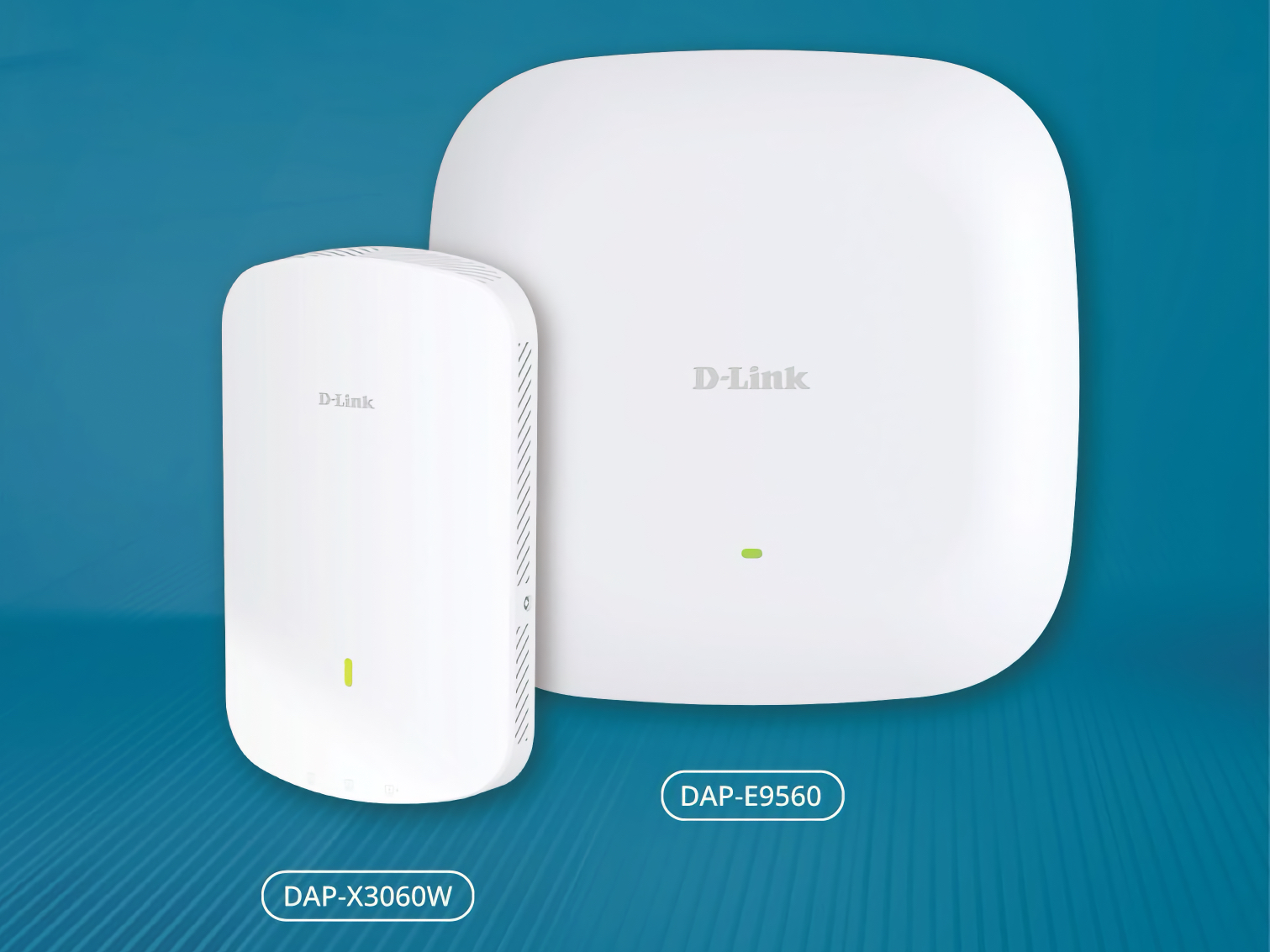
D-Link is refreshing its enterprise wireless lineup with two new access points aimed squarely at businesses dealing with dense device environments, hybrid work, and the growing expectation that Wi-Fi should just work everywhere. Announced December 18, the new products include the DAP-E9560 BE9500 Wi-Fi 7 ceiling-mount access point and the DAP-X3060W AX3000 Wi-Fi 6 wall-plate access point, and together they signal where D-Link sees enterprise networking heading next.
At a time when offices, hotels, schools, and multi-dwelling buildings are juggling more connected devices than ever, D-Link is clearly betting on flexibility rather than one-size-fits-all hardware. The idea here is straightforward. Use high-capacity ceiling-mounted access points where lots of people gather, and pair them with discreet in-room wall units where privacy and predictable performance matter more than raw range.
The more aggressive of the two launches is the DAP-E9560, which brings Wi-Fi 7 into D-Link’s enterprise portfolio. Wi-Fi 7 is still early days for many organizations, but it promises higher throughput, lower latency, and better handling of crowded environments. The DAP-E9560 is a tri-band access point supporting 320 MHz channels and 4096-QAM, which D-Link says can deliver roughly 20 percent faster speeds compared to Wi-Fi 6 under the right conditions. For wired backhaul, it includes both a 10 Gigabit Ethernet port with Power over Ethernet and an additional 2.5 Gigabit Ethernet port, making it a fit for newer network cores that are already moving beyond 1GbE.
This model is clearly positioned for places like conference halls, lecture rooms, classrooms, and open-plan offices where dozens or hundreds of devices might be competing for airtime at the same moment. Security is also part of the pitch, with support for WPA3 Enterprise and configurable VLAN policies, which should appeal to IT teams that need to segment traffic without turning the network into a management nightmare.
On the other end of the spectrum is the DAP-X3060W, a wall-plate Wi-Fi 6 access point designed for room-based deployments. This is the kind of hardware you would expect to see in hotel rooms, dorms, apartments, or meeting spaces where each user or tenant needs reliable connectivity without interfering with the next room over. It supports dual-band AX3000 Wi-Fi 6, draws power over Ethernet, and includes multiple Gigabit LAN ports for wired devices like smart TVs, IP phones, or desktop PCs.
Wall-plate access points are not flashy, but they solve real problems. Instead of trying to blast Wi-Fi through walls and floors, you bring the access point directly into the room. That often means better performance, easier troubleshooting, and clearer security boundaries between users. D-Link is leaning into that reality here, pairing WPA3 with per-room or per-tenant segmentation to keep networks predictable and contained.
Both access points plug into D-Link’s Nuclias management ecosystem, which can run either as a cloud service or on-premises. From an enterprise perspective, that unified management story may matter just as much as raw radio specs. Nuclias allows centralized provisioning, monitoring, firmware updates, and remote troubleshooting across multiple sites, which is increasingly important as organizations spread out across offices, campuses, and remote locations. The promise is that IT teams can manage ceiling-mounted APs in public areas and wall-mounted units in private spaces through the same interface without juggling multiple tools.
D-Link is also emphasizing its manufacturing and design approach, pointing to Made in Taiwan quality and a focus on long-term reliability rather than rapid turnover. While marketing language around engineering precision is nothing new, it does reflect a broader enterprise concern right now. Businesses are less interested in chasing every new Wi-Fi buzzword and more interested in hardware that can stay in place for years without becoming a maintenance burden.
Taken together, these launches show D-Link positioning itself as a practical enterprise networking vendor rather than a bleeding-edge experimenter. Wi-Fi 7 may still be overkill for some deployments, but offering it alongside a more conservative Wi-Fi 6 wall-plate option gives organizations room to modernize at their own pace. For schools, hotels, offices, and MDUs planning refresh cycles in 2026 and beyond, that kind of modular approach may be more appealing than ripping and replacing everything at once.
Pricing and availability details were not included in the announcement, but enterprise buyers will likely be watching closely to see how these models stack up against competing Wi-Fi 7 and Wi-Fi 6 access points once they hit the channel.
Support independent tech journalism
NERDS.xyz is independently owned and operated. If you enjoy my coverage of Linux, AI, hardware, cybersecurity, and tech culture, consider supporting the site on Ko-fi.
Support NERDS.xyz